

New Department of Health data shows 69% of all hospital consultants are now working the 2023 Public-Only Consultant Contract (POCC), which requires them to exclusively treat public patients in public hospitals.
Of 3,483 hospital consultants now working the contract, 2,217 are “switchers”, or consultants who have moved onto it from other contracts, and 1,266 are new entrants.
The 2023 contract, which pays consultants a basic salary of €233,527-€280,513, aims to remove private practice from public hospitals to ensure there are greater numbers of consultants available to treat public patients.
It is a key pillar of Sláintecare, which seeks to end the “two-tiered” healthcare in public hospitals.
The new data, contained in a Department of Health presentation dated 30 June 2026, obtained by RTÉ’s Prime Time, shows a wide variation in the take-up of the contract across the main hospitals and HSE regions.
At University Hospital Limerick, less than half, or 45%, of all consultants are working the public-only contract, the lowest take-up of the large teaching hospitals, which handle complex specialist care and highly critical patients.
By contrast, in Beaumont Hospital, 83% of consultants are now working the POCC, with 82% of all consultants at both the Mater Hospital and St James’s Hospital also doing so.
In other large teaching hospitals, such as University Hospital Waterford and University Hospital Galway, the take-up rate is 73%, while in Tallaght University Hospital it is at 69%.
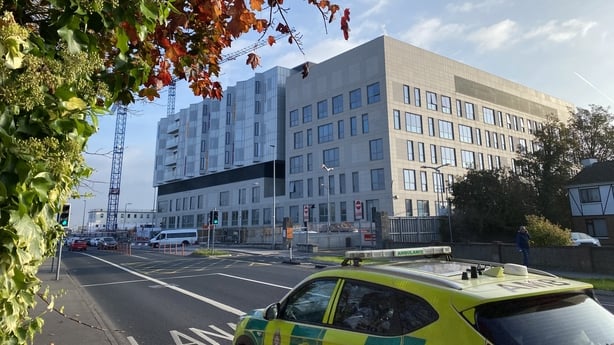
Less than half of consultants at University Hospital Limerick are working the POCC
At St Vincent’s University Hospital and Cork University Hospital its 66% and 65% respectively.
In ‘model 3’ hospitals, which provide localised 24/7 emergency, medical, and general surgical care, the percentage of consultants who have moved to the new contract also varies widely.
Just 46% at all consultants at the Midlands Regional Hospital, Portlaoise are on the POCC while at Cork’s Mercy University Hospital and Cavan General Hospital just over half are, at 54% and 55% respectively.
The highest take-up amongst ‘model 3’ hospitals was at University Hospital Kerry at 89% while 80% of consultant at Letterkenny University Hospital now work it.
Maternity hospitals – The Rotunda and Cork University Maternity Hospital
The data shows that just 14 out of the 32 obstetricians and gynaecologists, or 44% of the total at these maternity hospitals, are now on the POCC contract.
While the vast majority of anaesthetists, radiologists and psychiatrists (91-100%) at these hospitals are now on POCC.
HSE regions
The same variation is reflected more widely across the HSE regions.
For example, in HSE Mid-West just over half of consultants, 51%, are now working the public-only contract, whereas in HSE Dublin Northeast, it is 74%.
The second highest regional take-up is in HSE Dublin Northwest at 73%.
Across the rest of the regions – HSE Dublin & Southeast, HSE Southwest and HSE Dublin & Midlands, it is at 66%.
Medical specialities
The data also shows the variance in the take-up rate of the contract across the medical specialities.
The lowest take-up is in obstetrics and gynaecology, with just over half or 54% of all obstetricians and gynaecologists taking up the public contract.
Similarly, just 58% of orthopaedic consultants are on POCC, while 61% of those in paediatrics and general surgery have taken up the new contract.
The highest take-up is by anaesthetists, geriatricians and radiologists, with a take-up rate of 70% – 75%.
Extended hours – weekdays and Saturdays
A key objective of the new contract is to have more consultants in hospitals for longer hours during the week and on Saturdays.
This is to ensure that public patients get greater access to specialist medical care and that public hospitals operate as efficiently as possible.
The ‘core hours’ of the consultants’ 37-hour week under the contract are Monday to Friday 8am to 10pm and Saturdays 8am to 6pm.

The highest take-up is by anaesthetists, geriatricians and radiologists
Yet the new data shows that in many areas, a minority of consultants are being asked to work any extended hours during the week or on weekends.
For example, in HSE Southwest – counties Cork and Kerry, just 121 of the 431 or 28%, are rostered to provide extended hours during the week.
In HSE Dublin and Northwest and HSE Dublin and Southeast, just 30% are rostered for longer hours on weekdays.
However, in HSE Midwest, 70% of all consultants – not just those on the public-only contract – do longer weekday hours.
Rostered hours on Saturdays
Where the contract implementation is at its poorest in the rostering of consultants is on Saturdays.
For example, in HSE Dublin & Northeast, just 54 out of 803 public-only consultants or 7%, are rostered on Saturdays.
Similarly, in HSE Dublin & Midlands, just 62 out of 761 consultants or 8%, are expected to work that day.
Across five out of the six HSE regions, the percentage of consultants scheduled to work on Saturdays is at 10% or lower.
The sole exception is in HSE Midwest, where almost half or 48%, work Saturdays.
The new data reflects the findings of a recently published HSE internal audit report, which found “no structured national or regional reporting framework to monitor” either the phasing out of private care in public hospitals or the “achievement of enhanced roster flexibilities” planned for in the new public-only consultancy contract issued by the HSE in 2023.
Responding to the new data, Social Democrats TD and Chairperson of the Oireachtas Joint Committee on Health Pádraig Rice said: “For too long, there has been a hands-off approach to contract governance and reporting.
“This needs to change. We must see increased rostering of consultants at evenings and weekends.
“The poor use of extended hours has a direct impact on waiting lists, with over one million people now waiting for a hospital appointment”.
“We have to make maximum use of expensive hospital equipment and discharge patients over the weekends.

Social Democrats TD Pádraig Rice criticised a ‘hands-off’ approach to governance
“To do this, we need consultants to fulfil the requirement to work more on evenings and weekends as per the landmark public-only consultant contract,” he added.
In a statement, the HSE said: “The POCC has already had a significant and measurable impact on both the quantity and quality of healthcare being delivered in our acute hospitals.
“There are more outpatient clinics, improved weekend discharges with enhanced patient flow, more patient-facing activity by specialist teams, and safer and more sustainable rosters.”
Referring to new data on extended rostered hours on weekdays and Saturdays, the HSE also said: “36% of consultants are now on an extended working day as part of their core working hours.
“11% are being rostered to work on Saturdays as part of their core working hours. These figures are rising, but they are still too low, and the regional variation is too great.
“It is for this reason the Chief Clinical Officer of the HSE wrote to clinical directors around the country on Tuesday, requiring them to review all current rosters to ensure these extended hours and Saturday shifts are scheduled and staffed based on clinical service needs.
“This has already been directed by the CEO in previous correspondence.”
“The POCC is already making a real difference to the provision of healthcare in Ireland, and this impact will grow in the coming weeks and months,” the HSE added.