
One of The Fallen‘s most important clarifications concerns the widespread misconception about what the laundries actually were. Small Things Like These’s inaccurate dedication owes to the apparent fact that Keegan and director Tim Mielants collapsed the distinction between the laundries and Ireland’s Mother and Baby Homes: two very separate institutions, even if both were run by religious orders.
This is a fairly shocking blunder, considering that it was long-listed for the Booker Prize and won the Orwell Prize for Political Fiction. The Mother and Baby Homes cared for women and girls who were pregnant outside of marriage; after giving birth, most were expected to leave their children behind and return to their ordinary lives, “carrying private shame, but with social standing intact.” The nuns would then make arrangements for the “illegitimate” children: sending some to industrial schools, placing others with families or religious institutions and, in some cases, facilitating adoptions — often across the Atlantic — through what Brangan describes as a system of “clandestine adoption” that the women themselves had no power to refuse.
Unlike Mother and Baby Homes, the Magdalene laundries weren’t maternity institutions, and as Brangan repeats throughout, no babies were born there. There’s also a popular misapprehension that the laundries served as overflow facilities for these homes, when in truth it was rare for those discharged from a laundry to go straight to a home. This was a measure reserved, clarifies Brangan, only for “repeat offenders” and the women and girls who’d had multiple illegitimate pregnancies.
As Brangan details, the grounds for ending up in a laundry were, for the most part, capricious. Carmel ended up there because, at eighteen, she returned to the Good Shepherd nuns who’d raised her in an industrial school (the order ran institutions for orphaned and abandoned children) to ask for different work. They put her in a car and drove her to a laundry in another county without explanation. “The violence and neglect in the industrial schools were among the most heinously excessive of all these institutions; regimented beatings, force-feeding, sexual abuse,” Brangan writes. Still, the l aundries were widely regarded to be far worse than the industrial schools themselves.
The eldest woman ever received at a laundry was ninety-eight, Brangan records; the youngest, nine.
Brigid was sent to one at twelve for truancy. Catherine was deposited by her father on the crossbar of his bicycle at fourteen, regarding her as a surplus to requirements after he remarried. Eileen was brought by two women from the Legion of Mary who decided that the fifteen-year-old maid, spotted alone in a Dublin bed and breakfast on a Sunday evening, was in “imminent moral danger.” The eldest woman ever received at a laundry was ninety-eight, Brangan records; the youngest, nine. In an Internal Departmental Memorandum in 1973, some civil servants suggested that these institutions also provided “worthwhile services for a large no. of women who are unfit for work,” such as “OAPs [old-age pensioners], mentally or physically retarded women, mildly handicapped and delicate women and women who are unstable for social or moral reasons.”
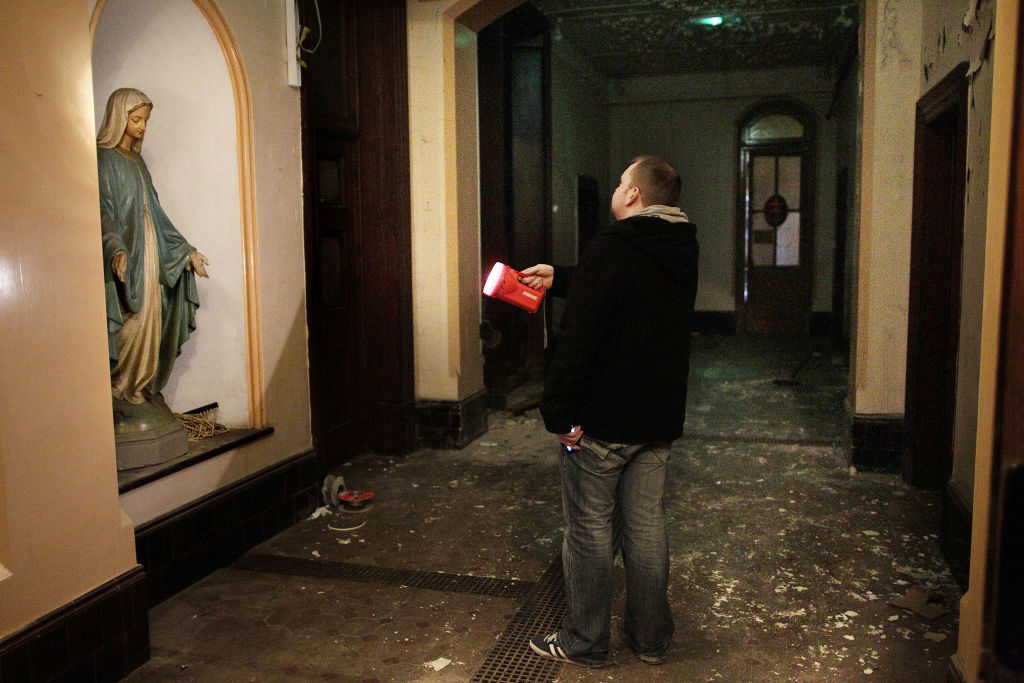
The first laundry was Protestant-run, intended as a “program of reform with prostitutes and other ‘fallen women’, as well as the homeless and alcoholics — all of whom were deemed in need of moral and spiritual recovery, heroically described as ‘rescue work.’” They were so named after Mary Magdalene: a follower of Jesus who, through centuries of ecclesiastical interpretation, was transformed into an emblem of female sexual transgression. While the Gospels never describe her as a prostitute — she instead appears as a woman from whom Jesus cast out seven demons, a disciple present at the Crucifixion, and the first witness to the Resurrection — Pope Gregory the Great identified her with the unnamed “sinful woman” of Luke 7, likely a prostitute. Though this conflation was not accepted everywhere in Christianity, it became dominant in Western Catholicism for more than a millennium, including in Ireland. In the Bible, Mary Magdalene and the Virgin Mary are both beloved intimates of Jesus, both integral to his divine arc. But in twentieth-century Ireland, they were polar opposite icons of feminine virtue or lack thereof.
By the 1950s, more women were held in laundries than men in prison: for every one hundred thousand Irish women, seventy were detained in a laundry, while for every one hundred thousand men, only twenty-seven were in prison. In many cases, the laundries’ living and working conditions were comparable to, if not indistinguishable, those of the British-run penal colonies from the nineteenth century, though what took place inside there was strictly “spoken about in taut euphemisms — charity, redemption.”
On arrival, the women and girls imprisoned in the laundries were generally shorn of their hair and stripped of their given names and given a saint’s name — or, more heinously, just a number. Subjected to a strict rule of silence, they worked six days a week — washing, ironing, packing — using mostly heavy, unwieldy machines. They cleaned the vestments and uniforms of priests and prisoners, and “the linens of hotels, restaurants and family dining rooms passed through these women’s hands. They endured Ireland’s stench and dirt, the stains that wanted removing, to be made pristine, and professionally transformed.”
They were so named after Mary Magdalene: a follower of Jesus who, through centuries of ecclesiastical interpretation, was transformed into an emblem of female sexual transgression.
The women and girls received no pay for this work, nor was there any clear prospect of release. The smallest infractions were met with physical punishment and solitary confinement. Sinéad O’Connor, who was sent to a laundry as a teenager, recalled in a 2013 interview being “locked in, cut off from life, deprived of a normal childhood.” It was little wonder, then, that many women believed they were going to die inside the laundries, and many did. Brangan’s own research on this is grimmer still. The official McAleese Report estimated 879 deaths from 1922 onward — but that figure excludes women transferred to hospitals or nursing homes before they died, and those who entered before independence. At High Park Laundry in Drumcondra, seventy-five death certificates corresponded to 155 bodies in the ground. Activists who have counted names on gravestones put the figure as high as 1,837.