
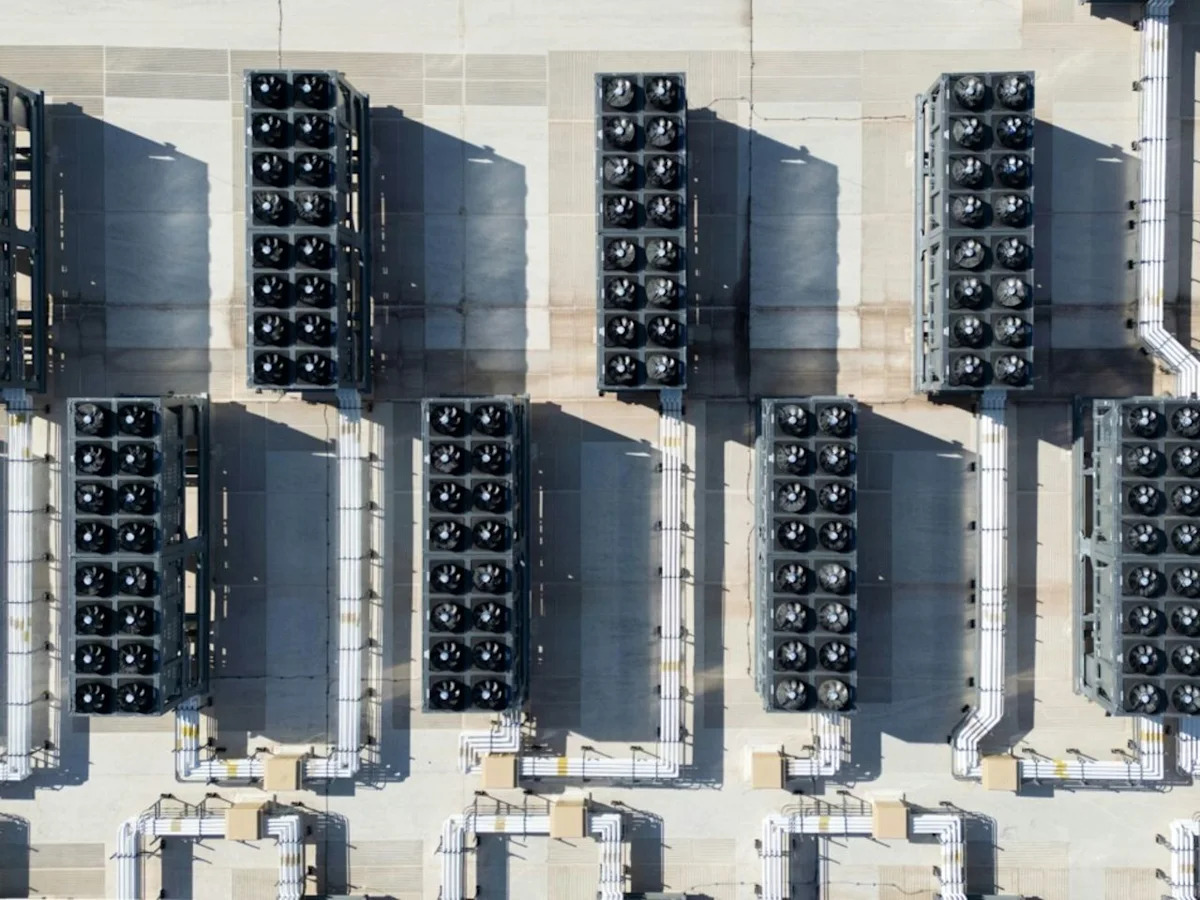
 Cooling vents on data centres in Virginia, U.S. (Credit: ANDREW CABALLERO-REYNOLDS/AFP/File)
A Vancouver-based startup says it has raised $100 million from a group of private investors to advance its energy- and water-efficient cooling technology for artificial intelligence data centres.
Founded in 2025, Wafr Technologies Ltd. announced on Thursday that it will use the new funds to launch an AI research lab and data centre, while furthering its commercialization efforts. The company will hire dozens of technical staff in the coming months, and is looking for new sites to build out its operations across the country.
It intends to raise an additional $200 million “as soon as possible” from government funds and private investors, said Darrell Kopke, co-founder of Wafr, who also serves as the Vancouver executive director for the Creative Destruction Lab, a startup incubator program. He declined to name the current investors but said an announcement is coming soon.
Wafr says that it has developed a hyper-efficient cooling system that can help AI data centres reduce water use by up to 95 per cent and cooling power use by up to 80 per cent. Its proprietary technology is a thermal battery that captures cooling capacity when grid electricity is cheap and releases it as required at peak times.
Large-scale AI data centres, which house clusters of tightly-packed advanced computing chips that generate heat while in use, consume vast amounts of water and energy to keep systems cool. The bigger facilities operated by American hyperscalers — the major cloud computing providers like Amazon.com Inc., Google LLC and Microsoft Corp. — manage AI data centres that are 100 megawatts and above.
A 100-MW AI data centre in the U.S. consumes around 2 million litres of water per day, which is on par with the water consumption of 6,500 households, according to a 2025 analysis from the International Energy Agency.
“(This) crazy, massive market has a major bottleneck, which is power and water,” Kopke said. “Our technology virtually eliminates the need for water and stops evaporative water for cooling,” he said.
Kopke said that the company has already launched commercialization efforts and has signed letters of intent with international partners involved in constructing AI data centres.
Wafr is prioritizing the United States market, alongside European countries like Germany.
“The U.S. has 5,300 data centres. The country that has the next highest amount of declared data centres is Germany at 400. It would be impossible for us to ignore the U.S. It is also the market that has the least sustainable AI and that’s something we can fix,” he said.
Cooling technology has become a lucrative opportunity.
In March, U.S. company Ecolab Inc. announced that it was purchasing Calgary-based CoolIT Systems Inc., which makes liquid cooling products for data centres, for US$4.75 billion in one of the largest-ever Canadian tech takeovers.
American Big Tech companies including Amazon, Microsoft, Alphabet Inc. and Meta Platforms Inc., are expected to spend over US$700 billion this year to accelerate their AI infrastructure buildouts, and are on track to surpass US$5 trillion on AI and data centre spend by 2030, according to a June report by Goldman Sachs Group Inc.
Advancing Canada’s AI infrastructure is also a key priority for Mark Carney‘s Liberal government. Ottawa earlier this year launched a public call for proposals to build large-scale AI data centres in the country.
Kopke and Bikram Singh co-founded Wafr in March 2025. Singh spent nearly two decades in the cooling industry across the Middle East and India and completed his Master’s of Business Administration at the University of British Columbia under Kopke.
• Email: ylau@postmedia.com