
Redmi just confirmed its Note 17 series for this month — and the leaked specs show batteries that might actually outlast your entire weekend. The announcement comes as the Redmi Note lineup hits 500 million global sales, even as rising costs squeeze premium features out of budget phones everywhere. Here’s every confirmed detail, leaked spec, and what we think it means for buyers in 2026.
Redmi Confirms July Launch, Kills the Note 16
The confirmation dropped via a Weibo post from Redmi on July 2, alongside a milestone celebration: the Redmi Note lineup has officially crossed 500 million units sold worldwide over its 12-year history. That averages out to more than 41 million phones per year for a single mid-range series — a number most brands would love for their entire portfolio.
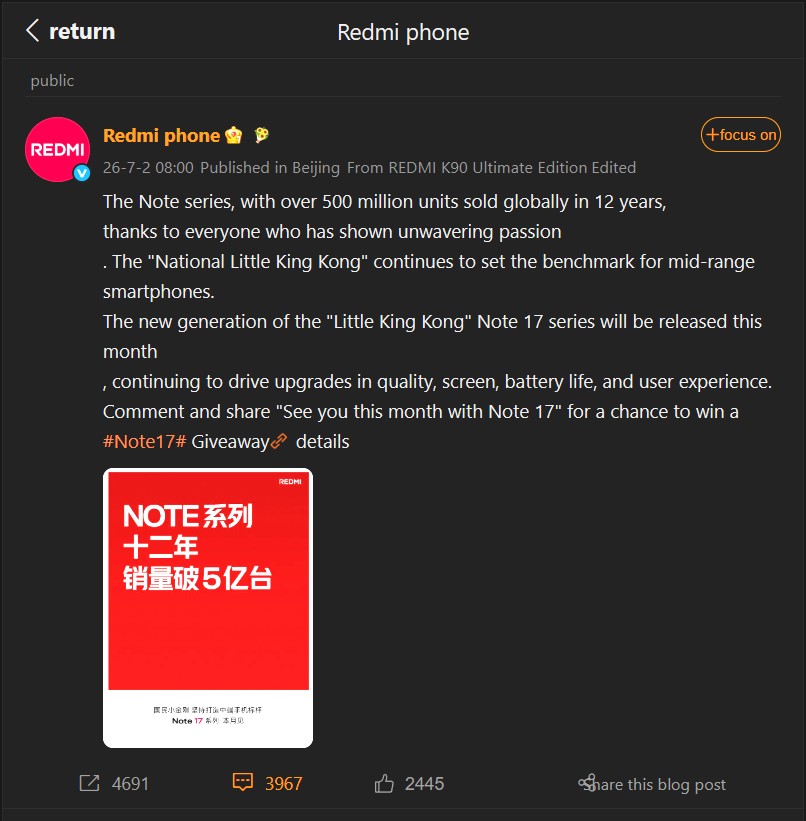
There’s one immediate twist worth flagging. Xiaomi is skipping Note 16 entirely and jumping straight from Note 15 to Note 17. The reason? Branding alignment. Xiaomi’s flagship line already uses the “17” name after making the same leap last year to match Apple’s iPhone generation numbering. But we think there’s a subtler play here too. Calling it “Note 17” puts this mid-range lineup on the same mental shelf as Xiaomi’s premium flagships, even when the price tags are worlds apart.
Redmi President Lu Weibing added some context that matters more than any spec. He acknowledged that rising component costs are stripping premium features — OLED displays, water resistance, Gorilla Glass — from budget phones industry-wide. Features that were standard under ¥1,000 (~$140) are disappearing. The Note 17 series, he said, is Redmi’s response.
Every Leaked Redmi Note 17 Spec So Far
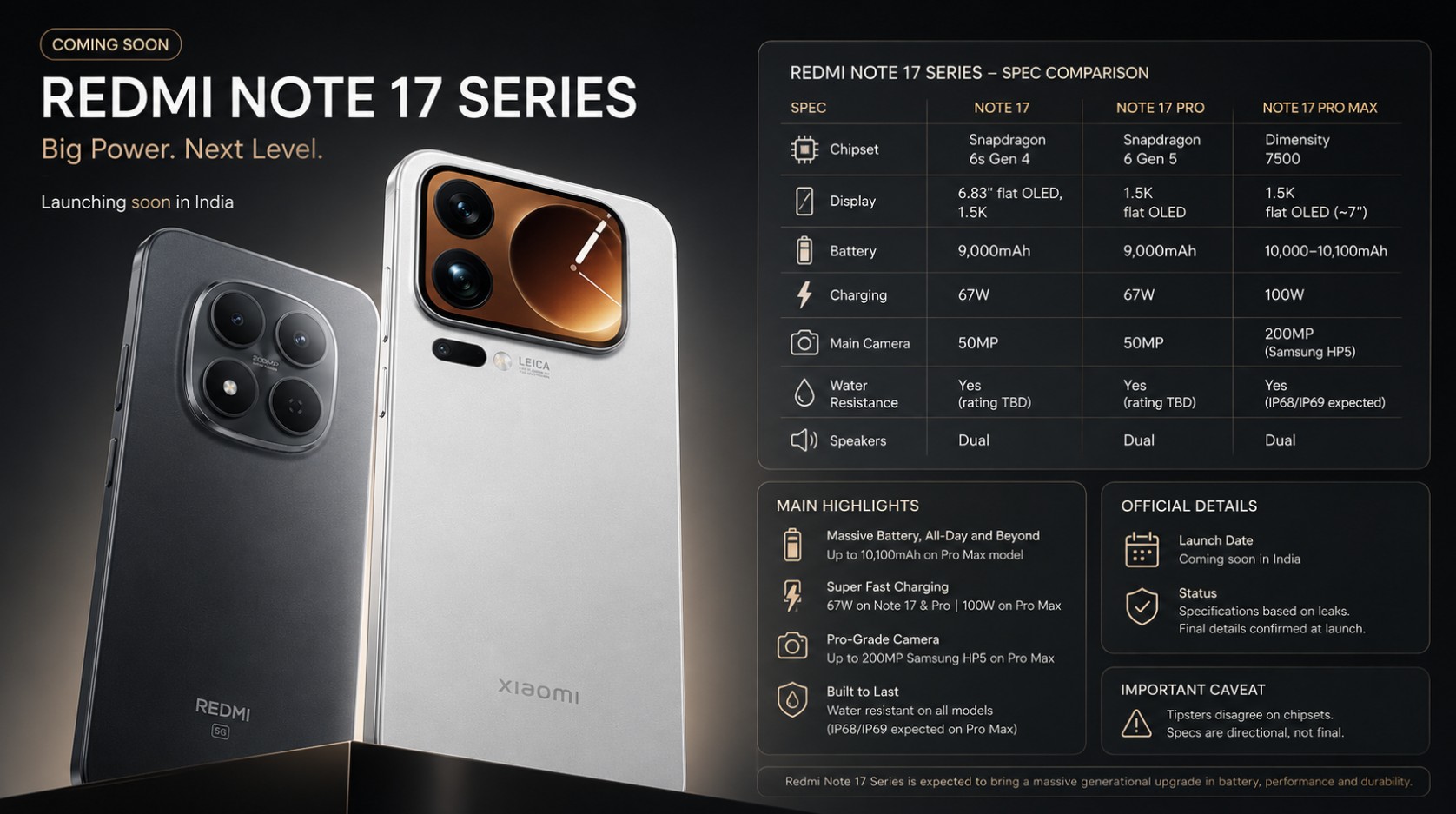
Xiaomi hasn’t confirmed hardware details yet, but leaks from tipsters Digital Chat Station and Smart Pikachu have painted a detailed picture. Here’s the full Redmi Note 17 specs breakdown based on the most consistent reports:
Note 17Note 17 ProNote 17 Pro MaxChipsetSnapdragon 6s Gen 4Snapdragon 6 Gen 5Dimensity 7500Display6.83″ flat OLED, 1.5K1.5K flat OLED1.5K flat OLED (~7″)Battery9,000mAh9,000mAh10,000–10,100mAhCharging67W67W100WMain Camera50MP50MP200MP (Samsung HP5)Water ResistanceYes (rating TBD)YesYes (IP68/IP69 expected)SpeakersDualDualDual
Important caveat: two separate tipsters disagree on which chipset goes in which model. Treat these as directional, not final. The real picture will emerge once Xiaomi starts dropping teasers — which we’d expect within days.
What immediately stands out is the battery. The Note 15 Pro+ shipped with a 6,500mAh cell. The Pro Max’s leaked 10,000mAh represents a 54% increase in a single generation. That’s not an incremental improvement — that’s a fundamental shift in how you think about charging. Multi-day battery life under normal usage isn’t a marketing stretch at this capacity. It’s realistic.
The 10,000mAh Battery Isn’t Just a Big Number
Let’s put that capacity in perspective. Most 2026 flagships hover around 5,000–5,500mAh. Even the OnePlus N6 and its 8,000mAh battery turned heads when it launched at $243 earlier this month. The Redmi Note 17 Pro Max pushes that ceiling by another 25%.
There’s a strategic logic behind this battery bet. According to reports from XimiTime, NAND flash storage costs have surged in 2026, making it expensive to push on-device storage limits. Xiaomi’s response is to redirect that budget into battery innovation instead — a trade-off that most average users would probably prefer anyway. A dead phone is more frustrating than running low on storage.
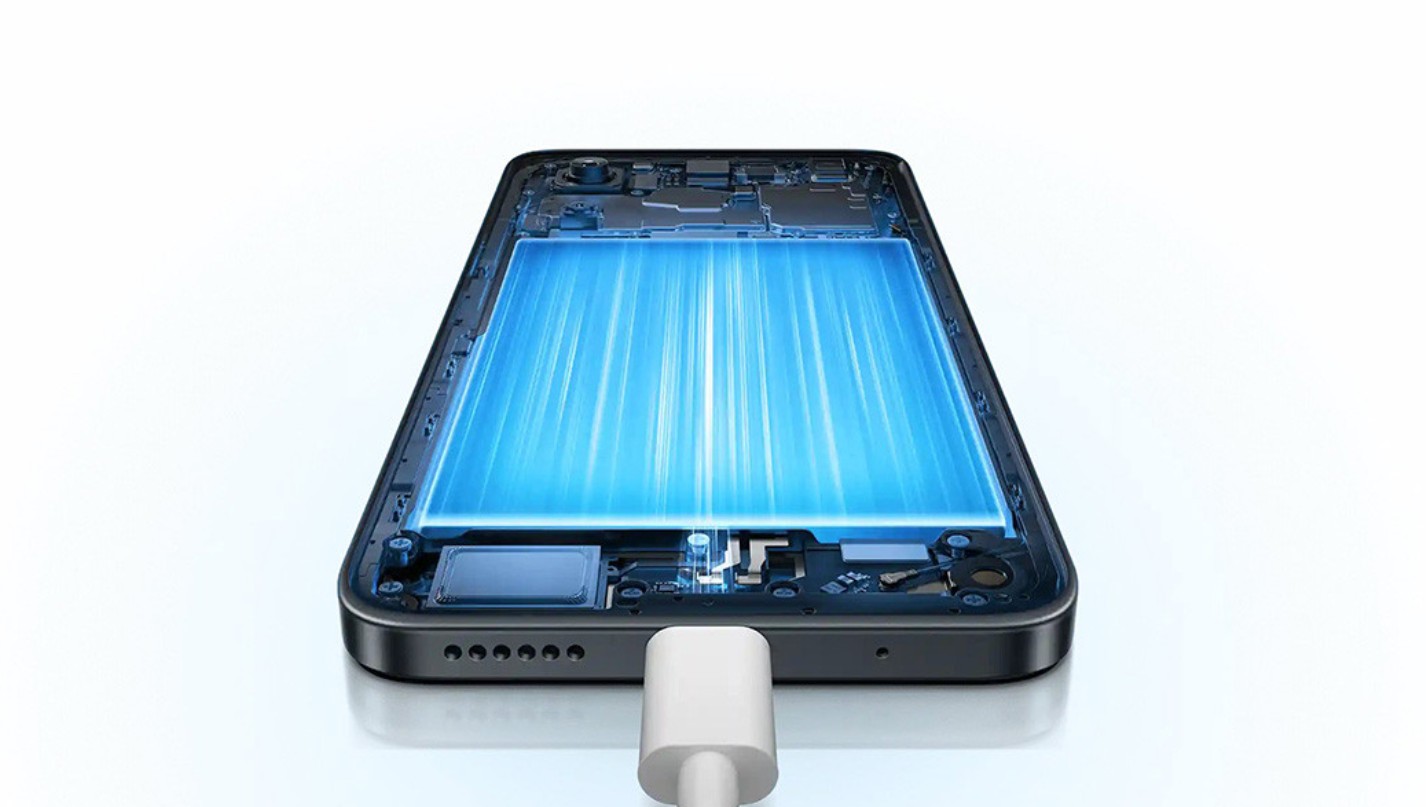
Paired with 100W fast charging, you’re looking at a phone that could go two full days on a charge and refill in under an hour. For a mid-range smartphone, that kind of endurance used to exist only in bulky, rugged-category devices. The fact that it’s showing up in a sleek consumer lineup is genuinely new territory.
When Does the Redmi Note 17 Go Global?
China gets first access this month. But if you’re outside China, the timeline is murkier.
There’s strong evidence a global version is coming. Xiaomi has already certified a device (model 26073RA49G) with the Eurasian Economic Commission, and the “G” suffix confirms it’s a global unit — not China-exclusive. GSMA IMEI database listings also show regional variants for Latin American and other markets.
Xiaomi typically staggers its rollouts, so if you’re in India, Europe, or Southeast Asia, expect the global Redmi Note 17 to land in late 2026 or early 2027. And one important detail: global specs often differ from the Chinese versions. Chipsets, battery sizes, and camera setups can all change between markets. Don’t assume you’ll get the exact same hardware.
July 2026 is stacking up as one of the busiest months for phone launches in recent memory. Samsung Galaxy Unpacked is set for July 22 with at least six new devices in tow. Redmi entering the same window feels deliberate — a play to grab mid-range headlines before Samsung’s event dominates the cycle.
What This Means for Budget Phones in 2026
The Redmi Note 17 specs aren’t just interesting on a spreadsheet — they’re a statement about where the mid-range market is headed. Lu Weibing’s public warning about vanishing budget features is both an acknowledgment and a challenge to competitors. He’s essentially saying: “We know it’s getting harder. We’re doing it anyway.”

Xiaomi poured an estimated $5.7 billion into R&D in 2026 across more than 730 labs globally. That investment needs to show up somewhere, and pushing premium features into affordable hardware is exactly how Redmi built a 500-million-unit franchise. The Note 17 is the biggest test yet of whether that formula still holds under real cost pressure.
If the final pricing stays competitive — and the previous generation started at roughly $278 in China — this could be the budget battery phone that resets expectations for the rest of the year.
FAQsHow does the Redmi Note 17 Pro Max stack up against the OnePlus N6?
Both are battery-first mid-range phones, but the Pro Max pushes further with a 10,000mAh cell versus the N6’s 8,000mAh. The Pro Max also adds a 200MP camera. Read our OnePlus N6 battery specs breakdown for a full comparison on value and performance.
What phones will Samsung reveal at its July 2026 event?
Samsung’s Galaxy Unpacked 2026 event on July 22 is expected to showcase the Galaxy Z Fold 8, Z Flip 8, Galaxy Ring 2, and new Galaxy Watch models — making it the biggest head-to-head launch window with Redmi this year.
Is the Galaxy Z Flip 8 really Samsung’s last flip phone?
Reports suggest Samsung may discontinue the Flip line after 2026 due to declining sales and supply chain costs. Our detailed Galaxy Z Flip 8 report covers what’s confirmed and what it means for the foldable market going forward.
When is the Google Pixel 11 expected to launch?
Google’s next Pixel generation is rumored for fall 2026, with leaked CAD drawings suggesting four models. Check our Google Pixel 11 release date coverage for every confirmed detail and how it fits into the 2026 lineup.
How is Motorola competing in the 2026 battery race?
Motorola’s Razr Fold 2026 brings a 6,000mAh battery to the foldable category, beating most rivals in that form factor. Our Motorola Razr Fold 2026 coverage breaks down how it compares on battery, display, and value.
Vincee Cole is a technology journalist with four years of experience covering the full spectrum of modern tech — from consumer devices, artificial intelligence, to quantum computing, blockchain, and digital assets. His reporting cuts through complexity to deliver stories that are sharp, grounded, and relevant to both general readers and industry insiders. Previously, he worked with fintech research teams across Southeast Asia, analysing how emerging technologies are reshaping financial systems at scale.