
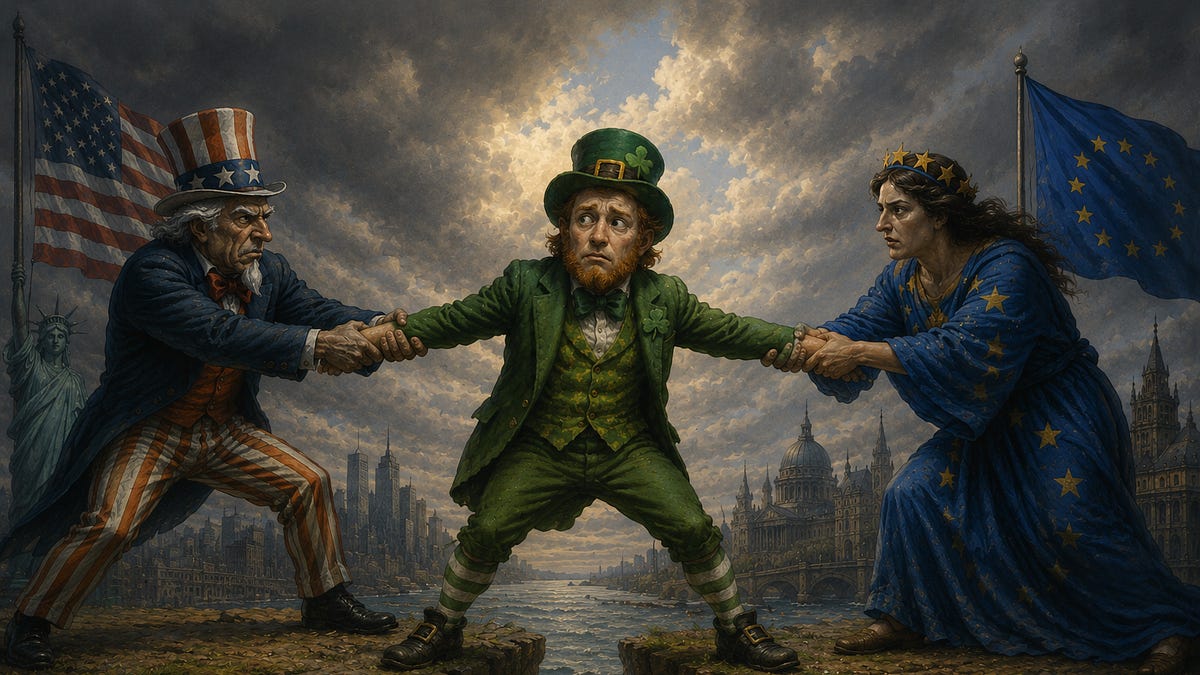
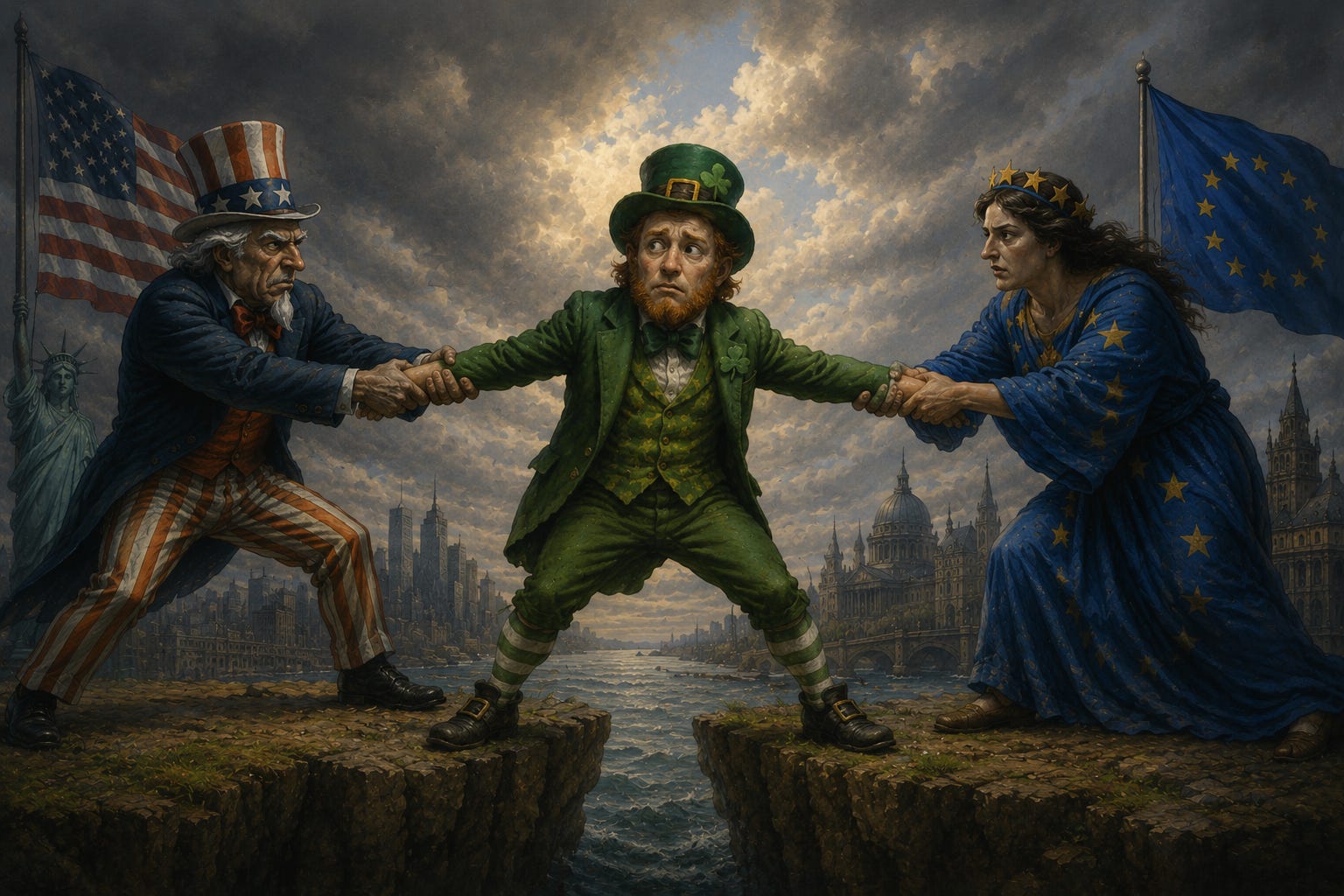
I’ve been in Ireland the past days on the press trip for the start of Ireland’s presidency of the EU Council – the upper chamber of the union’s legislature representing national governments with a rotating chairmanship. It’s always a delight to be in Ireland. I make no secret of the fact that this is my favourite EU country, and not just because of my ancestry. Nevertheless, the article is going to dish out some harsh truths about the emerald isle that some will not like to hear.
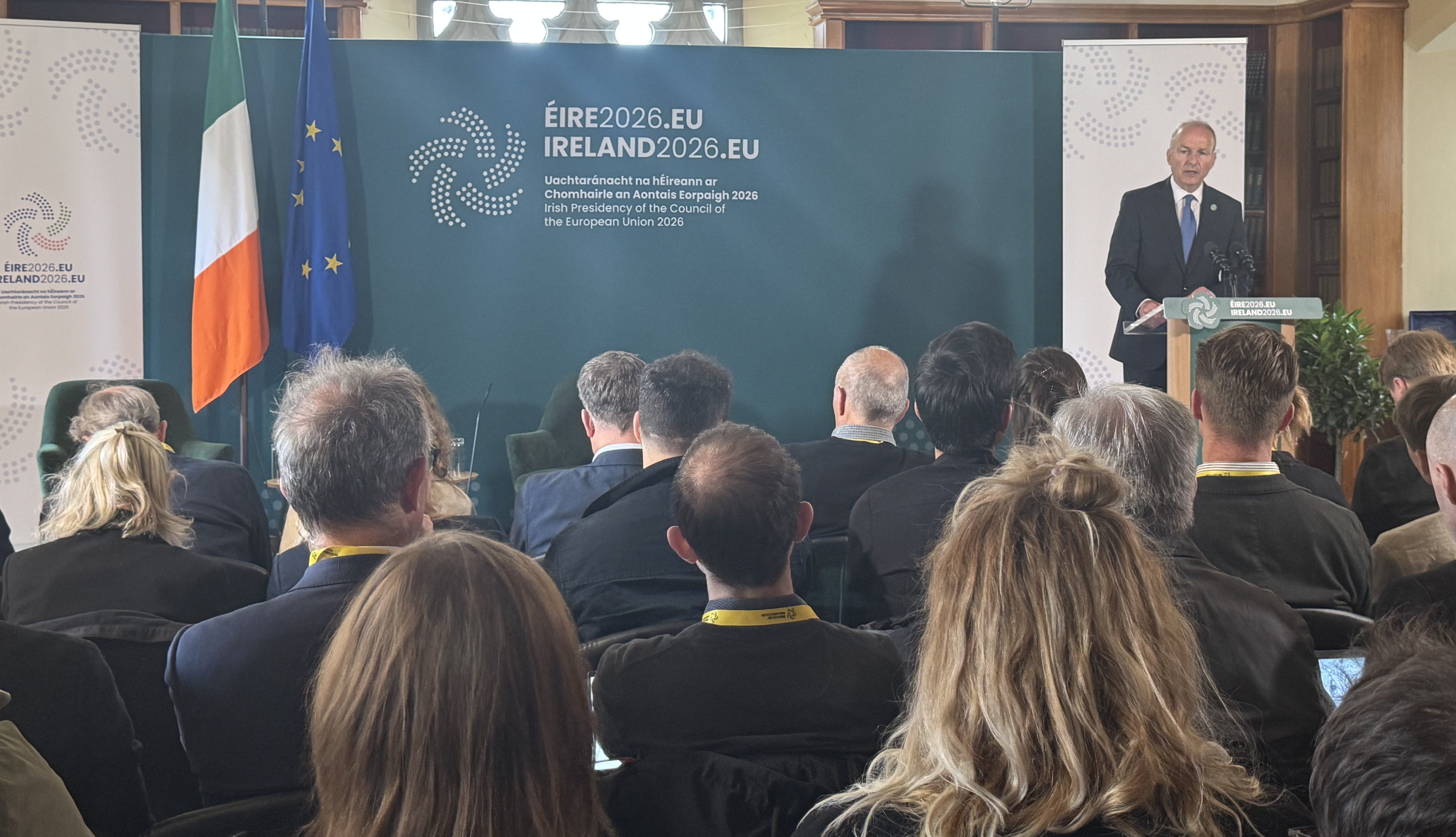
We’ve had briefings with Irish ministers and business leaders, as well as a joint press conference with Irish Taoiseach (prime minister) Micheál Martin and European Commission President Ursula von der Leyen held after she convened a college meeting in Cork.
During all these briefings, it became clear that there are two awkward subjects that Ireland’s politicians are having to grapple with as their presidency starts. One is their military neutrality in the face of Russia’s war on Ukraine (I’ll write more about that below). The other is the degree to which American big tech companies (and pharma as well) have disproportionate power in this country. The sweetheart tax deals that attracted them to base their European headquarters here has given them quite a lot of power in Dublin, since they account for such a large portion of the country’s economy.
It wasn’t only the low corporate tax rate that attracted Google, Meta, Apple Microsoft, Amazon, Intel, Salesforce, Pfizer, Johnson & Johnson and Paypal to base their European headquarters here. It was also the well-educated English-speaking workforce and the country’s close historical ties to America. For years, Irish leaders liked to brag about their unique position as a bridge between America and Europe – which they argued (rightly, in terms of the economy) was stronger than the UK’s supposed “special relationship”. But what was interesting as we spoke with Irish politicians over the past days was that, for once, they actually seemed keen to avoid the topic of their country’s close relationship with America. I’ve never seen it before from a country which is usually so eager to talk about their US connections.
At his press conference with us on Thursday at University College Cork, Taoiseach Martin was asked about whether it will be difficult to be a ‘neutral arbiter’ chairing the tech sovereignty debates coming up in the Council – given that the Irish economy is so deeply entrenched with the same US tech giants that are fiercely resisting the EU’s quest for tech sovereignty. “There are tech companies in many EU member states,” he insisted, and Ireland is just one of them. Nothing to see here. It’s a line he’s been using repeatedly in recent interviews, and it’s a big departure from the way Irish leaders used to brag about having the most American investment. Asked on RTE’s Morning Ireland last week whether the Irish government should recuse itself from chairing sessions on these tech regulations that the American giants are opposing (such as the social media ban for children that President von der Leyen might propose in September) “because Ireland has such a cozy relationship with tech companies”, Martin insisted that the US companies do not have disproportionate lobbying power in Dublin.
“Tech companies make their case, but not in that kind of context,” he said. “If you look at the fines of the Data Protection Commission, there is no evidence actually that Ireland is any softer in respect to violations of technology laws than any other jurisdiction in Europe”
But this is a disingenuous argument because Ireland doesn’t make the rules, it simply has the task (not the option) of enforcing them because this is where the tech companies are based. Behind the scenes, as detailed in a Guardian opinion piece last week, the Irish government has been opposing these decisions against US tech companies. But once a decision is taken in Brussels, Ireland has no choice but to enforce it – otherwise they would be violating EU law and would themselves be subject to infringement fines. Ireland’s Data Protection Commission has become the de facto enforcer of the EU’s General Data Protection Regulation for the entire union, and it has faced years of criticism, including from its European counterparts, for being too slow and too gentle with the companies it’s meant to police. The newer Digital Services Act enforcer, Coimisiún na Meán, now finds itself squeezed between an EU mandate to regulate American platforms and an increasingly hostile US administration threatening sanctions and visa restrictions against European officials who do exactly that. So presenting this enforcement as evidence of the Irish government ‘taking on’ the American tech giants doesn’t really hold water.
Ireland, in other words, isn’t just economically entangled with corporate America – it’s now a literal front line in the transatlantic argument over how much power that same corporate America should have.
Martin made another interesting comment to us during his press conference regarding Ireland’s EU path. Asked about whether Dublin will be pushing hard over the next six months to advance Ukraine and Moldova’s (and the Western Balkans’) EU accession, he gave an emphatic yes. “I always find it difficult for us to refuse countries who fulfil their criteria,” he said. “When we joined in 1973 we were the poorest country in the EU, many felt we were too poor to be in it. It has had enormous impact for economic development, and societal transformation as well. We feel morally it would be wrong for us to deny somebody that experience.”
Ireland has been the EU’s biggest success story, and Irish people are generally very pro-EU as a result. They moved from net receivers from to net payers into the EU budget in just one generation. Today they have one of the highest GDPs in the world and are an economic powerhouse that pushes far above their weight
But how much of Ireland’s transformation from one of Western Europe’s poorest countries into one of its richest was really about Europe, and how much was about America?
It’s worth remembering how poor Ireland actually was. Well into the 1950s it was a protectionist, agrarian backwater – paralysed by the firm grip of the Catholic church – bleeding people to emigration at unsustainable rates. The pivot came with T.K. Whitaker’s 1958 plan to ditch economic nationalism and chase foreign investment instead, followed by accession in 1973 to the European Economic Community (which transformed into the EU in 1992), which gave Irish exporters – and, crucially, foreign firms manufacturing in Ireland – tariff-free access to the vast European market next door.
Then came the tax engineering. In 1981 Brussels agreed to let Ireland apply a special 10% rate to manufacturing, a state-aid exception that effectively created the Irish model as we now know it. That carve-out got extended to Dublin’s International Financial Services Centre in 1987, and when the EU eventually forced Ireland to phase out the special rate in the late 1990s, Dublin simply cut its standard corporate rate to 12.5% instead, applying the low rate to everyone rather than losing it altogether. Add in a legal architecture built for shifting intellectual property and royalty payments through Irish subsidiaries – alternatively called the “Double Irish,” or the “Single Malt” – and you had a machine purpose-built to attract American capital in industries with lots of IP to shelter: pharmaceuticals, and above all tech.
American companies obliged, at a startling scale. Apple came in 1980. By the 2000s, Google, Meta, Microsoft and LinkedIn had all planted their EMEA headquarters in Dublin. It’s hard to think of another EU capital this thoroughly colonised by the corporate architecture of a single foreign country.
The scale of it today isn’t subtle. Corporation tax receipts have gone from around €4.6 billion in 2014 to roughly €39 billion in 2024, and are on course to top €30 billion again this year. That’s a sum equivalent to something like €5,000 for every person in the country. Corporation tax now makes up close to a third of all Irish tax revenue, up from under a fifth just six years ago. Foreign multinationals, overwhelmingly American, pay something like three-quarters to as much as 88% of that total in a given year, depending on how you slice it.
And it’s not spread out. The top ten corporate taxpayers account for well over half of all corporation tax receipts; in some years the top three alone, usually some rotating cast including Apple, Microsoft, Alphabet and a pharmaceutical giant, have accounted for close to 40% of the total. Ireland’s fiscal watchdogs have been warning for years, with increasing urgency, that the state is running a structural surplus built on the profits of a handful of American firms deciding, for now, to keep moving their global intellectual property income through Dublin. Should the accounting logic that makes that worthwhile ever change (such as a US tax reform, an OECD rule shift, or a corporate restructuring) a meaningful chunk of that revenue could evaporate quickly. It happened before with GDP itself: when Apple restructured its balance sheet in 2015, official Irish GDP jumped 26% in a single year, a statistical event so absurd economists nicknamed it “leprechaun economics.”
This isn’t just a tax story either. Foreign multinationals directly employ well over 200,000 people in Ireland at wages roughly double the industrial average, and indirectly touch far more of the economy through services, construction, and the vast physical footprint of the data centres that now hoover up grid capacity that might otherwise go to new housing.
It beggars belief that these American companies would have so much power over the Irish economy without also wielding a large amount of political power as well. One example: When EirGrid warned in 2021 that Dublin’s electricity system was hitting its physical limits, a proposed moratorium on data centre growth was killed by a lobbying coalition of Amazon, Google and other hyperscalers according to a report by The Irish Times.
So did Ireland get rich because of the EU and the accompanying subsidies and single market access, or because of American corporations? The answer is both. And if you took one side or the other out of the equation, it’s unlikely Ireland would be as wealthy as it is today. But the difference is that the EU factor is sustainable and governable, while the American factor is mostly out of Ireland’s control.
The entire pitch to American boardrooms for fifty years has been: locate here, use English, use Ireland’s low tax rate, and get frictionless access to 500 million EU consumers. Strip out EU membership and Ireland is just a low-tax island off the coast of a market it can’t sell into. Ireland’s attractiveness to American capital only exists because of the union it belongs to. Strip out the American capital, on the other hand, and Ireland looks a lot more like Portugal or Greece: a beneficiary of European structural funds and market access that modernised steadily but never became one of the richest countries per capita in the world. The EU built the highway. America brought the trucks.
What should worry people, in Dublin and in Brussels alike, isn’t that this hybrid model worked. It’s that it worked so well it became structurally impossible to unwind. A government that gets a third of its tax revenue from ten American companies, whose national grid is being reallocated to serve them, and whose flagship regulators are trying to police the very firms propping up the exchequer, isn’t just an unusually Americanised European economy. It’s a small state that has, in important respects, outsourced its own leverage. The bill for that arrangement hasn’t come due yet. But every fiscal council report out of Dublin these days reads like it’s bracing for the day it might. It’s a subject I write about in my book The Owned Continent, citing Ireland as one of the most egregious examples of American corporate capture (far more than the UK, a dependence examined by Angus Hanton’s book Vassal State: How America Runs Britain).
The Pax Americana of the last 80 years has been good for a lot of countries, but perhaps none more so than Ireland (other than America itself of course). Not only has this young nation-state been able to free itself from the British yolk by using the united economic infrastructure set up jointly by Washington and Brussels (as detailed in Glyn Morgan’s new book The Rise and Fall of American Europe which I reviewed last month), it also set up a military protectorate that allowed Ireland, a country embroiled in civil war just a few decades earlier after a bloody independence revolution, to demilitarise and spend that money instead on developing the state.
Ireland was able to have its policy of neutrality after the world wars because, as an island surrounded by NATO countries and essential to America’s control over Europe, it didn’t have to join NATO in order to be protected by it. Obviously, in the very preposterous hypothetical of Russia invading Ireland tomorrow, NATO would declare war on Russia. Indeed, those who believe NATO’s Article 5 security guarantee is illusory these days have pointed out that ironically NATO is more likely to declare war on Russia in order to defend Ireland (and its undersea data cables) than it is to come to the defence of the Baltics. That’s realpolitik, and no piece of paper changes that security calculation.
Unlike other militarily neutral countries in Europe like Sweden, Finland and Austria, Ireland chose to completely demilitarise precisely because its geography acts as a natural protector while the geography of those other countries to the East makes them a likely target. Even before they ended their policy of non-alignment, Sweden and Finland spent 1.2% and 2.2% of their GDP respectively on their military in 2021 – compared to 0.2% in Ireland.
One of the most useful things about these press trips that come at the start of every presidency is that you can see what subjects are likely to dominate the next six months. On this trip it was clear: the topics of tech sovereignty and lack of Irish support for Ukraine were repeatedly asked by journalists. The latter became particularly relevant after it was revealed last month that an alumina plant in Ireland is still exporting to Russia, fuelling the Russian war effort.
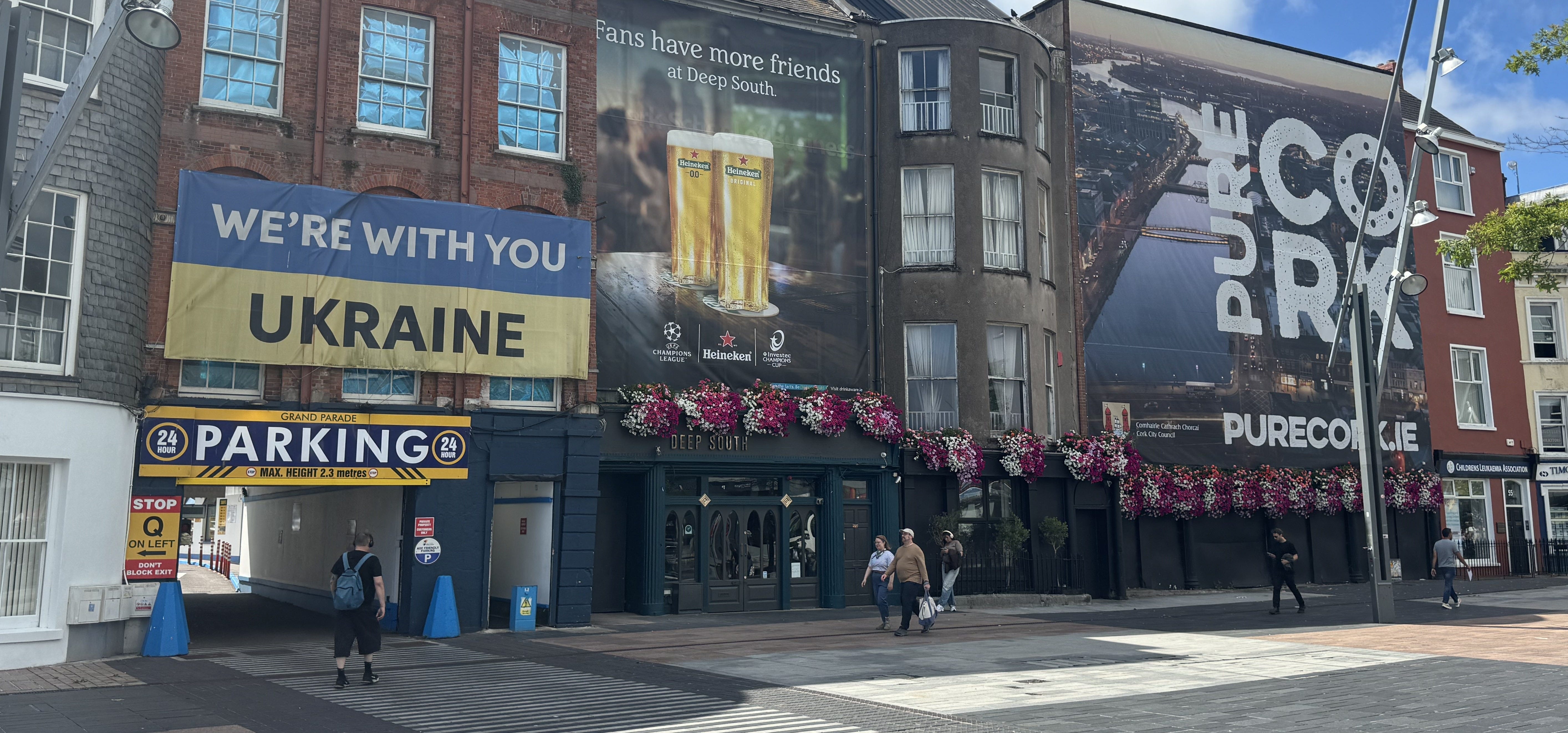
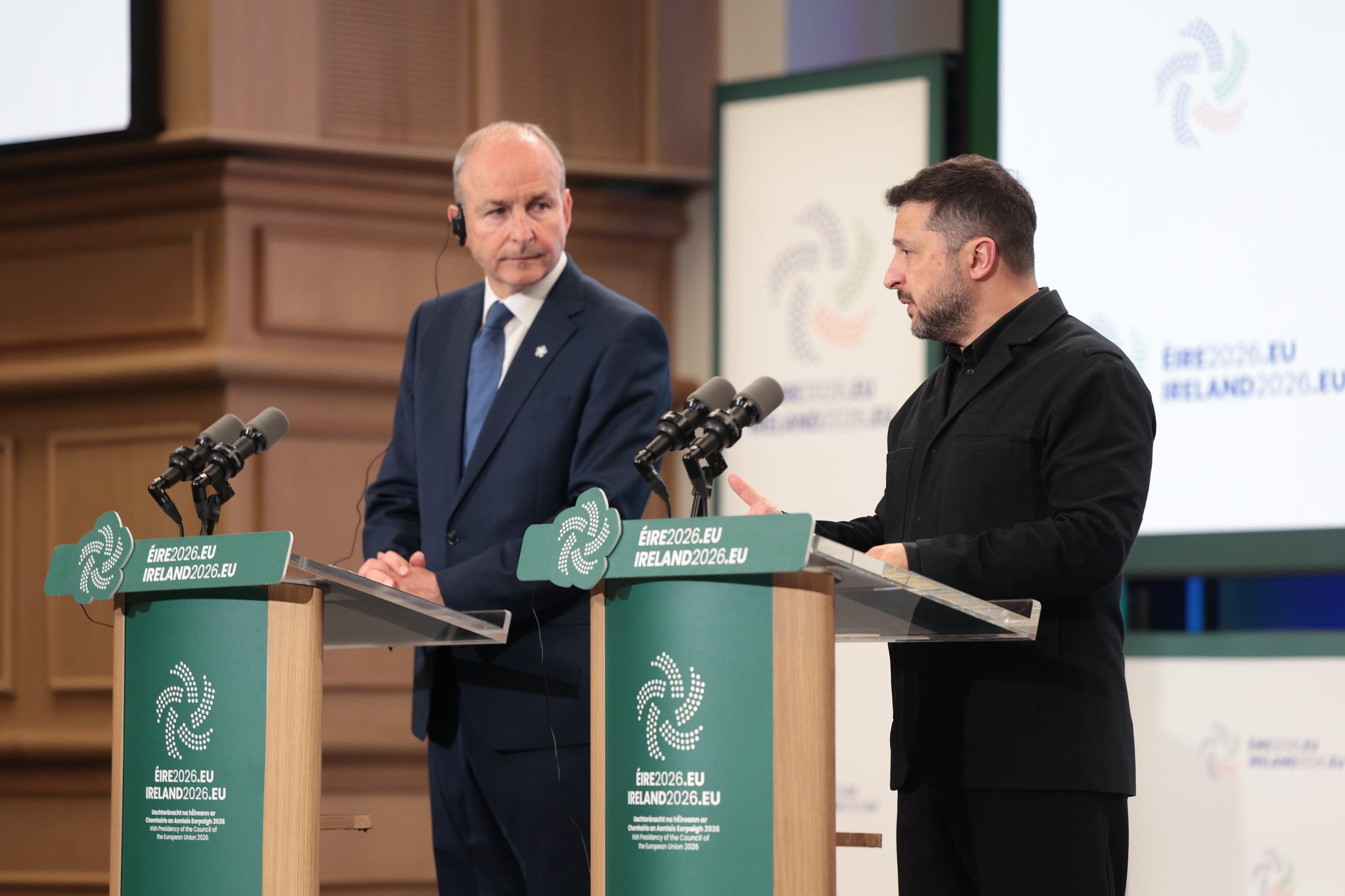
The government was intent on dispelling the idea that they’re not supporting Ukraine during this trip. Banners supporting Ukraine could be seen around Dublin and Cork. President Zelenskyy made a surprise visit to Dublin Castle for the opening ceremony on Wednesday, standing next to the Taoiseach who stressed Ireland’s support and its condemnation of Russia. “We might be militarily neutral but we’re not politically neutral,” he reminded us the next day at his solo press conference in Cork, his hometown. He insisted that an investigation into whether the alumina plant should be nationalised to prevent it exporting to Russia will be completed “within weeks” he said, but he reminded that exporting alumina to Russia is currently not prohibited under the EU sanctions regime.
But Zelensky couldn’t resist making a jab about the alumina issue as he stood beside Martin at Dublin Castle: “Every tonne of raw materials that ends up in Russia is used against us in this war,” he said pointedly.
As my incomparable colleague Jorge Liboreiro from Euronews noted at the end of our trip, this story is not going to go away. “After three days covering the start of Ireland’s EU Council presidency, one conclusion emerges on its own: alumina has become a hazardous liability,” he said. “The special occasion has been largely overshadowed by a persistent scandal over continued alumina sales to Russia, an embarrassing, perhaps untenable, look for a country that has placed support for Ukraine at the very top of its priorities and is supposed to act as an ‘honest broker’ among the other 26 member states. For Ireland, whose controversies essentially revolve around Big Tech and low taxation, the perception of being an indirect enabler of the greatest armed conflict on European soil since World War II has turned into a devastating PR crisis that takes a new turn every week.”
It is obvious that a country that has benefitted the most from Pax America will be impacted the most by its collapse. In an era where the American security guarantee now appears to be gone, Ireland’s free-riding ‘neutrality’ is clearly too much of a risk. But as the US government becomes increasingly friendly with Russia and increasingly antagonistic toward the EU (and the UK), Ireland’s dependence on American corporations is also going to put it in a very uncomfortable mid-Atlantic position. Given that Ireland’s success has been due to a mixture of the EU and the US, what’s going to happen if it’s forced to take a side? If the EU starts taking a harder line in defending itself from Washington’s attacks (as I’ve argued it should), will the US be able to leverage their power in Dublin to make Ireland their own “liberum veto” within the EU to sabotage efforts for independence – the same way Russia was using Hungary as its fifth column within the Council before April’s election?
These awkward questions are unlikely to go away as Dublin hosts Council meetings over the next six months. It is therefor as good a time as any for Ireland to have a society-wide debate about what kind of future they want. Is it time to lessen the American influence on this island in order to create a stronger EU? If Ireland is forced to choose, should it look West or East? Just like in the UK, this will require shedding decades-old assumptions and talking about concepts that have been verboten in public debate up till now.
Is Ireland ready to have a grown-up conversation about its real place in the world?