
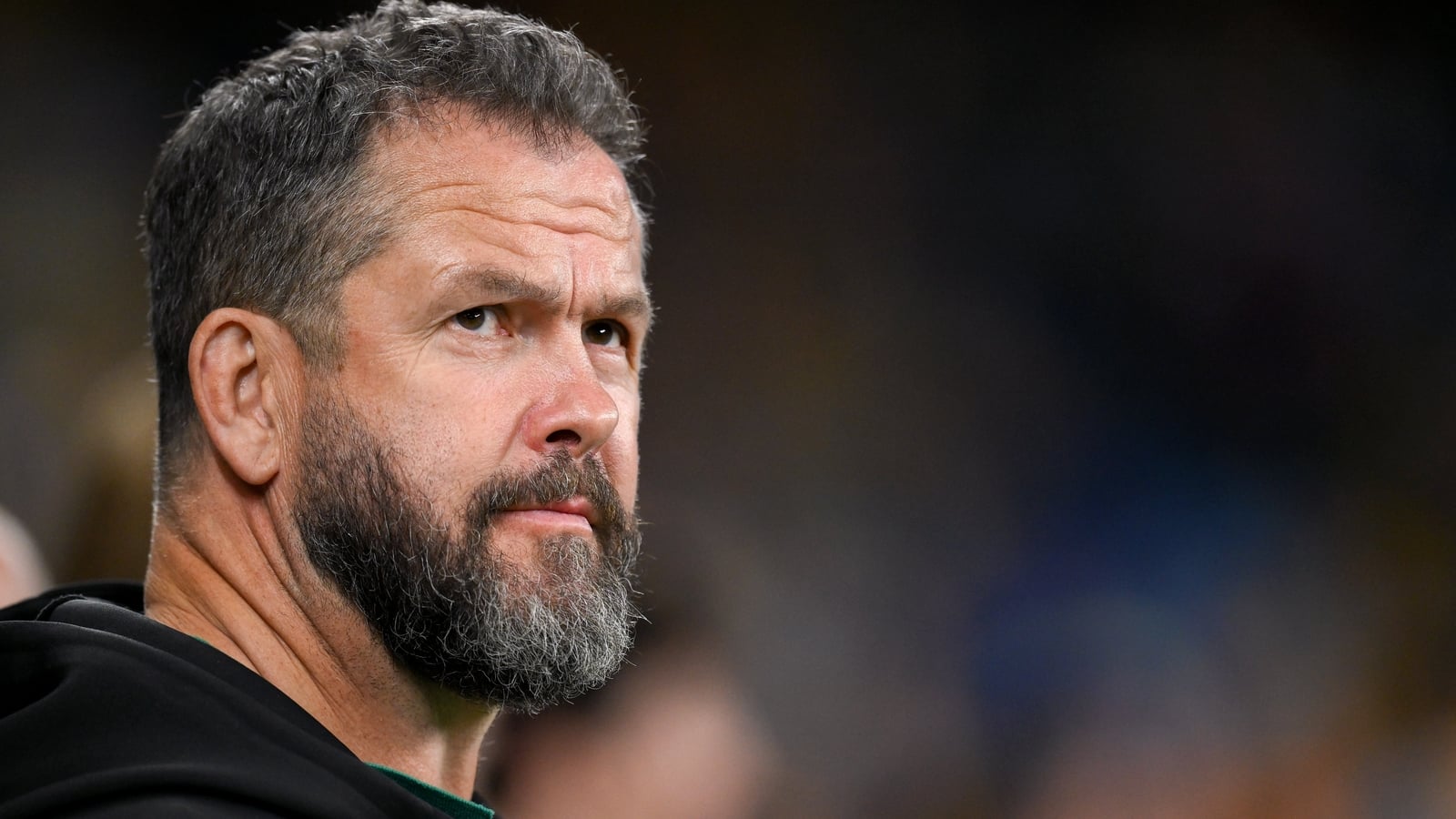
It’s too early to tell whether the Nations Championship will be a success, but organisers will be pretty pleased with their lot after the opening round of games.
Of the three marquee matches, two were thrillers that went right down to the wire, as Ireland and New Zealand edged out Australia and France respectively, and while South Africa outmuscled England in Johannesburg, it was a largely compelling and competitive contest.
Over in Cordoba, Scotland and Argentina shared 12 tries and 85 points, with Gregor Townsend’s side starting off with an impressive 47-38 win away from home.
The one drawback to a brilliant weekend of games is that we can’t just do it all over again this week. Ireland against the Wallabies again on Saturday? Sign us up. All Blacks v France part two? It’s hard to argue against it.
It might take a while for us to get used to losing out on the traditional Test series and the narrative that two or three weeks of the same match-up brings, but if the same standard of games are produced, we will eventually come around.
Even the idea of a league table outside of the Six Nations crept up on us all.
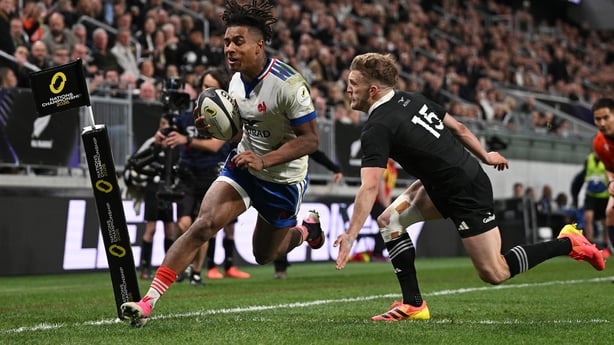
New Zealand and France played out a thriller in Christchurch on Saturday
As we watched the All Blacks and France throw haymakers at each other before Saturday night’s game in Sydney, the main talking point was, “Well, which result is better for Ireland?”. The heart said France, and the head said New Zealand.
When Hugo Keenan darted in for Ireland’s fourth try early in the second half in Sydney, it took a moment to remember that at least one bonus-point had been locked in for Andy Farrell’s side.
Saturday’s 33-31 win ensured the tourists started their campaign with the full five points, a vital result if Farrell and his players have designs on making it to the finals weekend in November as the top team in the northern hemisphere table.
“That’s the reality, isn’t it? It’s a tournament and we ended up with five points, which is great,” Farrell said.
“When you scrape through, at the end, in a high-scoring game like that, to get five points, that would be the pleasing thing I would have thought.”
Australia will make their way up to Queensland ahead of welcoming France to Brisbane next weekend, while Ireland will base themselves in Sydney until Thursday, before travelling a couple of hours north to Newcastle where they will take on Japan on Saturday.
As always, there will be plenty of things to consider for team selection.
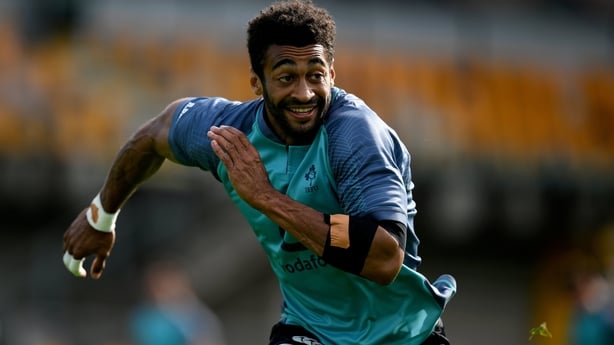
Rob Baloucoune (above) was a late scratch from the starting team to play the Wallabies because of a tight hamstring, which will continue to be monitored this week.
Jeremy Loughman has been stood down due to concussion, and will follow the return to play protocols. With no additional props called into the squad, Connacht’s Billy Bohan now looks set to make his debut in Newcastle.
Garry Ringrose appeared to be carrying a knock when he departed Saturday’s win during the second half, but isn’t listed in today’s injury report, although Farrell will also have to consider how much rotation he’s willing to make, particularly with Japan coming into the week in impressive form, defeating Italy 27-10.
“To give people time in the saddle, experience etc at an international level, I certainly believe you’ve got to put them in a good team as well, so we’ll see who earns the right to do that,” the Ireland head coach added.
“They’re a good side, Japan, and you saw the result with the Maoris last week. That wasn’t the full-strength side.
“They play some good rugby and we all know how improved Italy are. I’ve not watched it [yet], but that’s a hell of a win.”
Repairing the defence will likely be their top priority across the next fortnight, particularly with New Zealand – who Ireland face after Japan – looking so potent in their victory against New Zealand.
What was most unusual about Ireland’s performance on Saturday was how often the Wallabies found gaps through the middle.
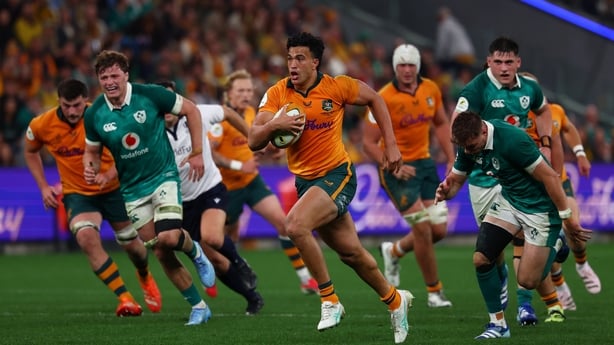
Ireland struggled to contain Joseph-Aukuso Suaalii
Carter Gordon’s connection with Joseph-Aukuso Suaailli and Len Ikitau cause constant issues in the opening half, as Joe Schmidt’s side made 10 linebreaks across the game.
At times, it looked like the players in the Irish defensive line were approaching defence in different ways, creating gaps and doglegs which the Wallabies continued to expose.
Farrell and his players have always denied it’s an issue, but it will once again raise questions about the contrasting defensive styles of Leinster and the Leinster-dominated Ireland.
The two most recent examples of Ireland being so open defensively were New Zealand last year in Chicago, and France in the Six Nations opener in Paris. Both games were the first of a Test block, and both times the defence grew stronger as the international window progressed.
In the Six Nations, Ireland’s organisation behind the ball improved drastically by the time they saw off Wales and Scotland to close out the Triple Crown, and although they finished November with a difficult defeat to South Africa, their defence was the reason the scoreline was in any way competitive.
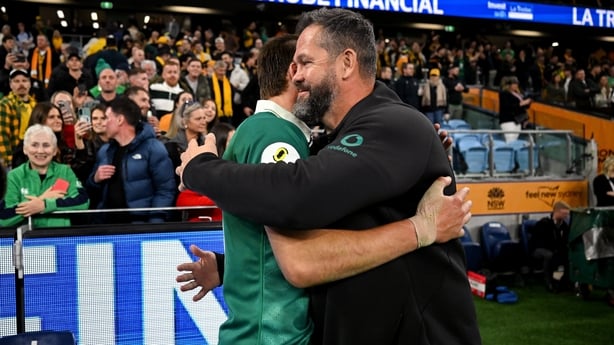
Andy Farrell congratulates Sam Prendergast after Saturday’s win
Farrell offered his take for Saturday’s defensive errors: “Because of the speed of ball and how the breakdown was, they was onto the breakdown attacking-wise before the tackle was completed. That’s difficult to stop speed-wise.
“We became a bit disconnected away from the ball and they found, with their flowing rugby, people coming around the corner, they found a few tight-five forwards not connected enough, and that’s because of the speed of the ball, so they created that.”
As previous windows have shown, many of those defensive errors should come out in the wash over the next two weeks.
“We’ve said it before, with our preparation being great, you’ve still got to go out there and deal with what the pressures of international rugby throws at you,” the head coach added.
“That type of game threw everything at them, and they found a way. That’s the most pleasing thing.”