
Gardaí visited 166 brothels across the State and interviewed 269 sex workers last month as part of a global crackdown on sex trafficking.
An Garda Síochána said this amounted to it speaking to more than a quarter of all sex workers in Ireland.
A man, aged in his 50s, was arrested at a Cork-based “massage parlour” on a German warrant for child kidnapping, illegal restraining and hostage taking during the operation.
The force said the man was being detained in custody pending extradition proceedings. It said it also secured a separate prosecution for the purchase of sex services in Co Meath.
Intelligence gathered during the operation also led to a sting at a location believed to be used as a brothel and for money laundering in the Limerick Garda division last week.
A man in his 50s was arrested and more than €840,000 in cash was seized. The man appeared before Limerick District Court last Thursday and was bailed.
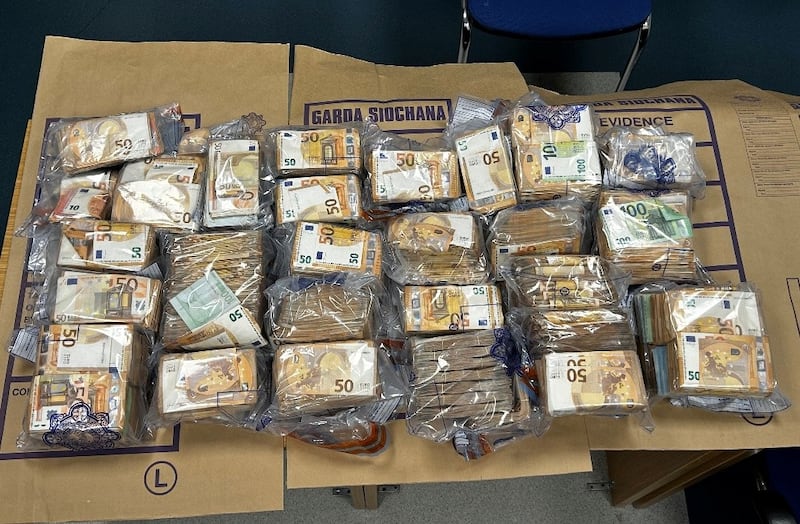 A seizure made by An Garda Síochána at a suspected brothel and money laundering facility in Limerick. Photo: Europol
Gardaí said they detected no victims of sex trafficking during the operation but the force appealed for anyone with information on such “heinous crimes” to come forward.
Under Irish law, it is not an offence to sell sexual services but it is illegal to buy them or to operate a brothel. It is also a crime to control the operation of a sex worker and to profit from doing so.
A source with knowledge of Garda operations said that while few significant arrests were made, the operation will “lay the groundwork” for further efforts and contribute information to a wider global anti-trafficking lockdown at transport hubs.
As part of the operation, more than 17,400 passengers were assessed by the Garda National Protective Services Bureau, in conjunction with local protective services and serious crime units, while entering and leaving the State to check if they were trafficking victims.
Alongside border control units, they examined records regarding 64 flights at Dublin, Cork and Knock airports, as well as ferries at Dublin and Rosslare ports.
The initiative was part of a multilateral operation, Operation Global Chain, which comprised policing and intelligence services from 59 different countries and was led by Interpol and Europol.
Across five continents, more than 2,070 potential victims of human trafficking were detected including 162 children, Europol said. Most of the victims were based in Latin America.
A total of 1,024 arrests were made globally, of which 334 were for suspected human trafficking offences.
The operation centred around targeting human trafficking operations which centred around sexual exploitation, forced criminality and forced begging.
These crimes and the exploitation of vulnerable victims are understood to be key fundraising mechanisms for organised crime groups.
In Iceland, the operation targeted two suspected prostitution locations believed to be run by a Chinese organised crime network, with 50 suspected clients arrested.
In preparation for the operation, the Garda took part in a 32-country ‘hackathon’ initiative aimed at generating “high-quality intelligence”, the force said.
Europol said the hackathon identified 252 potential victims, and 80 suspected traffickers.