
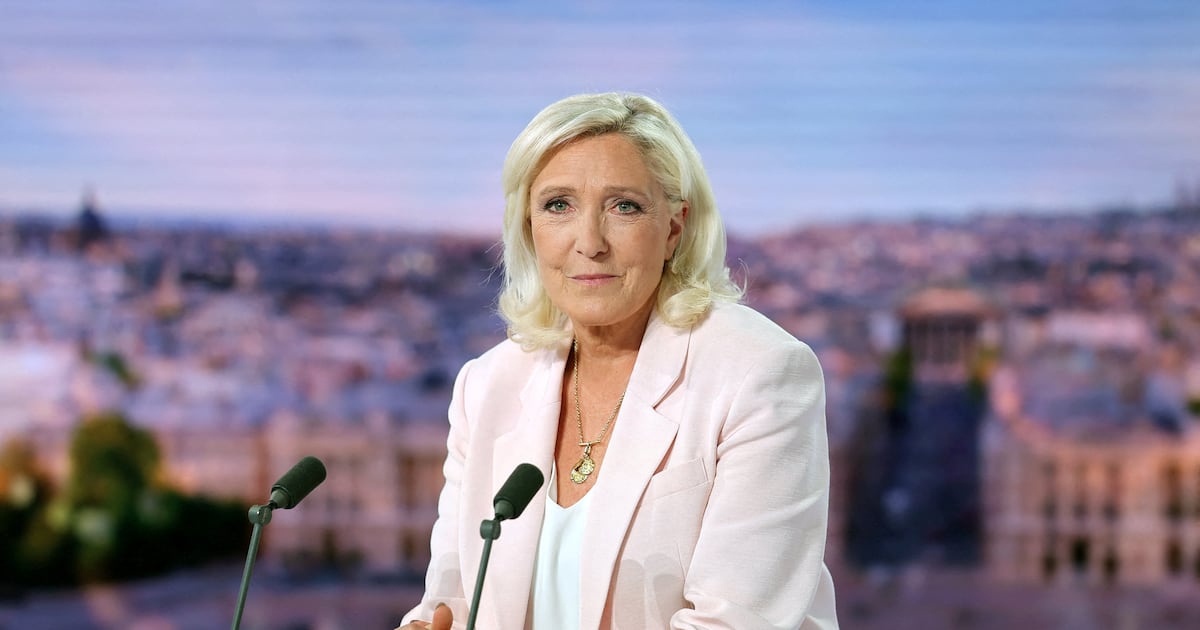
Hard-right leader Marine Le Pen announced her candidacy in France’s 2027 presidential campaign after an appeal court shortened a sentence for misappropriating European Parliament funds that had previously barred her from running.
“Tonight, I am a candidate for the presidential election and I will not change my mind,” the National Rally party politician declared in a television interview. “The French people will have the final say.”
The appeal court reduced an initial five-year ban on holding office to 45 months with 30 suspended, in effect meaning that the suspension has already been served.
A four-year prison sentence was reduced to two years suspended and one year served outside prison with an electronic bracelet, while imposing a fine of €100,000.
Le Pen announced that she would appeal the ruling once again to France’s higher adjudicating Court of Cassation, and that her sentence would not begin until after this final appeal is heard, probably in the coming months.
“I will therefore campaign without an electronic tag,” she said.
Le Pen had previously said that an electronic tag would rule her out as a candidate as it would be impossible to campaign if she needed judicial permission to hold a rally or travel to meet voters.
The National Rally had been expected to put forward 30-year-old MEP Jordan Bardella as a presidential candidate if Le Pen was ruled out of the race.
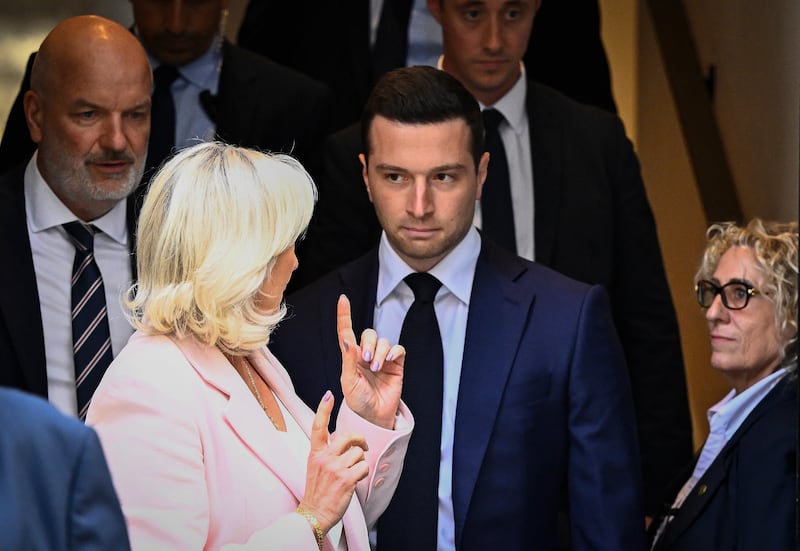 Jordan Bardella (centre) and Le Pen leave the National Rally’s new headquarters following a meeting in Paris on Tuesday. Photograph: Julien De Rosa/AFP via Getty Images
Le Pen said the two would campaign together and that she would appoint Bardella as prime minister if she wins, keeping close the man who had been lined up as a successor and a “Plan B” to her candidacy.
Current president Emmanuel Macron cannot serve another term, and it is currently unclear who all the rival candidates will be.
Polls indicate that the National Rally is the clear front-runner with Bardella – the assumed candidate by pollsters pending the outcome of Le Pen’s appeal – on about 36 per cent support ahead of his nearest rivals on 15-20 per cent.
French presidential elections usually go to a second round run-off between the two leading candidates if no candidate initially wins a majority, and in the past voters of different political leanings have rallied together to block the far-right candidate.
[ The French revolutionary: Can a veteran firebrand stem France’s far-right surge?Opens in new window ]
What is the case about?
Le Pen had been appealing against her conviction last year of misappropriating European Parliament funds, for which she received a five-year ban on holding public office, initially excluding her from running in the presidential election.
The case revolved around the hiring of assistants to Members of the European Parliament, who are paid with taxpayer money made available through parliamentary allowances to lawmakers.
Suspicions were first raised more than a decade ago about the National Rally, then known as the National Front, when European Parliament administrators noticed that several of the party’s MEP assistants were also named as having a role in the party’s domestic organisation in France.
Complaints were made to the European Anti-Fraud Office, which began an investigation alongside French authorities.
During the course of investigations, disaffected MEPs accused the party of foisting assistants on them who were actually hired to assist the national party and not for parliamentary work.
A former vice-president and MEP for the party, Jean-Claude Martinez, told French media that he had been pressured to hire as assistants Le Pen’s bodyguard and a woman who acted a “nanny” for Le Pen’s children and “never set foot” in the parliament – something the woman denied.
A former aide to Le Pen, Gael Nofri, accused the party of offering him a European Parliament contract when he was recruited to work on her 2012 presidential campaign. When he refused to sign it, he said he was fictitiously employed as working in an accounting office that he had never visited.
The party strenuously denied wrongdoing and Le Pen insisted that though it may have been “disorganised” there was no intention to defraud. “Did the party commit a crime intentionally? I believe not,” she told the court.
The ruling went against her and the presiding judge ruled that Le Pen had been “at the heart” of an organised “system” of embezzlement.
It found that the party had improperly cost the European Parliament an estimated €4.8 million, including through the use of “fictitious contracts” to “remunerate people who actually worked for the party or the party leaders”.
It found that Le Pen had instigated the scheme and had directly organised eight fictitious contracts collectively worth about €474,000.
She was banned from holding public office for five years, fined €100,000, and sentenced to four-years imprisonment, with two to be suspended and two served outside jail with an electronic bracelet.
An additional eight MEPs were found guilty, along with 12 people found to have worked fictitiously as parliamentary assistants, two accountants, and the treasurer of the party.
Le Pen has claimed the affair is a politically-motivated prosecution, holding a “Stop the Steal”-style rally in an echo of the strategy of US president Donald Trump.
“I will not let the French people have the presidential election stolen from them,” she said in advance of the verdict.