
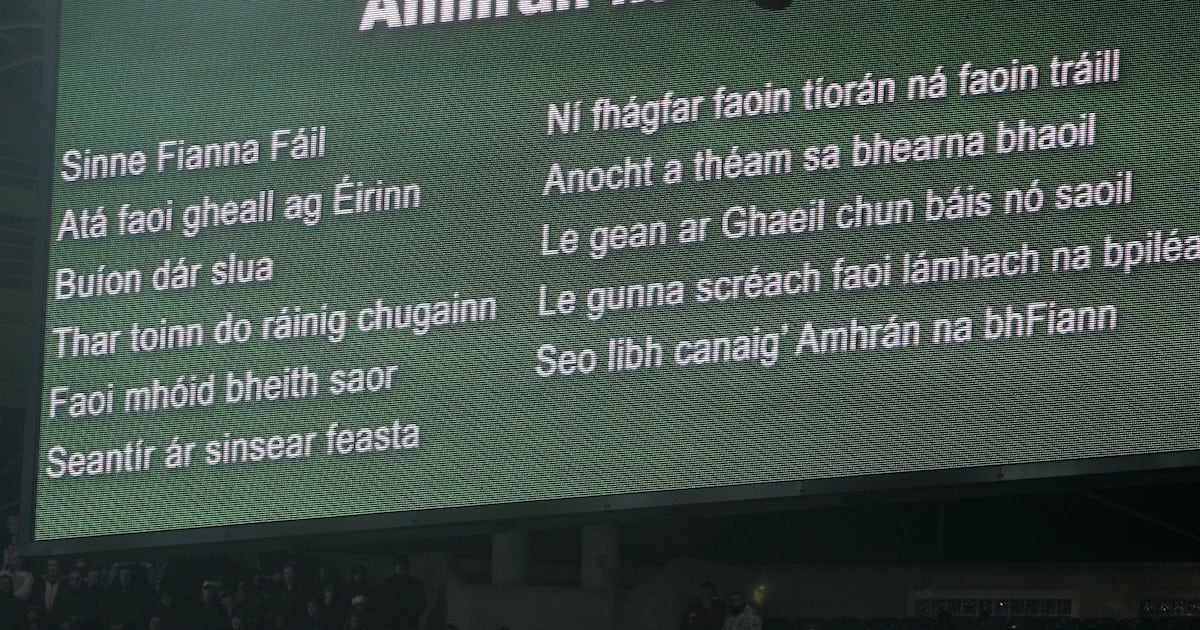
The centenary of Amhrán na bhFiann as the national anthem has been as inconspicuous as the original decision to make it so.
On July 12th, 1926 the Cabinet, led by president of the Executive Council (taoiseach) William T Cosgrave agreed to adopt The Soldier’s Song, as it was then known, as the national anthem of the new State.
For reasons best known to Cosgrave, he did not make any public announcement about this decision.
The issue was only clarified eight days later in a response to a parliamentary question from Cumann na nGaedheal TD Osmond Esmonde to the minister for defence Peter Hughes.
Esmonde pointed out that the army bands had recently played two different songs purporting to be the national anthem. Which one was the right one?
Hughes responded by stating it was not the role of the Executive Council president to decide on what the national anthem should be, but did not elaborate on whose responsibility it should be.
When pressed, Hughes responded laconically, The Soldier’s Song and that was it. Unlike the national flag, the national anthem has no official status though there’s no dispute that it is the anthem.
The low-key beginning to the national anthem reflected a degree of ambivalence about it. The lyrics for The Soldier’s Song were written by Peadar Kearney and the tune by Patrick Heeney around 1911.
It became popular during the 1916 Easter Rising and during the War of Independence (1919-1921), but there were other contenders for the national anthem, among them Thomas Moore’s Let Erin Remember, Thomas Davis’s A Nation Once Again and God Save Ireland, the song about the Manchester Martyrs.
Because of its association with the revolutionary period, The Soldier’s Song was already the semi-official national anthem before it was made ‘official’.
The issue was not resolved by the time of the 1924 Olympic Games in which Let Erin Remember was nominated as the Irish national anthem, but was never used as Ireland did not win a gold medal.
The government refused to commit to a national anthem and even an unofficial competition run by the Evening Mail to find a contender failed to rouse the government from its torpor.
The Irish Army, which had repeatedly asked for clarification as to which song to play, accepted The Soldier’s Song in the absence of anything better.
“‘The Soldiers’ Song’ is good enough for the present … The note of defeat or sorrow is absent from it. In the songs of the past, sadness, disappointment and failure had too much prominence. The new spirit was caught by the writer of ‘The Soldiers’ Song’,” the Army’s own publication, An tÓglach noted.
With no official announcement, The Soldier’s Song became by usage the national anthem that was used by the army band, by RTÉ Radio Éireann (2RN) at the end of broadcasts and by the GAA.
Eventually, the English-language version was replaced by the Irish translation done in 1916 by Liam Ó Rinn and supplants both the English-language title and version.
Kearney was paid £1,000 in 1933 for the copyright into perpetuity for the song, though his estate later got an extra £2,500 in 1965.
The song went out of copyright in 2013, 70 years after Kearney’s death. An Oireachtas committee in 2017 recommended legal protection for Amhrán na bhFiann/The Soldier’s Song, but nothing came of it.
It’s free for anybody to use for good or ill.
[ Amhrán na bhFiann author had to sue State for royaltiesOpens in new window ]