
Most auction barns in Western Canada were closed during the week ending July 4.
A few locations held sales, but the overall volume was too small to establish true price discovery.
South of the border, the Oklahoma weekly cattle summary reported that prices were down US$5-$10 per hundredweight on average compared to the previous week.
On July 2, the December live cattle futures closed down $4 from six days earlier, which contributed to a weaker tone in the U.S. feeder complex.
Western Canadian feeder markets are expected to hold value over the next couple of weeks and may divorce from U.S. feeder prices.
Feedlots in southern and central Alberta are contending with adverse pen conditions due to excessive rains. There has been a drag on weight gain efficiencies throughout the month of June.
Feedlot operators are not anxious to bring in fresh replacements under the current conditions. This will limit the upside in the short term.
In Kansas, live cattle were trading at $255 per cwt. f.o.b. feedlot, down $3 per cwt. from a week earlier. Despite the weaker U.S. live cattle market, Alberta fed prices made fresh historical highs.
On July 2, Alberta packers were buying fed cattle on a dressed basis in the range of $590-$600 per cwt. delivered, steady to $5 per cwt. above values from June 25. Using a 60 per cent grading, this equates to a live price of $354-$360 per cwt.
Fed cattle prices for yearlings bought earlier in winter are in the range of $320-$330 per cwt. The healthy margin structure is supporting the nearby Canadian feeder market.
For the next expansion phase of the cattle cycle, the first significant round of heifer retention will occur during the late summer and fall period. In Western Canada, heifers for beef cow replacements are expected to be up 50,000-60,000 head from year-ago levels.
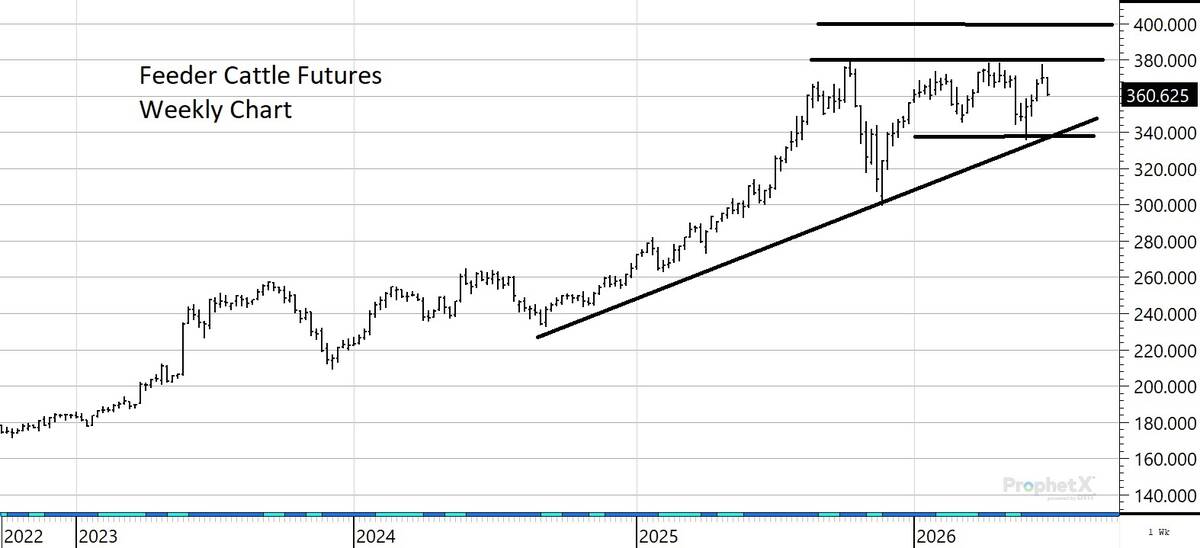
The feeder cattle futures have traded in a range while maintaining an upward trend. Support is at $340 and resistance surfaces at $380. A close above $380 would result in upside to the $400 level. Longer-term, producers need to watch how the market behaves on pull-backs to the upward trendline. When a market breaks below a long-term upward trendline, there is usually a significant move.
Photo:
DTN ProphetX
In the United States, we’re forecasting a year-over-year increase of 400,000-500,000 head. This often causes the feeder market to overextend to the upside.
During the last week of June, larger-frame, quality genetic 1,000-pound steers off grass were valued at C$470 per cwt. f.o.b. ranch in central Alberta for immediate delivery.
During the first weeks of August, we’re expecting 1,000-lb. steers off grass to trade in the range of $480-$500 per cwt. The yearling market is expected to make seasonal highs during the first couple weeks of August.
For October and November delivery, 600-lb. steers have been quoted in the range of $680-$700 per cwt. f.o.b. ranch in central Alberta.
The calf market is expected to make seasonal highs during the last week of September or the first couple weeks of October. The price pattern during the fall of 2026 is expected to be very similar to the fall of 2025.
The western Canadian feeder market peaked during the first half of October 2025 and traded lower for about five weeks in a row.
U.S. and Canadian feedlot margins are expected to move into negative territory during October. This will be a contributing factor to the seasonal downturn in the feeder market.
Exogenous factors
During March, April and the first half of May, crude oil futures were trading at more than $100 per barrel due to the U.S.-led war on Iran and the closure of the Strait of Hormuz.
At the time of writing this article, the United States and Iran were in the process of negotiating a peace agreement, and regular trade flow had resumed through the strait. In early July, crude oil futures were less than $70 per barrel and trending lower.
Earlier in spring, there were widespread concerns that higher gas prices and elevated inflation would result in lower restaurant sales in the second quarter.
Gas prices are now down 12-15 per cent from 30 days earlier and continue to trend lower. Weaker energy prices should eventually ease inflationary pressures.
For the week ending June 27, U.S. restaurant traffic was up 11-15 per cent on average, while Canadian restaurant visits were up 17-22 per cent. This is positive news for beef demand.
Restaurant and grocery store spending tends to make seasonal highs during the summer.
The Canadian economy is expected to grow by two per cent in the second quarter, while the U.S. economy is forecasted to expand by three per cent. As a rule of thumb, as long as economic growth remains above two per cent, the cattle and beef markets tend to trade sideways to higher.
Feed supply and demand
Canadian farmers seeded 6.7 million acres of barley this past spring, according to Statistics Canada. This was up 9.3 per cent, or 569,000 acres, from last year. Using a traditional abandonment rate and an average yield of 77.5 bu. per acre, production has the potential to reach 10.3 million tonnes, up from the 2025 output of 9.7 million tonnes.
For July delivery, Lethbridge area feedlots were buying feed barley in the range of $290-$295 per tonne delivered. Prices have dropped $20-$30 per tonne over the past month.
For August and September positions, Lethbridge feedlots were showing bids for feed barley in the range of $265-$270 per tonne delivered.
Given the weather pattern over the past month, feedlot operators are expecting about 20 per cent of the spring wheat crop to be feed quality. Feedlot operators are not anxious to book new-crop feed grain supplies until the crop quality is more certain.
In conclusion, the western Canadian feeder market is expected to remain firm through the summer.
The function of the feeder market is to ration demand and encourage expansion. We’re expecting significant heifer retention during the summer and fall, which will cause feeder cattle prices to overextend to the upside.
Barley prices are expected to drop to seasonal lows in September and October, and feedgrain supplies will be burdensome.
The easing of energy prices will be supportive for beef demand. Consumer spending remains on solid footing in Canada and the U.S. as economic growth forecasts remain above two per cent.