
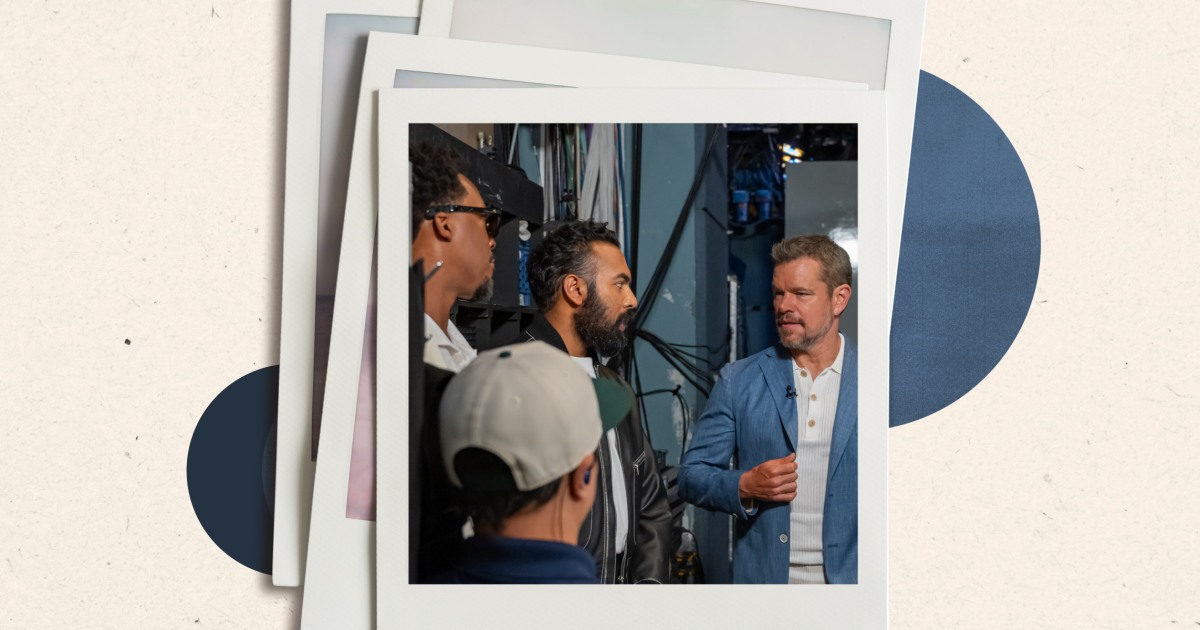
This interview has been lightly edited for clarity.
At its core, what kind of tale is “The Odyssey”? Is it a love story? A war story? A story of PTSD?
Matt Damon: I actually think it’s all of them, and that’s why it’s endured. It’s so rich thematically, and I think it almost depends on where you are in your life when you encounter the story of what it reflects back to you. I’ve talked to people who’ve seen it, and they feel it’s about family, it’s about love, it’s about war, it’s about death, it’s about regret. There’s so much in it and that’s why we’re still talking about it 3,000 years later.
Corey Hawkins: I think it’s one of those things that we think about mythology and why these stories constantly endure. But also not just Greek culture – but culture to culture to culture, it’s because they are mirrors to who we are and they’re actually talking to us, they’re actually telling us more things about ourselves. It truly is all of the above.
Himesh Patel: I agree with these guys. It’s the way that it ensures over time. It’s amazing to me that it’s taken this long to tell this story in a way that we’ve told it and I’m so proud of that. But it truly is a testament to why this story has endured over thousands of years.
Himesh, in some ways, your character, Eurylochus, served as the conscience of this film, especially when he was forced to confront his hero, his leader, Odysseus. Did you feel that way, too?
Himesh Patel: Yes, I did. I was so excited every day when we had those scenes when we got to play that dynamic of, “This is my king, my leader, who’s led us through war,” and yet I’m having to watch his mind sort of eroding, as is my faith in him eroding. It’s really heartbreaking, actually, the end that we get to.
But the complication of that, the morality … because people look at Eurylochus, who know the story, and they think he’s just a guy who makes a stupid decision eventually. But actually the way that Chris has adapted that story and made it really a heartbreaking decision that he has to make because he has no other choice, I thought was really beautiful.
There was an intense amount of prep for each of you ahead of shooting this film. Matt, to get into physical shape, you went gluten-free and still are gluten-free. Obviously the ultimate sacrifice.
(Damon, Patel and Hawkins laugh.)
Patel: No bread while shooting. Oh my god.
But really, what was the biggest challenge in preparing for your respective roles?
Corey Hawkins: Chris’ reputation obviously precedes him. An incredible filmmaker, an incredible canon of work. Then I looked at the cast, many of whom have worked with him before, but in their own right, clearly amazing artists, amazing actors.
Also, not knowing what you’re stepping into, because I didn’t know until after I had the role. So, you go into the room and you read it and you’re like, “OK, this is what’s ahead of us.” I was pleasantly surprised. The challenges — it sort of reminds me of theater and that precision. It has to be on the page and it requires so much of you, so fully. You have to be present.
There’s no sort of downtime and that can be draining in a really good way because sometimes on film sets, you can kind of let your guard down. But this is … there’s no time for that. And when you look around and you see that not only the actors, Chris, our crew, but our incredible background artists, everybody is literally in this kind of posture, leaning in for 12 hours sometimes. And so it can be draining and grueling in that sense, but also just incredibly rewarding because it just pours into you.
Matt Damon: That’s quite the perfect way to put it because it’s true. It was really grueling, definitely the hardest film that I’ve ever been a part of, but I got so much energy from looking around at the other actors and then also the crew. Everybody was being asked to do more than they’d ever been asked to do. And there was a real joy in that because it was a shared experience.
So all of those challenges actually just did become these kind of joyful … they felt like opportunities, and the second we got these roles it was like, “OK, this is what I have to do to prepare.” But that didn’t feel like a hardship, it felt like it was something really exciting and different. And the fact that it was hard made it worth doing.
Himesh Patel: I agree. I was going in with some knowledge of how Chris works and what the set was like, but I knew that this was going to be a whole other level. The minute (Christopher Nolan) told me we’re doing “The Odyssey” … and knowing how he wants to work, I knew we were not going to be doing anything by half measures.
So, I was kind of trying to mentally prepare myself to go into that. Also, not knowing so much about how we were going to do it, but knowing it was going to be tough. When you’re there, especially Matt as a leader is amazing, but the crew as well, everyone’s pulling towards the same thing every day because everyone knows that we’re going to create something special. And that just gets you through every moment.