
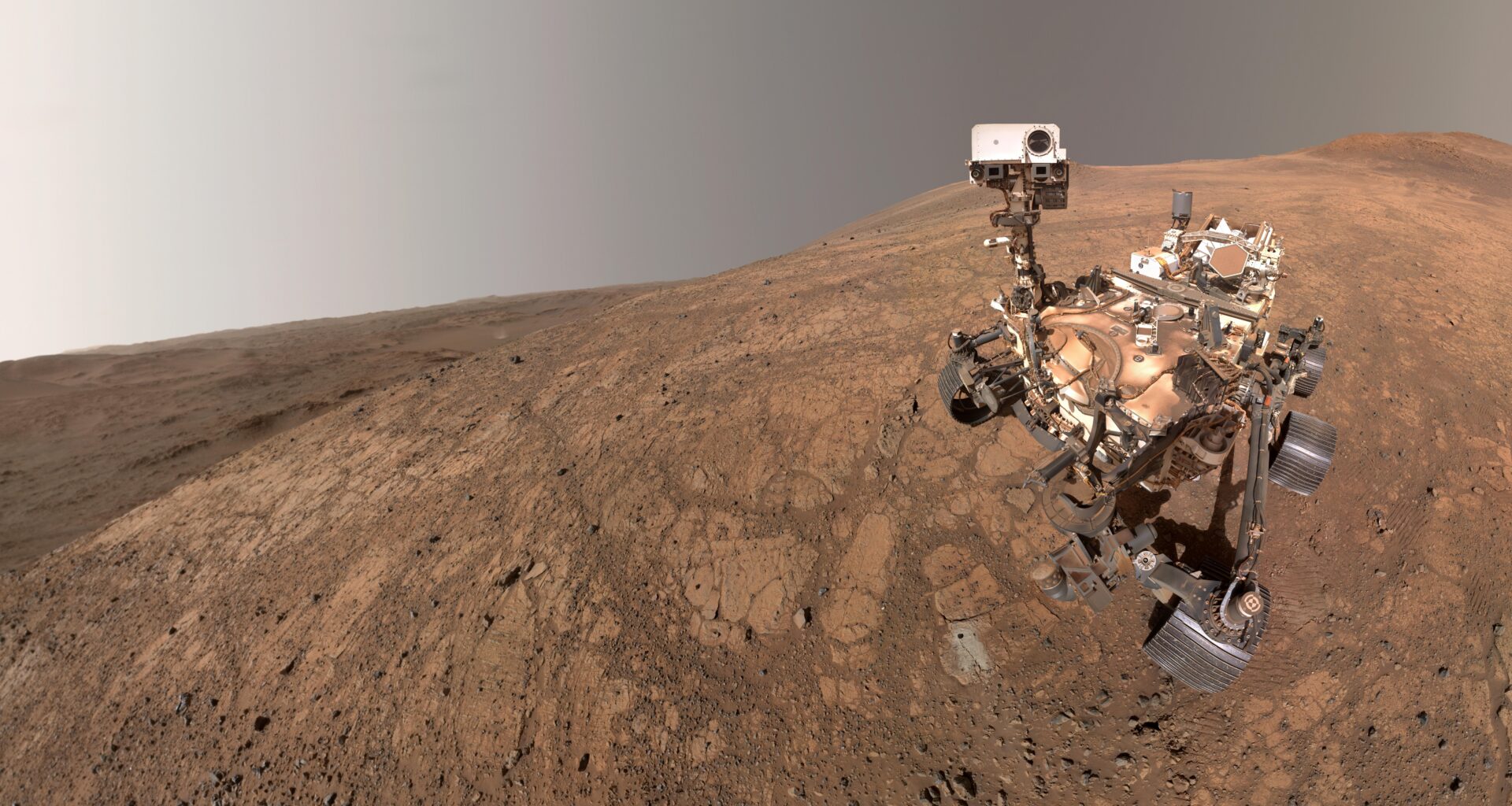
What can layered rocks on Mars teach scientists about planetary formation and evolution? This is what a recent study published in JGR: Planets hopes to address as a team of scientists investigated the layering (scientifically called stratigraphy) of rocks in Jezero Crater on Mars. This study holds the potential to help scientists better understand te formation and evolution of rocky planets and what this could mean for finding life beyond Earth.
For the study, the researchers used NASA’s Perseverance rover to analyze a rock outcrop in the western rim of Jezero Crater, which is hypothesized to contain rock sections that are billions of years old. There were several motivations for this study, including the formation and evolution of the early solar system, testing longstanding hypotheses regarding the exposed rock layers in Jezero Crater, and separating confusion between volcanic and sedimentary history. In the end, the researchers found that the layered rocks weren’t formed from volcanic or sedimentary processes, but instead from meteorite impacts billions of years ago that were preserved all this time due to the lack of weathering and plate tectonics on Mars.
“The different rock layers are a record of variable-sized impacts occurring at different distances from where this rock sequence was accumulating,” said Alex Jones, who is a PhD student in planetary geology at Imperial College London and lead author of the study. “Some large impacts took place very far away, some small impacts nearby. Their debris all ended up landing here, constructing this thick section of rock.”
This study comes as Perseverance has been exploring Jezero Crater since 2021, along with descending the western rim of Jezero Crater in 2025. Jezero Crater is a large impact crater on Mars measured at 28 miles (45 kilometers) in diameter and displays evidence that it once housed a large body of flowing liquid water within its depths billions of years ago.
What new insights into Jezero Crater’s rock layering and planetary evolution will researchers make in the coming years and decades? Only time will tell, and this is why we science!
As always, keep doing science & keep looking up!
Sources: JGR: Planets, EurekAlert!
Featured Image Credit: NASA/JPL-Caltech/MSSS