
Lawyers for the girlfriend of murder accused Derek Boyd said there is not a “shred of evidence” that she was aware of the nature, extent or gravity of the injury to the deceased when she provided a statement to gardaí.
Chantelle Harcourt, 34, stands accused of impeding her partner’s prosecution and it is the State’s case that she knew some or all of what had occurred that night and avoided telling the truth to gardaí in the hours after the fatal stabbing.
Mr Boyd took the stand at the trial last week, telling a Central Criminal Court jury how he picked up a knife and “begged” Mark Carroll – who he had been drinking with just moments earlier – to leave his home, only for the deceased to repeatedly threaten to kill him.
The accused man said that Mr Carroll grabbed him and, during a struggle, tried to take the knife.
Mr Boyd said he managed to “break free” and swung the knife at least three times but never intended to kill or seriously injure Mr Carroll.
However, the prosecution say the accused man had chosen to pick up a knife in “a determined, murderous attack”.
In his closing speech last week, Seán Guerin SC, prosecuting, said the core message Ms Harcourt had conveyed to gardaí was that nothing had happened in the house, which he said was obviously done to protect Mr Boyd.
The prosecutor said there was a symmetry in their charges and suggested to the jurors that there was ample evidence that both accused were guilty of the charges against them.
In his closing address, defence counsel John Byrne SC said Ms Harcourt was accused of the complex charge of assisting an offender.
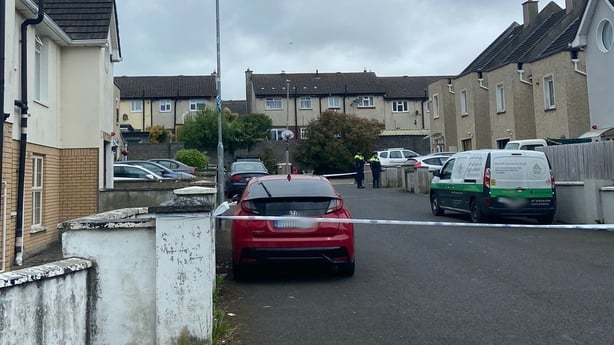
Emergency services were called to scene in the Scribblestown area of Finglas on 9 June 2024
Mr Byrne said lying to gardaí or not telling the truth or the whole truth is not of itself a criminal offence. He said the act must be done with impeding the arrest of the principal offender.
Counsel said the prosecutor told the panel in his closing address that Ms Harcourt knew a lot, some or all of what happened in the house that night. He said this comment was not supported by the evidence in the case.
Mr Byrne said his client had no involvement in the events that led to the death of Mr Carroll.
“Her whole world and that of her children were turned upside down in the blink of an eye…within two hours she is sitting in Blanchardstown Garda Station being questioned of what she had seen and what she had done…is it that a mother of two young children was simply trying to put as much distance between herself and Scribblestown Place?” he asked.
He said there was no evidence that Ms Harcourt had witnessed any physical altercation between the two men.
He also stated that CCTV supported the accused woman’s assertion that she was upstairs for that seven-minute period, as a light had come on in the upstairs bedroom minutes before Mr Carroll was seen running from the house.
Counsel said the prosecution would like the panel to believe that Mr Boyd and Ms Harcourt had a conversation at the front door of Scribblestown Place so that the accused woman was left in no doubt of what had occurred.
Or that when Mr Boyd had returned to the house for a second time, the couple had sat at the kitchen table “and plotted and schemed”, he added.
Mr Byrne told the jury that they knew nothing about Ms Harcourt’s actions and for all they knew the accused woman could have been upstairs with her children until gardaí arrived at the house that night.
The lawyer said Ms Harcourt had opened the door to the Armed Support Unit that night, spoken to gardaí when asked, given her phone to an officer and told another where Mr Boyd might have gone.
“Are these the actions of a person who is hell bent or deliberating trying to frustrate the actions of An Garda Síochána.”
Concerning the voluntary interviews given by Ms Harcourt, counsel said gardaí were “at pains” to convince the jury that the accused woman had voluntarily participated.
“How fortunate we are that we have the video and audio recordings, how different would those statements have been if you hadn’t seen the recording,” counsel said.
Mr Byrne said the panel would have been justified in concluding that the words spoken were those of Ms Harcourt if they had not seen the video recording.
“The vast majority in the statement is not said by Ms Harcourt at all, but rather a record of the question posed by the officer and Ms Harcourt saying yes or no”.
He described his client as a woman of few words.
Mr Byrne submitted gardaí had not told his client that Mr Carroll had died at 2.15am and there was not a shred of evidence she was aware of the gravity or injury to Mr Carroll.
“The nature, extent or the gravity of the injury to Mr Carroll was not communicated to her…had that been done your task would be much more straightforward,” he said.
In summary, Mr Byrne asked the panel to ask themselves whether they could be reasonably satisfied that Ms Harcourt was doing her utmost best to frustrate the actions of gardaí “because if the answer to that question is no, you must acquit”.
Ms Harcourt, of Primrose Grove, Darndale in Dublin 17, has pleaded not guilty on 9 June 2024 at Blanchardstown Garda Station, in circumstances where another person had committed an arrestable offence, namely murder, and knowing or believing that person to be guilty of that offence or of some other arrestable offence, did without reasonable excuse an act with intent to impede the apprehension or prosecution of the said person.
Mr Boyd, with an address at Scribblestown Place, Finglas in Dublin 11, has pleaded not guilty to murdering 34-year-old Mark Carroll at his home on 9 June 2024.
Mr Boyd, 31, has also pleaded not guilty that on the same occasion he assaulted Megan Rock, causing her harm.
The jury of seven men and five women will return to the Central Criminal Court tomorrow to continue considering their three verdicts.