
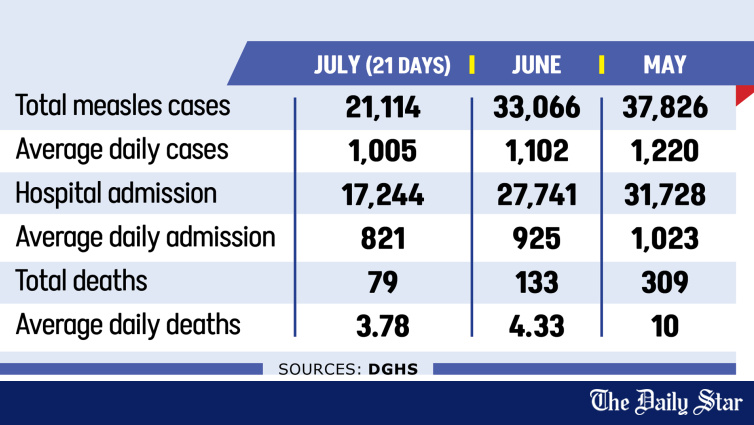
Measles continues to kill nearly four children and hospitalise more than 800 people every day, even as both the government’s response and public attention appear to have waned.
In the 24 hours to 8:00am yesterday, the country recorded 1,218 hospitalisations, the highest since May 21, when 1,279 patients were hospitalised. Four more died with measles-like symptoms yesterday, taking the total death toll to 797, according to the Directorate General of Health Services.
Although the government claims to have exceeded its target in the emergency measles vaccination campaign, hospitals continue to receive large numbers of unvaccinated patients, indicating significant gaps in vaccine coverage.
And in the first three weeks of July, 1,005 suspected and confirmed measles cases were recorded on average in a day along with 821 daily hospital admissions and nearly four deaths, according to the Directorate General of Health Services.
“The situation has improved, but not as much as expected two months after the vaccination campaign — the authorities do not appear to realise that,” said Prof Mahmudur Rahman, chair of the National Verification Committee for Measles and Rubella Elimination.
Health experts attributed the continued outbreak to a gap in vaccination coverage affecting around 40 lakh children, infections among children outside the campaign’s target age group, and inadequate infection prevention and control measures.
This correspondent spoke to the attendants of seven measles patients — three at the DNCC Dedicated Covid-19 Hospital and four at Infectious Diseases Hospital (IDH) Sunday and found that six of the seven children had not been vaccinated against measles.
As much as 80 to 90 percent of the measles patients now being admitted are unvaccinated, said Asif Haider, administrative officer of the DNCC hospital, which has been providing exclusive measles care since mid-March.
He said 74 measles patients were admitted to the hospital in the 24 hours ending at 8:00am on Sunday. Of them, only five had been vaccinated. Among five, three were more than five years old, meaning only two got the jabs during the emergency vaccination drive.
One such patient is the nine-month-old Farhan Haque of Araihazar upazila in Narayanganj, who was brought to the DNCC Hospital on Friday with fever and symptoms of measles.
“He missed the vaccine — I was in Dhaka, and my wife was not aware of the vaccination campaign,” said his father Shamsul Haque, who works as a goods supplier for a private company.
It was the same story over at the Infectious Diseases Hospital (IDH) in Mohakhali, where 31 measles patients were undergoing treatment as of Sunday.
As much as 98 percent of the measles patients admitted recently were unvaccinated, said a nurse at the hospital, who spoke on the condition of anonymity as she is not authorised to speak with the media.
“I haven’t seen any recently admitted patient who was vaccinated,” she said.
Many of the admitted children are either younger than six months or had been under six months when the emergency vaccination campaign was conducted, leaving them ineligible for vaccination, said FA Asma Khan, superintendent of the 100-bed hospital.
Amid an unprecedented measles outbreak, the government launched an emergency measles-rubella vaccination campaign in phases on April 5 targeting 1.80 crore children aged six to 59 months nationwide.
By May 20, the initial deadline for the drive, the campaign had vaccinated 1.84 crore children. The health ministry later extended the drive, saying some children had been left out, although the reported coverage remained unchanged.
In contrast, 2.23 crore children in the same age group received Vitamin A capsules during the nationwide campaign on June 28, exposing a 38.83 lakh coverage gap.
Experts said it takes three to four weeks for immunity to develop after vaccination, and data show infections and deaths began declining from June. However, the drop, particularly in infections and hospital admissions, has not been substantial.
Around 24 percent of reported measles cases are among infants younger than six months, who are too young to be vaccinated, said Prof Mahmudur.
Another significant share of infections is occurring among children older than five years, who were also outside the target age group of the recent vaccination campaign.
These two groups will continue to sustain transmission unless targeted interventions are introduced, he said.
He also pointed to the 40-lakh gap between the measles-rubella and Vitamin A campaigns, saying it suggests a large number of susceptible children remain unvaccinated.
Calling the 40-lakh gap “astonishing”, Prof Be-Nazir Ahmed, a health expert and former director of disease control at the DGHS, said it suggested the vaccination target had been set too low.
“If the target itself was inaccurate, this outcome was inevitable.”
The measles campaign suffered from inadequate preparation and publicity, leaving many families unaware of the revised vaccination schedule, he said.
The first dose of the measles vaccine is usually given at nine months, but the emergency campaign covered children from six months of age. It also extended the upper age limit for vaccination to 59 months, from 15 months.
“Families needed to know these changes. If they did not know a child was eligible at six months, they would naturally wait until nine months,” he added.
One such parent is Rabeya Akhter, whose 10-month-old son Hossain Ibn Al Khameni has been receiving treatment at the IDH Hospital for 10 days now.
She said she knew her son was supposed to receive the routine measles vaccine at nine months but was unaware that children aged six months were eligible under the emergency vaccination campaign.
Prof Mahmudur said the authorities need to strengthen public health and social measures, like home isolation, for infants younger than six months.
He also suggested targeted supplementary immunisation activities in areas reporting the highest number of cases and expanding vaccination beyond the current target age group to include older at-risk children.
The government should convene experts to assess the “unusual situation” and decide on additional measures.
“But such consultations were not taking place,” he added.
The government is continuing its measles vaccination efforts as many children continue to be infected with the disease, said Health Minister Sardar Md Sakhawat Husain.
Asked about the 40-lakh gap, he said the measles vaccination target was underestimated — and was wrong.
Besides, he said there is now a group of people who do not want to vaccinate their children while some parents are afraid of the vaccine. Many poor families cannot find the time to bring their children for vaccination, he siad adding, “We are now identifying those children and trying to vaccinate them.”