

My route to screen eight felt a little ‘nine and three quarters’, if you catch my drift. I’d lost count of the turns, the split levels. Left right, up down, left right. Not unlike a cheat code on an old console – appropriate given the film I’d come to see. Inner-city Odeons have an odd, placeless quality about them. Deep-plan buildings, windowless, warren-like, their cranked corridors working against worldly orientation. You might call them liminal.
‘Liminal’ is one of those teabag words – steeped in the discourse, connoting more than it defines. The liminal may be anomalous, exotic or just plain dull; referencing uncanny, six-fingered spaces devoid of ascertainable meaning or function. But you don’t need to have read Marc Augé, or care who he is, to appreciate liminality. Anybody who’s felt a little lost in a building, an airport or an Ikea is au courant with spatial ambiguity.
For the jobbing architect, liminal space is essentially residual space: what’s left over when you’ve put your design fee into everything else. Circulation and back of house do not commonly benefit from design thinking, after all, being often calculated as a percentage of GIA – their dimensions the minimum necessary to allow for storage and unobstructed access. You are not, properly speaking, supposed to enjoy liminal space. But that hasn’t put people off. In recent years the liminal has become an aesthetic category of its own, a kind of late capitalist sublime. An acquired taste, like other forms of hard-won aesthetic awareness: a fondness for scaffolding, say, or the works of Messiaen. Which explains the appeal of Backrooms.
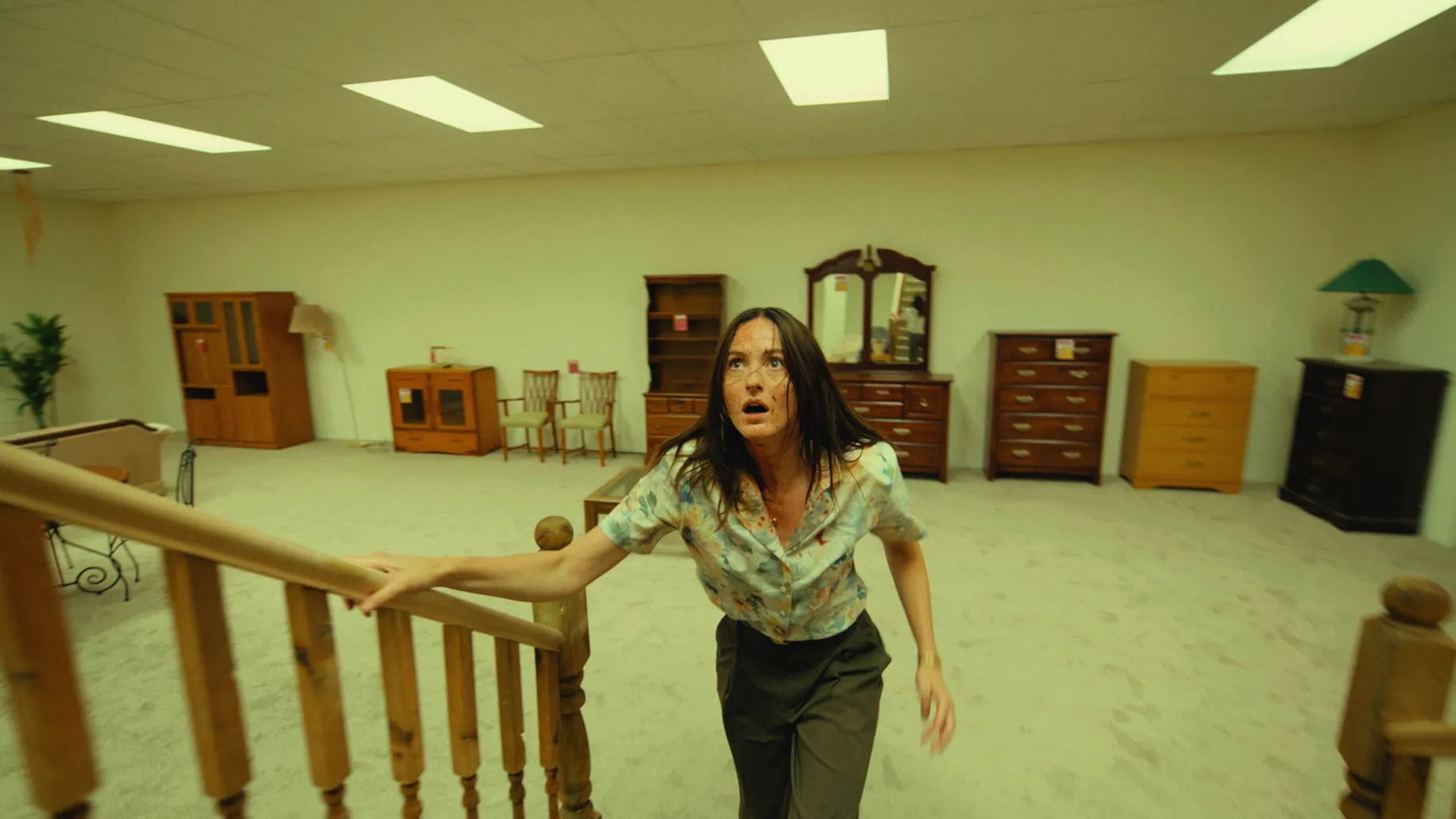
Renate Reinsve plays Clark’s therapist, who visits the backrooms herself
Source: Courtesy of A24
The film has its origins as a cult YouTube series, developed by then teenage director Kane Parsons from his experiments in graphics software Blender. It is derived from an online trend in sharing images of so-called liminal spaces, which Parsons adapted into short video essays in architectural suspense.
For those even vicariously acquainted with psychiatric ‘episodes’, a psychiatric full length feature film might seem a little extra. But that’s just what it is. Backrooms is the imaginary record of a disappointed architect’s mental breakdown – disappointed because he has to make a living selling furniture, all the more degrading for its adjacency to architecture proper. The image of an out-of-work architect, forced to hustle to make ends meet, will play to the anxieties of the AI-conscious and the creeping redundancy they anticipate. If doomsayers are correct, liminality beckons.
On first entering the backrooms, our protagonist seems engaged in a surreal snagging exercise. Everything appears unfinished, out of whack. Built by a contractor with a sense of humour perhaps, or a grudge. His progress is eerily in step with his surroundings, which develop by degrees of sophistication, like the successive efforts of somebody getting to grips with 3D modelling software.
In a troubling analogy of online presence, the more time he spends in the backrooms, the more he recognises himself in his environment and the more difficult he finds it to leave. He becomes trapped in an architectural equivalent of doom-scrolling. The definition of insanity as doing the same thing over and over and expecting a different result*, came not from Einstein but Alcoholics Anonymous – the other, other AA. It is pertinent not only to the film’s psychiatric themes, but the way it has been made. There is a kind of art that involves doing essentially the same thing repeatedly, obsessively, and getting something slightly new each time. It requires a monomaniacal level of commitment, which Parsons has in spades.
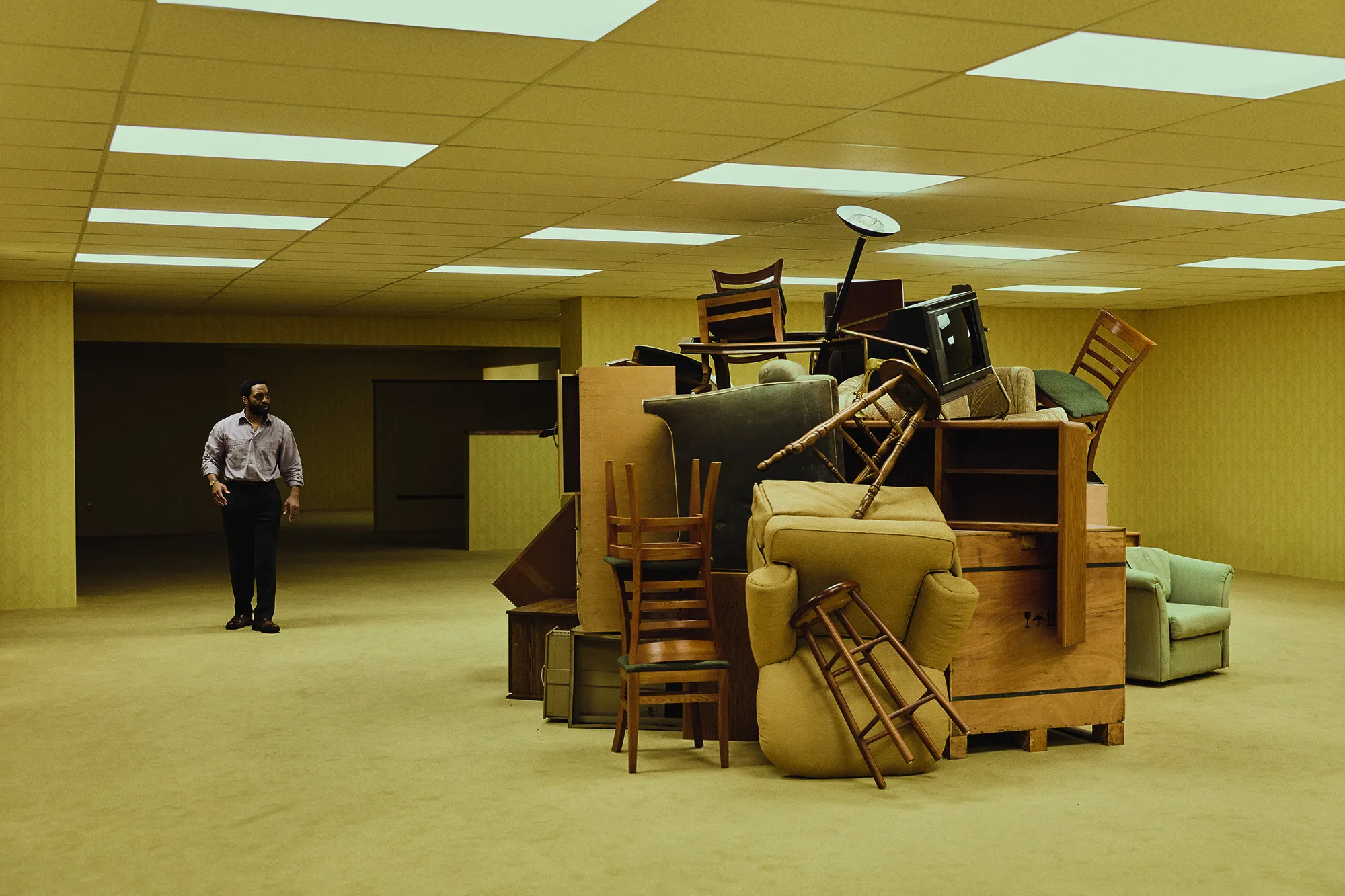
Furniture stacked up in one of the backroom areas
Source: Asterios Moutsokapas
Architects like references. They help anchor our assessments. Works are judged by their accommodation to type. Backrooms invites numerous associations. But you won’t find any explicit nods to precedent, except to video games you’ve likely never heard of, let alone played. The disavowal of influence is ordinarily a red flag but oddly refreshing in somebody so young.
Much has been said already about the director’s youth and precocity. How has a teenager been allowed the funds to front their own feature film? How can the result have been so commercially successful – the largest opening weekend for an A24 film? But to hear Parsons in interviews is to get a sense of his plausibility. He is mature, measured, articulate. Architects would do well to pay attention to what he’s up to.
As we lower ourselves into the warm bath of AI, his insistence in making physical sets, and taking time to produce things, makes him eligible at least for an RIBA honorary fellowship, if not a Blue Peter badge.
Matthew Bovingdon-Downe is a designer based in London