

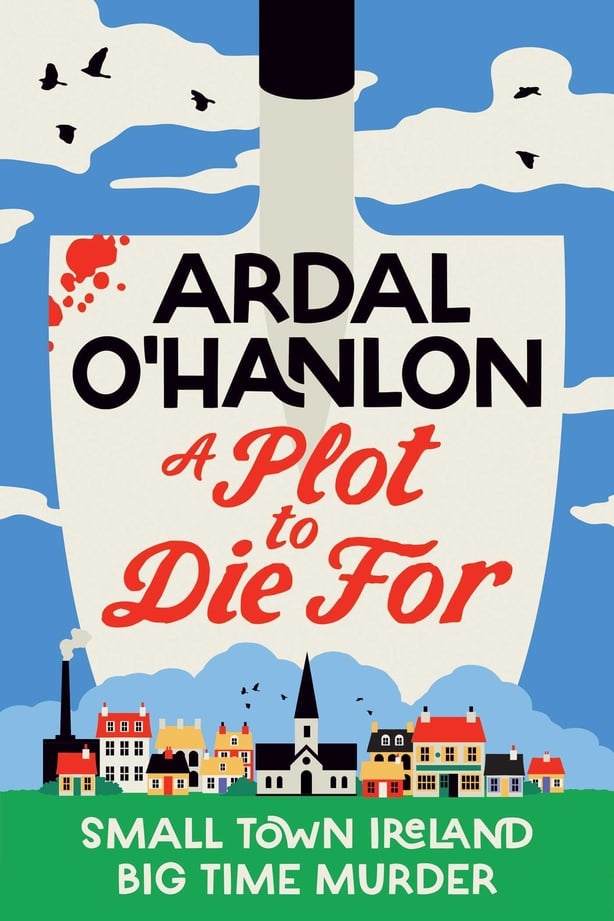
We present an extract from A Plot To Die For, the new murder-mystery from actor, comedian and author Ardal O’Hanlon.
When beloved celebrity gardener Finn O’Leary returns to his hometown of Abbeyford in Ireland to care for his aging mother, he is naturally roped into the Tidy Towns committee.
For his best friend’s sister, Aoife, it’s a competition she’s determined to win. With everyone’s favourite gardener on board, she is sure that this year Abbeyford will take home the prize.
But Finn’s not been back long when an alto-baritone at his mother’s choir practice drops dead during a rendition of ‘What the World Needs Now’.
With his mother, her Nigerian carer and Aoife in tow, Finn sets out to discover just who has brought murder to Abbeyford.
Finn and his mother’s new carer, Happiness, eyed each other warily through the rear- view mirror. It was probably fair to say she hadn’t warmed to him since he’d arrived home. She was, he decided, feeling territorial. She also, he gathered, had strong views about children’s obligations to their parents. Although a modest man by nature, in his own estimation, he had confidence in his ability to charm the stoniest of souls. He’d win her around. Eventually.
Happiness, lips pursed and leaning forward over the steering wheel, drove the short distance from the house to the community centre. More used to an automatic, Finn deduced, she drove the whole way in first gear. The groaning Yaris pleaded wth Finn to do something. Finn, at six foot two, was a little cramped in the back seat and too afraid of distracting Happiness to say anything. His mother, Maura, sitting contentedly in the passenger seat, asked for the tenth time, ‘Where are we going again?’
‘We are going to sing, Maura.’
‘Of course!’ Maura laughed. ‘I’ll forget my own head next. We’re going to choir practice, Finn,’ she explained, turning around to her son, as if he was the one who’d fallen while walking in the Comeragh Mountains.
Despite her accident and the resulting brain bleed that had left her bed-bound and delirious for the best part of five months, she looked younger than her seventy- two years. Having been a teetotaller all her life probably helped. Mind you, that description no longer applied, as he’d discovered the night he’d landed, a week ago, when Happiness had brought her a vermouth spritz. It was garnished with a twist of orange peel and a sprig of rosemary from the next- door neighbour’s garden. He could tell the rosemary was from Burke’s because of the noodle of golden retriever hair caught in the needles. The pair of them settled down to watch an episode of Death in Paradise. Somebody had fallen off a balcony. Were they pushed? Or did they jump? Finn had to smile when his mother insisted, as she always used to do when they watched detective shows when he was a boy, that they all write down who they thought the murderer was. Finn, much to Happiness’ disgust, guessed correctly.
‘We got the recipe on Alan thingy. Titmouse.’
It took a few moments for Finn to realize his mother was referring to the vermouth.
‘Titchmarsh,’ Finn said, the name of a bitter rival setting his teeth on edge.
‘He’s very good. Not quite as good as you, love. But he’s very funny.’
There was a lot to unpack in that speech. Enough to keep a therapist in work for years. Finn wasn’t quite sure if it was supposed to be a compliment or not.
‘I prefer Titchmarsh,’ Happiness declared firmly. He was absolutely sure that was not a compliment.
Not only had Maura been clean- living, she’d also been a keen hiker. That surely helped her rehab too. He’d never forget the call from his sister the previous autumn telling him to come home immediately. He’d been on location near Hebden in North Yorkshire trying to extricate a house from its cage of invasive bamboo when Eimear called. Maura wasn’t expected to live more than a few days after she’d slipped near the Mahon Falls while out walking with a retirement group. The thing that probably saved her in the end, more than the abstemiousness and the penchant for outdoor activity, was the complete absence of stress in her life. Her refusal to even countenance stress. Bearing in mind she’d been a district health nurse who’d seen it all, every stress and strain known to man, every pain and privation. Every type of death, natural and unnatural. And to top it all, she’d married possibly the most stubborn, wilful man that had ever walked the earth.
His father, Redmond, was what was known as a force of nature, whimsical and unpredictable and oblivious to the havoc he tended to leave in his wake. Apart from that, he was great. His intentions were good. It was only later in life, on reflection, long after he’d escaped to England, that Finn could in any way appreciate his father’s idiosyncratic point of view. At the same time, he took great satisfaction in his own refusal, even as a child, to bend to Redmond’s will. If he achieved nothing else in life that would be something.
Despite having to put up with this selfish man and his infuriating ways, Maura was determinedly stress- free and relatively free of cynicism too. She’d never, as far as Finn could remember, lost her temper and never raised her voice. Commuting from London, he visited her in the hospital as often as he could, particularly in the first few weeks after the accident. Then he held her hand and told her what a wonderful mother she was. What a wonderful woman she was. And he meant it. He wasn’t sure if Maura even recognized him. She spoke mostly gibberish in two languages, English and Irish. In her delirium, she often referred to the children she’d lost to pirates and the terrible things that had happened in the mother- and- baby home, but those events didn’t seem to correspond in any way to her own biography. And then, much to Eimear’s disgust, he had to go back to London to finish the latest series of Garden Nightmares. Did he absolutely have to go back? That was the question that tore away at his conscience. Well, he was contractually obliged to return to work for one. There was a team waiting for him. A production company. A demanding network. Not to mention millions of viewers and the forlorn householders whose runaway gardens were derailing their lives. But what about his obligation to his parents? To his father? Was he being entirely honest about his altruistic motives in returning home to help care for his ailing mother? Or was he just running away from Isabella? From responsibility?
A Plot To Die For is published by Simon & Schuster