
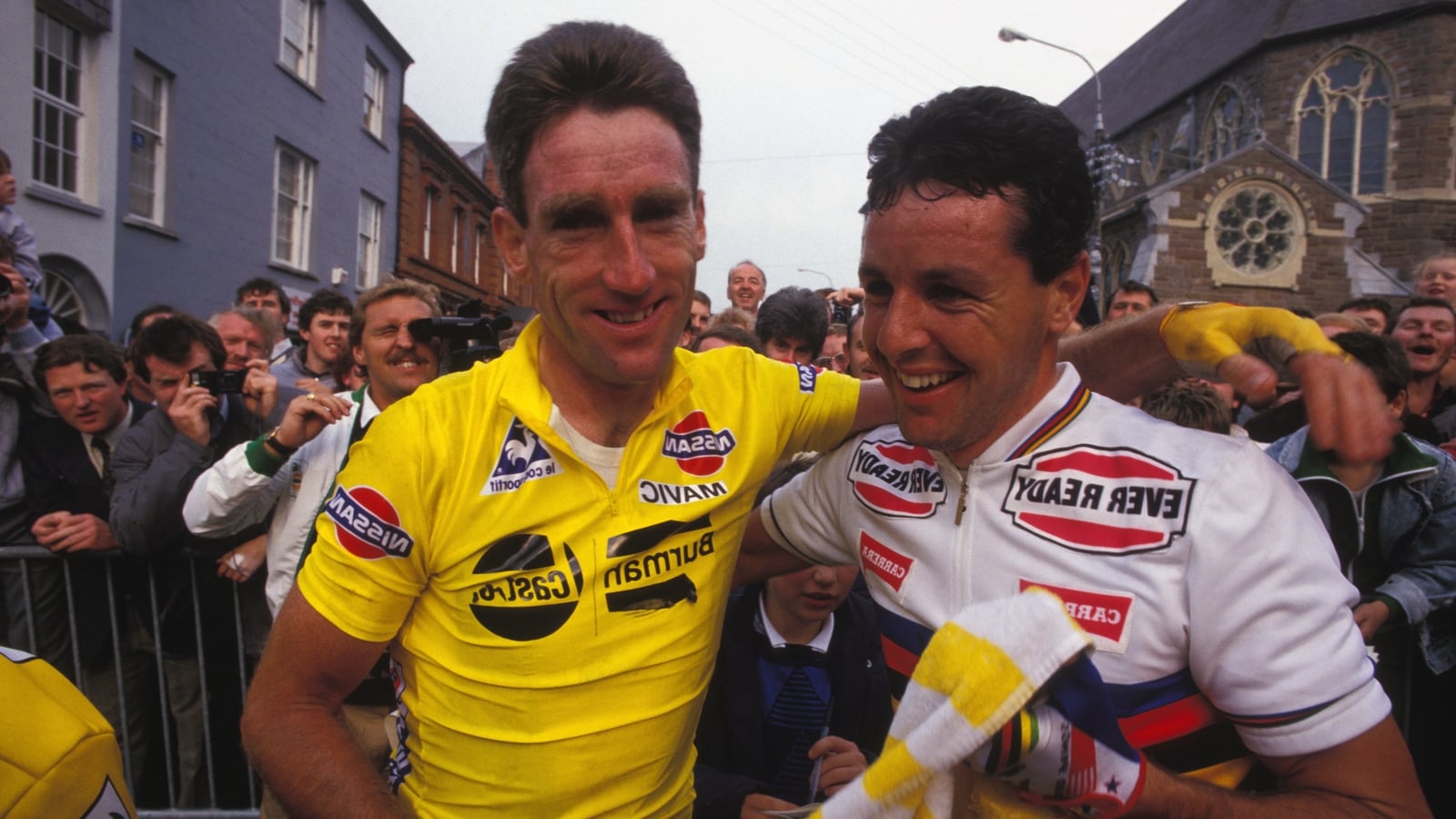
Analysis: The Tour de France has featured many prominent Irish cyclists over the years who have claimed the yellow jersey along the way
As this year’s Tour de France reaches its final stages, it is a good time to look at some of the Irish cyclists who have competed in this mythic cycle race. From its modest beginning in 1903 with just 60 cyclists, the Tour de France has caught the imagination of cycling fans and the general public around the globe to become one of the world’s best known road cycling races.
Shay Elliott
Seamus ( Shay) Elliott was the first Irish cyclist to take part in the Tour de France and the first to win an individual stage. It was 70 years ago in 1956 that he competed in the race for the first time. He won his first stage in 1963. It was that year’s third stage and it took him from Jambes in Belgium to Roubaix in the north of France. As he was the leader of the general classification (that is the rider with the overall best time), he gained a coveted yellow jersey.
Footage of Shay Elliott’s 1963 stage win in the Tour de France
He competed in four Tours and is remembered to this day with a one-day race named in his honour that is run in Co. Wicklow. Organised by Bray Wheelers Cycling Club, of which Elliott was once a member, the Shay Elliott Memorial race is one of Ireland’s leading amateur races. When the Tour was staged partly in Ireland in 1998, a wreath was laid at his grave by the Tour organisation, a nice gesture to honour Ireland’s first Tour competitor.
Sean Kelly
Tipperaryman Sean Kelly was the next Irishman to wear the yellow jersey. He became a professional cyclist in 1977 and took part in his first Tour a year later. In a highly auspicious start, he won the sixth stage of the race that year, covering the 162 km distance from Mazé–Montgeoffroy to Poitiers in a little over four hours. He would go on to compete in another 13 Tours and win another four stages in 1980, 1981 and 1982.
We need your consent to load this rte-player contentWe use rte-player to manage extra content that can set cookies on your device and collect data about your activity. Please review their details and accept them to load the content.Manage Preferences
From RTÉ Archives, Cathy Halloran reports for RTÉ News in 1994 on Sean Kelly’s retirement as a pro cyclist with a last race in Carrick-On-Suir
Kelly won the Tour’s green jersey four times in 1982, 1983, 1985 and 1989. It is awarded to the best sprinter and is based on a points classification. According to Procyclingstats.com, Sean Kelly stands at number one in Ireland’s list of ‘Best riders in alltime ranking’. The 1998 Tour passed through his hometown of Carrick-on-Suir as Stage 2 ran from Enniscorthy to Cork.
Stephen Roche
Stephen Roche made his Tour debut in 1982 and made history in 1987 by being the first Irishman to win the Tour. He also won the Giro d’Italia that year, as well as the UCI Road World Championships Elite Men’s Road Race. Those three wins earned the so-called Triple Crown of Cycling, an unofficial accolade given to the rider that wins three major cycling titles in the same season.
From RTÉ Archives, Vere Wynn-Jones reports for RTÉ News on Stephen Roche’s homecoming in Dublin after his Tour de France triumph in 1987
The final stage of the 1987 Tour was run on the cobble-stoned Avenue des Champs-Élysées in Paris with the riders cycling six laps of the famous avenue. At the finish line, Roche was flanked by the French prime minister Jacques Chirac and Taoiseach Charles Haughey as he put on his yellow jersey. Roche competed in 10 Tours altogether.
Martin Earley
Martin Earley was the next Irish winner of a Tour stage. Prior to taking part in his first Tour, Earley had won a stage in the Rás Tailteann in 1982, Ireland’s foremost international cycling stage race. He turned professional in 1985 and joined the French team Fagor.
Earley won a stage of the 1986 Giro d’Italia and when he won stage 8 of the 1989 Tour de France, he was a member of the Dutch team PDM (the same team as Sean Kelly). He came in four minutes ahead of his closest competitor with a time of 3 hours 51 minutes and 26 seconds on the 157 km stretch from Labastide-d’Armagnac to Pau. He finished 44th overall in that year’s Tour. He competed in eight Tours altogether and completed five of them.
We need your consent to load this rte-player contentWe use rte-player to manage extra content that can set cookies on your device and collect data about your activity. Please review their details and accept them to load the content.Manage Preferences
From RTÉ Archives, coverage of Martin Earley’s Tour de France stage win in 1989
Lara Gillespie
The Tour de France Femmes is a relatively new fixture on the cycling calendar. While women’s races were held infrequently in France under various names between 1955 and 2009, it was only in 2022 that the first Tour de France Femmes was staged. Organised by the same co-ordinators as the men’s race, three Irishwomen – Lara Gillespie, Mia Griffin and Fiona Mangan – took part in the nine-stage race in 2025.
Gillespie made history by being the first Irishwoman to stand on the podium when she came in third place in Stage 4 of the race. Another cycling milestone was passed when she became the first Irishwoman to compete in all three major stage races, that is the Tour, the Giro d’Italia and the Vuelta a España. She will not compete in this year’s Tour.
We need your consent to load this rte-player contentWe use rte-player to manage extra content that can set cookies on your device and collect data about your activity. Please review their details and accept them to load the content.Manage Preferences
From RTÉ Radio 1’s Inside Sport, World Championship Gold Medalist Lara Gillespie
The Tour de France has sometimes been marred with allegations of cheating and drug taking. However, the race that more-or-less started off as a publicity stunt by the French newspaper L’Auto to beat its rival Le Vélo in 1903, has survived all of these controversies. It is a gruelling test of endurance and can be summed up in the adage from the five-times winner of the race, Belgium’s Eddy Merckx, that “races are won by those who can suffer the most”.
Follow RTÉ Brainstorm on WhatsApp and Instagram for more stories and updates
The views expressed here are those of the author and do not represent or reflect the views of RTÉ