
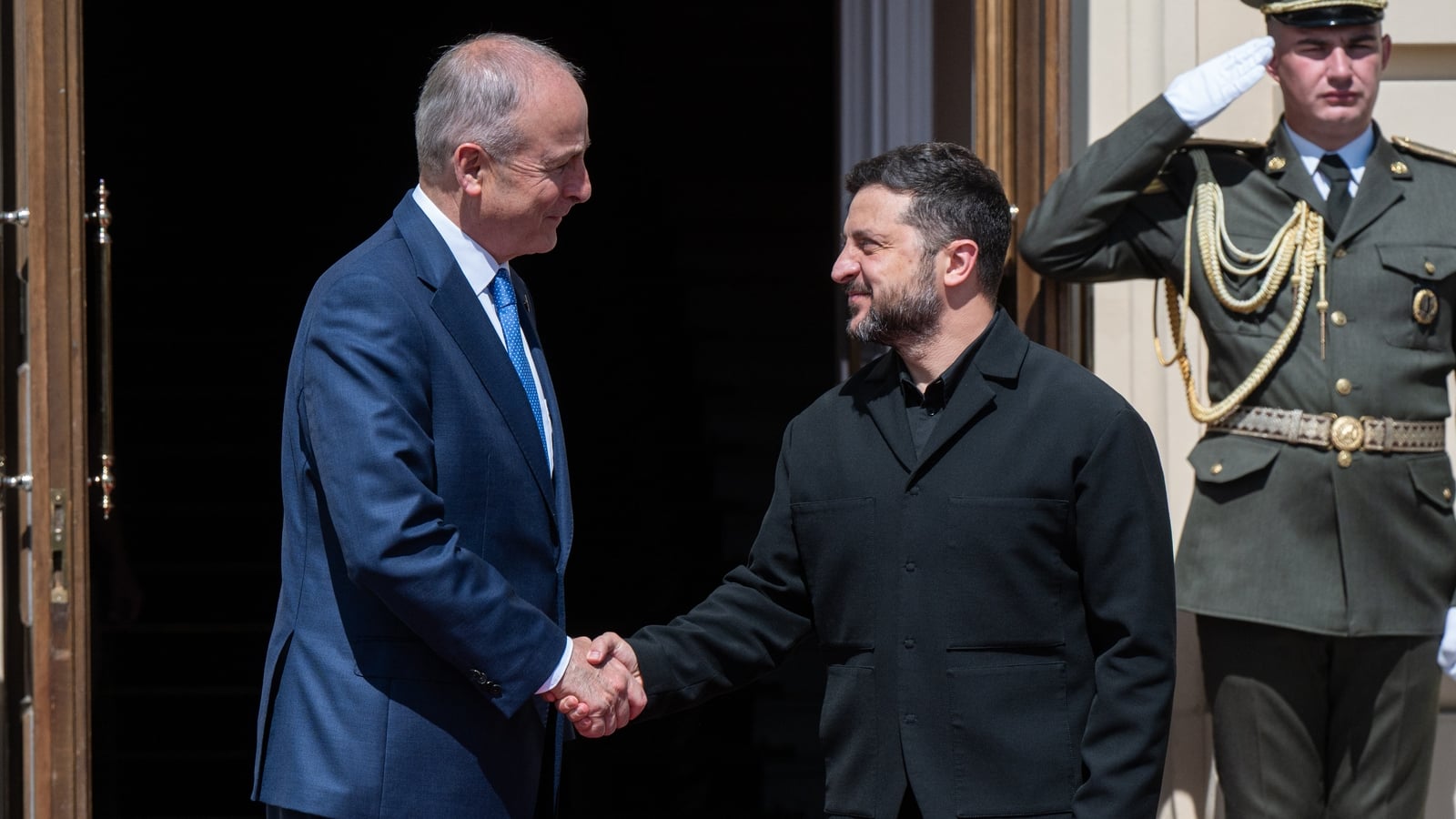
At 26B Dehtiarivska Street in Kyiv stands a block of flats that looks like it was destroyed a few years ago.
The building in the western Shevchenkivskyi district is charred and missing most of its external walls.
Yet people lived in the building only two months ago before a Russian ballistic missile struck the surrounding area on 24 May.
The missile singed all nearby structures, started fires and gutted nearby buildings along a stretch of Dehtiarivska Street.
Another Russian missile hit the surrounding area last Sunday night, 19 July, killing one person and injuring 17 near the local Lukianivska metro station. That same night, more than 40 Russian missiles hit five districts in Kyiv within one hour.
On Thursday afternoon, during his official visit to Kyiv, Taoiseach Micheál Martin stood in the searing heat outside 26B Dehtiarivska Street.
There, he listened to humanitarian workers from UNHCR who had provided emergency shelter to residents in the area, some of which is funded by the Irish Government.
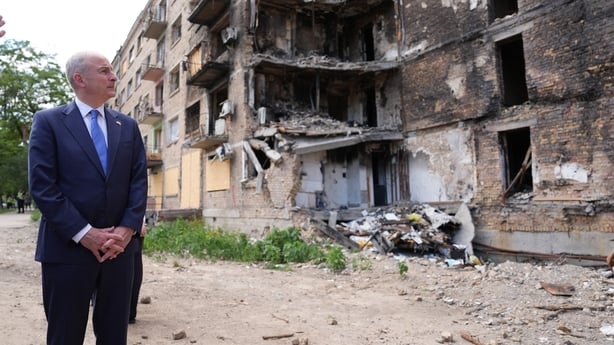
Mr Martin during a visit to the bomb damaged Lukianivska district of Kyiv, Ukraine
Oleh Kutz, a local man, perhaps in his 60s, recalled the events of last Sunday night for the Taoiseach, who listened carefully to the man’s words through a translator.
“The neighbouring house was attacked by a missile and part of it was damaged, and the shrapnel affected our house,” said Mr Kutz.
“When I came here to look at my apartment in this house, I was in despair,” Mr Kutz told the Taoiseach before thanking a group of UNHCR staff for their help.
“We are so appreciative because it truly matters to us.”
Another local resident, Liudmyla Vladnya, told the Taoiseach that at 2am that night she heard two loud explosions.
“Windows were blown out, balconies fell away, we hid in the restrooms,” she said.
“My pressure skyrocketed, my heart responded like crazy.”
It was a short encounter, but it seemed to make an impression on the Taoiseach.
Standing there in front of the destroyed block of flats, Mr Martin appealed to Russian President Vladimir Putin to stop the war.
“Let’s have a ceasefire and let’s have it now,” he said.
“People should not have to suffer like this.”
It was the right moment and the right place to make the appeal, though Russia’s leader continues to ignore calls from all quarters to stop the killing and his invasion.
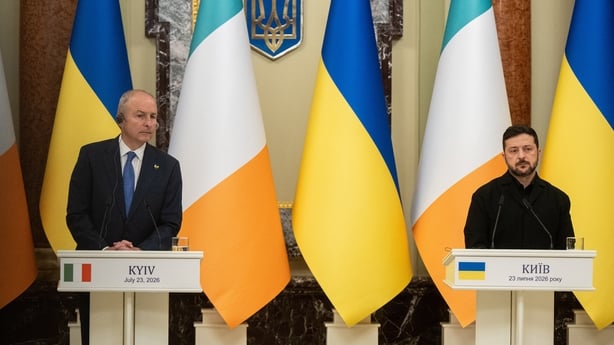
Taoiseach Micheál Martin and President Volodymyr Zelensky hold a press conference in Kyiv
Thursday’s visit by Mr Martin to Kyiv was his third since the start of the full-scale invasion.
His two previous trips took place in July 2022, when he was also Taoiseach, and, in October 2023 as Tánaiste, when he attended a special EU foreign ministers meeting in the Ukrainian capital.
This time, Mr Martin arrived as the head of a government that holds the EU presidency, and one that supports Ukraine’s ambitions to join the bloc.
“The defining theme of Ireland’s presidency of the European Union,” said Mr Martin in the ornate surroundings of Kyiv’s Mariinsky Palace, is, ‘Ní neart go cur le chéile’, strength with unity”.
Supporting Ukraine and its candidacy, he said, is a central focus of Ireland’s presidency.
Ireland hopes that Ukraine will move forward with opening the remaining four of its six clusters – negotiation areas – during its EU presidency so that Kyiv can advance its accession process.
That push to help Ukraine reach those accession milestones so quickly seemed to pique the interest of the Ukrainian journalists. Could it really be possible by the end of the year, they asked?
As was anticipated, there was a funding announcement too.
Ireland, said Mr Martin, will contribute a further €125 million in aid to Ukraine this year.
Some €100m of that funding will be directed towards non-lethal military aid. The other €25m will support the protection and restoration of Ukraine’s critical energy infrastructure.
There was also genuine warmth on display between the two leaders.
Mr Martin and Mr Zelensky hugged when they met on Thursday morning, before laying wreaths at the Wall of Remembrance of the Fallen for Ukraine, a long wall close to St Sophia’s Cathedral showing images of thousands of Ukrainian soldiers who have been killed in action since 2014.
How to handle exports of alumina by Aughinish Alumina to Russia remains a sensitive topic between the two governments, but both leaders seemed determined to work together on the issue and not let it damage Ireland-Ukraine relations.
Still, Mr Zelensky made it clear that he wants the supply of alumina to Russia to be limited and that national governments, meaning Ireland in this case, could play a role in delivering this kind of action.
It is an approach that Ukraine could pursue if the European Commission does not propose including alumina in the next round of sanctions on Russian entities.
Mr Martin’s trip took place after two weeks of political upheaval for Mr Zelensky who had appointed a new prime minister, overseen a cabinet reshuffle and faced growing protests this week over his decision to replace Mykhailo Federov, a 35-year-old defence minister.
To appease the protestors, Mr Zelensky also dismissed the commander-in-chief of the armed forces General Oleksandr Syrskyi on Tuesday with the aim of drawing a line under the spat between the army and the ministry.
Despite all of those domestic changes swirling around, Mr Zelensky welcomed the Taoiseach as the leader of a country that is viewed as a friend of Ukraine and an important supporter of its EU hopes.
The visit was yet another assurance for Ukrainians that their country’s long-term future lies in Europe.
Read more:
‘No adverse’ Aughinish findings, but lack of Russian data