
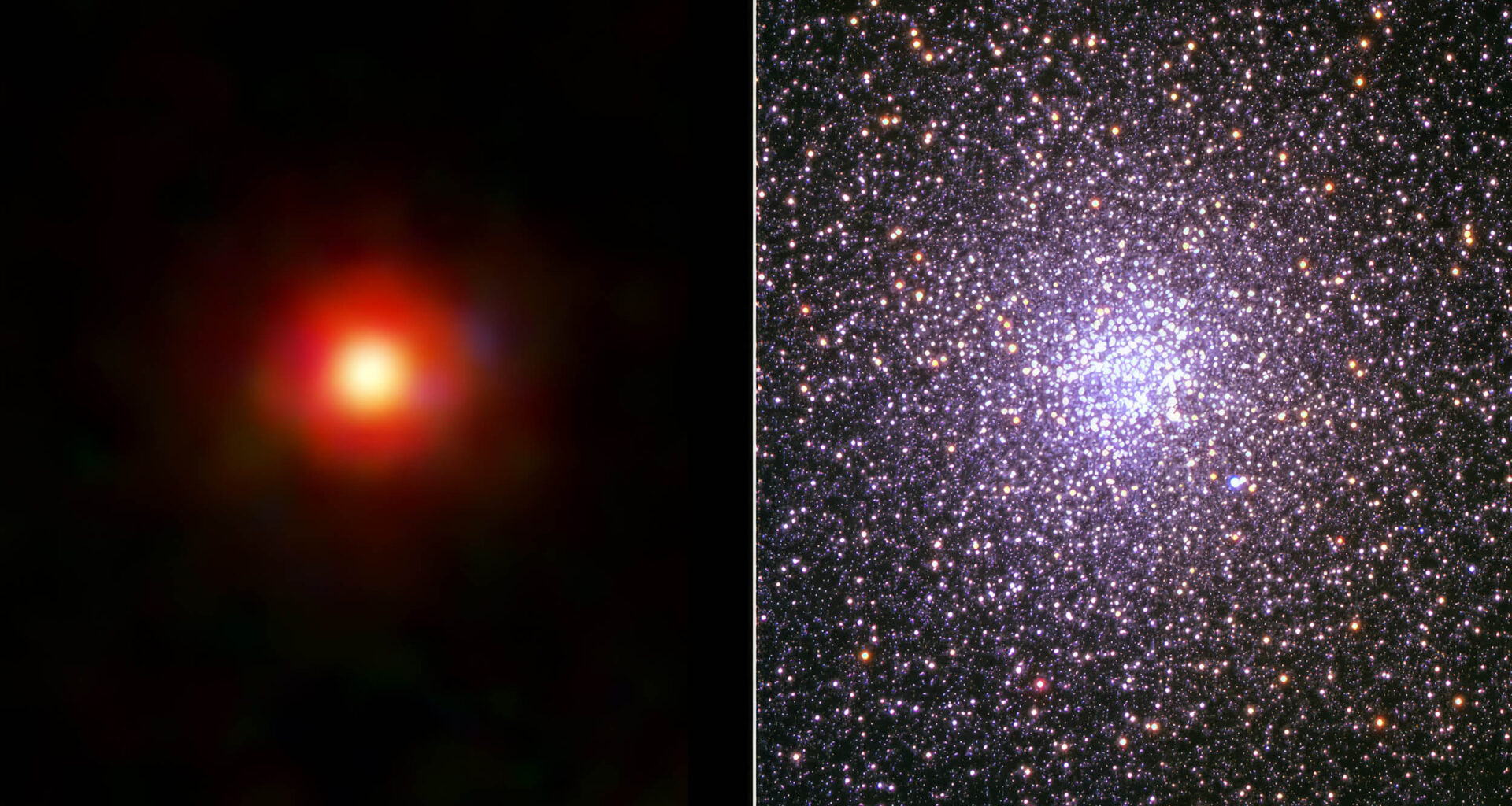
Little Red Dots have puzzled astronomers since the James Webb Space Telescope spotted them in the early universe.
At the same time, scientists have spent decades trying to explain how some of the oldest and most tightly packed groups of stars first formed.

A new study suggests those two mysteries may actually have the same answer.
The idea is surprisingly simple. Instead of being unrelated objects, the mysterious Little Red Dots may be the earliest stage in the life of globular clusters.
If the theory is correct, scientists may finally have a better explanation for where these ancient star clusters came from and why they look the way they do today.
A mystery that appeared with Webb
Little Red Dots were first detected by the James Webb Space Telescope in 2022. They showed up about 600 million years after the Big Bang and seemed to disappear roughly 1.5 billion years later.
They are small, extremely bright, and give off an unusual mix of red and ultraviolet light. Astronomers have debated what these objects really are.
One leading idea suggests they contain supermassive black holes hidden inside thick clouds of gas, where nearby young stars are pulled toward destruction.
That explanation matches many of the observations, but it is not the only possibility.
Dense collections of ancient stars
The new study, led by researchers at The University of Texas at Austin, argues that a young globular cluster with a supermassive star at its center could produce nearly the same appearance as a Little Red Dot.
“These may not be just a strange new JWST population with no connection to the universe around us today,” said John Chisholm, an astronomer at UT Austin and lead author on the study.
“Instead, Little Red Dots may persist past the early universe, evolving into something relatively familiar.”
Globular clusters are dense collections of ancient stars that orbit galaxies. The Milky Way contains around 150 of them.
Each cluster can hold hundreds of thousands or even millions of stars, making them some of the most crowded stellar neighborhoods in the universe.
Star clusters with mysterious origins
Scientists have studied globular clusters for more than a century, yet their beginnings remain uncertain.
One reason is that they are already billions of years old by the time astronomers observe them in detail.
“We usually see them after billions of years of evolution, at a time when their massive stars are gone, their gas has been cleared out, and dynamical processes have changed their masses and structures,” explained Danielle Berg, an astronomer at UT Austin and co-author on the study.
“That makes it very hard to reconstruct the original conditions they formed in.”
The stars inside each globular cluster generally formed during the same burst of star formation early in cosmic history.
Even so, many clusters contain unusual chemical signatures that have been difficult to explain for decades.
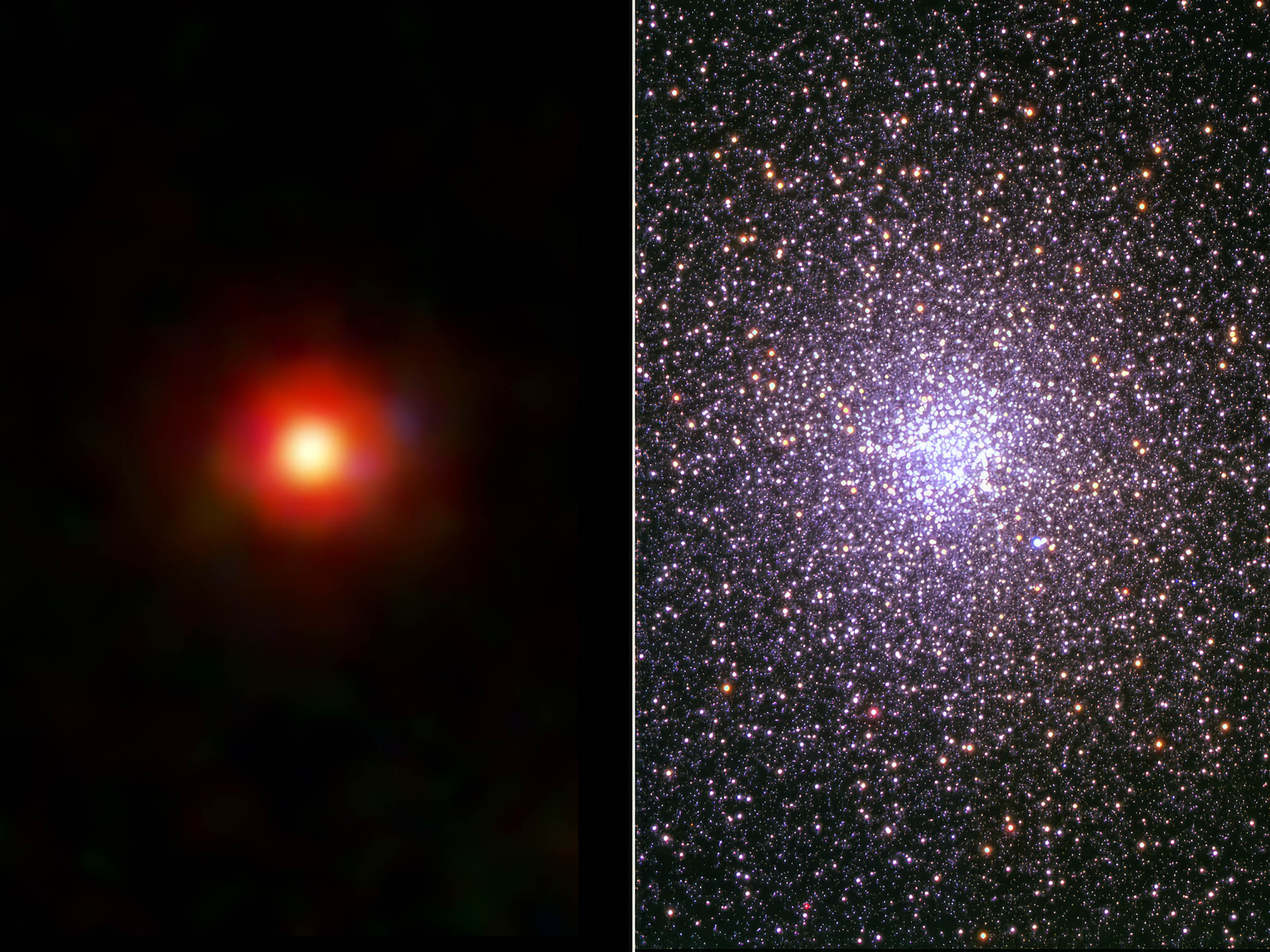 A Little Red Dot (left) and globular cluster 47 Tucanae (right). A new paper by UT Austin astronomers suggests that the two may not be distinct objects, but that instead Little Red Dots are globular clusters caught in the process of forming. Credit: NASA, ESA, CSA, STScI, Dale Kocevski/Colby College, ESO. Click image to enlarge.Clues hidden in the chemistry
Many globular clusters contain unusually high amounts of helium, nitrogen, sodium, and aluminum while showing lower amounts of carbon, oxygen, and magnesium.
“This specific pattern indicates nuclear fusion at very high temperatures, much higher than in the cores of even massive normal stars,” said UT Austin’s Mike Boylan-Kolchin, a co-author on the study.
“A supermassive star is precisely the kind of environment that could produce this combination.”
According to the researchers, such a star could have formed after repeated collisions between stars in a young globular cluster.
Over time, those mergers could build a single giant star reaching hundreds of thousands of times the mass of the Sun.
A short life with lasting effects
Although that enormous star would survive for only a short time, it could dramatically change the future of the cluster.
“When they die, they would blow that material back out, seeding the next generation of stars with the chemical fingerprints we still see in globular clusters today,” explained Berg.
“In our model, the supermassive star that helps make the object look like a Little Red Dot would live for only a short time,” added Chisholm.
“Once that star dies, the object may no longer look like a Little Red Dot, even if the cluster itself survives billions of years.”
That could explain why Little Red Dots appear early in the universe and then seem to disappear.
The clusters themselves may still exist today, but they would no longer have the bright appearance that first caught astronomers’ attention.
Signs that point in the same direction
The researchers say the chemistry is only one piece of the puzzle. The number and distribution of Little Red Dots in the early universe closely match the distribution of globular clusters seen today.
Computer models also suggest that the masses of Little Red Dots could naturally evolve into the masses of present-day globular clusters.
Their timing also lines up. Little Red Dots appear during the same period when astronomers believe the oldest globular clusters began to form.
“There’s no single smoking gun at this point that says Little Red Dots are globular clusters, but it would explain a lot of diverse and surprising observations,” said Boylan-Kolchin.
“Little Red Dots could be galaxies, they could involve black holes, or they could be something even more unexpected,” continued Chisholm.
“Our work shows that forming globular clusters with supermassive stars should be part of that conversation.”
The full study was published in the journal The Astrophysical Journal.
—–
Like what you read? Subscribe to our newsletter for engaging articles, exclusive content, and the latest updates.
Check us out on EarthSnap, a free app brought to you by Eric Ralls and Earth.com.
—–