
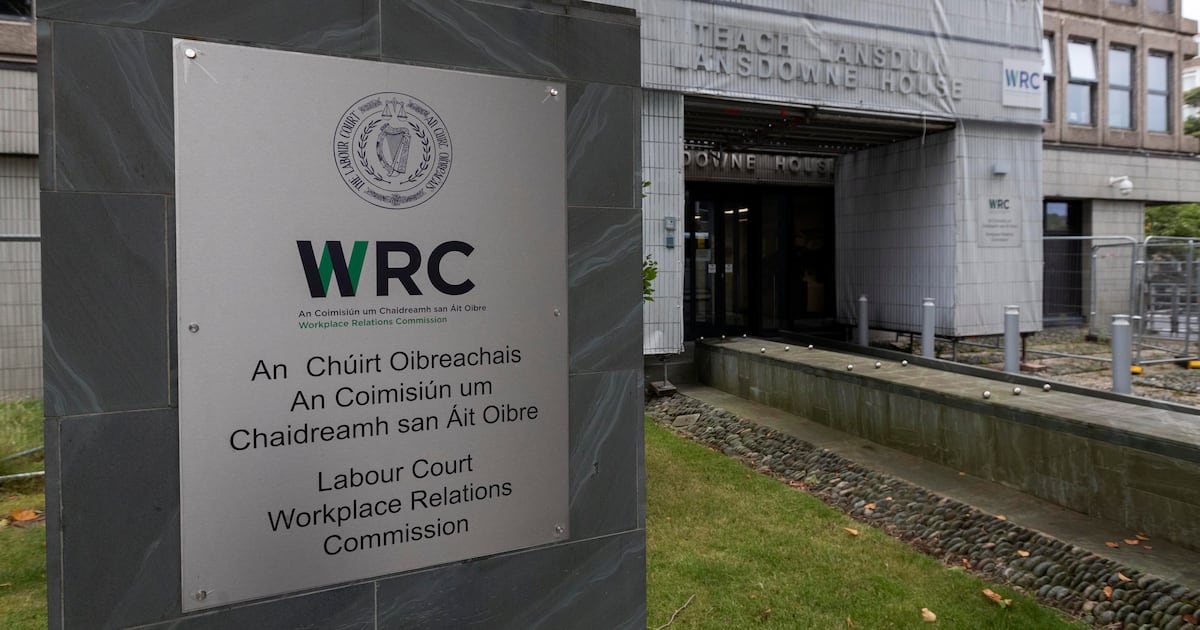
The head of the Workplace Relations Commission (WRC) complained of “sheer despair” over delays in remediating defects and expanding its Dublin office.
WRC director general Audrey Cahill wrote to the head of the Office of Public Works (OPW) in May outlining “sheer despair at this juncture about the lack of insight or engagement” from the OPW on a range of issues at the building – including addressing the risk of people “listening at the door” to sensitive hearings or confidential negotiations on public pay.
Works to a wall at Lansdowne House in Dublin, previously undertaken by the OPW, caused a big controversy when it emerged the cost ran to €490,000.
Documents released under freedom-of-information legislation show the WRC worried more controversy could arise from works to repair the “crumbling” facade of the building – which had dragged on for years amid fears that it could be “remedial and expensive”.
Cahill told OPW chairman John Conlan that scaffolding had been up at the building for five years to protect people “from pieces of concrete falling on them”, complaining that “we have no insight into where this project is currently at”.
With journalists regularly attending the building, the WRC was placed in a “precarious position” regarding “scrutiny into any works here as has already been witnessed in the context of the wall project”.
The WRC also worried that limited space available to it could lead to sensitive hearings being breached, seeking extra room in the building in light of an expanded workload and remit.
She said that unless WRC staff were tasked with following members of the press or public around there was no way to prevent people “wandering into a meeting of a confidential nature or indeed listening outside the door”.
“A key example of a risk would be the upcoming public pay talks,” she wrote. “The rooms are not soundproof, and it is not difficult to hear the conversations in the rooms when you are outside them.”
Cahill told the Department of Enterprise secretary general she was “really frustrated with OPW and the complete and utter lack of engagement no matter how hard we try”.
The documents show Cahill previously told Declan Hughes the WRC had “pushed hard” to have an extra floor of the building refurbished but “it has all fallen on deaf ears with no plan for the additional space that we would now say is business critical”.
She also said there was a “veil of secrecy and mystery” around a new tenant taking two floors of the new building, complaining that the WRC had not been “afforded the courtesy of some engagement and discussion about who is coming in”.
In reply to various pieces of correspondence Hughes said he shared the concerns – and sought to calm the situation, saying he had understood there was a solution at hand and that he had raised it with the OPW.
A spokeswoman for the Department of Enterprise said the WRC was an independent office and engages directly with the OPW on accommodation.
A spokeswoman for the OPW said Lansdowne House, built in the 1960s, is “one of the most significant examples of postwar modernist commercial architecture in Ireland” and had been built with on-site manufactured precast concrete units in the facade.
However, these have deteriorated, requiring “necessary ongoing repairs”. The OPW has been monitoring the situation since 2021 and is “in the process of considering the most appropriate solution to the facade defects”.
“The OPW collaborates closely with the WRC on an ongoing basis, including attending regular meetings at senior management level. The current occupants have identified accommodation needs and, in co-operation with the WRC, agreed solutions are being progressed”.
The OPW did not provide an expected budget for the works or costs incurred to date.
The WRC did not respond to a request for comment.