
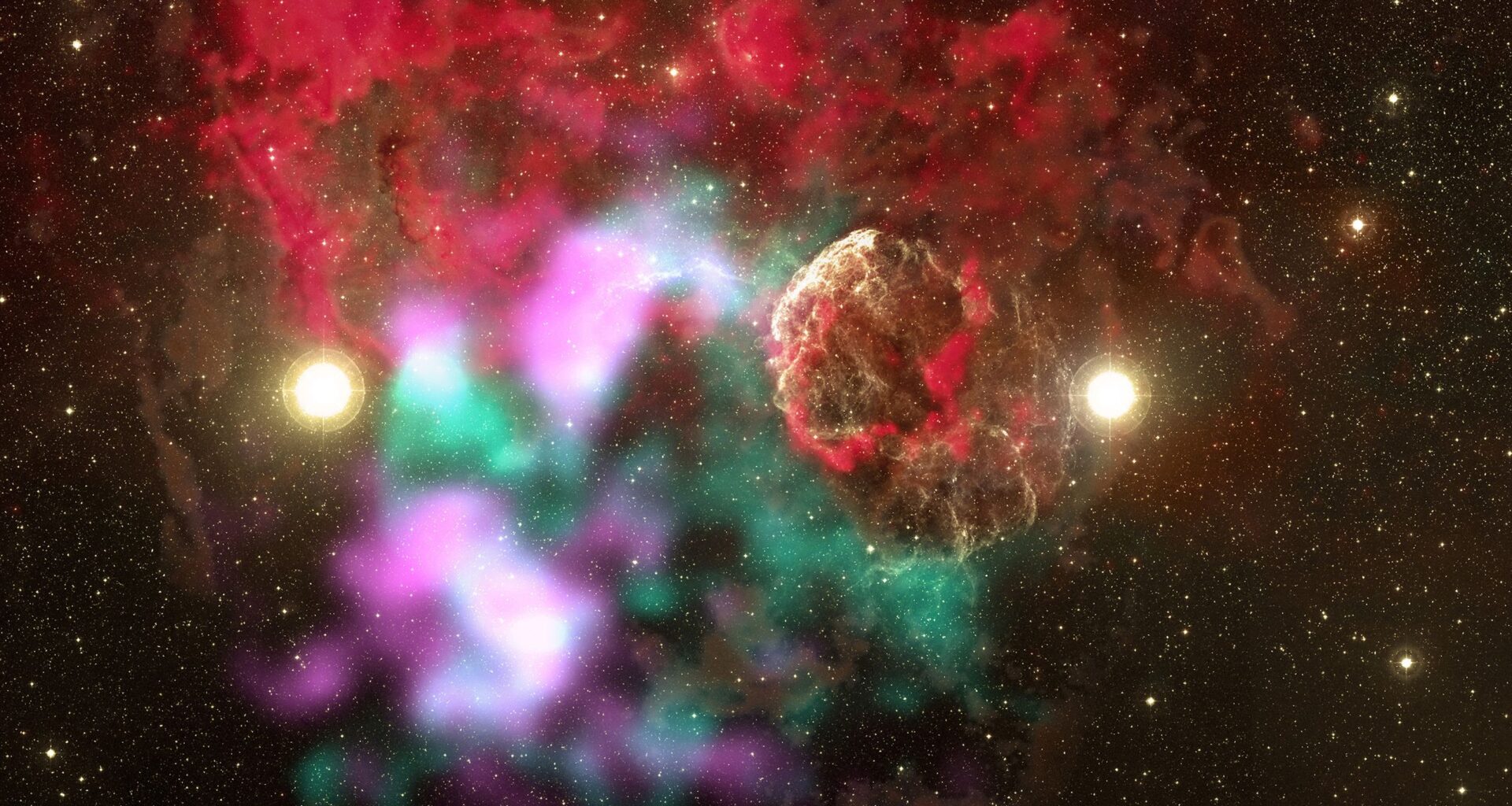
Astronomers may have just found a first-of-its-kind phenomenon buried in the shadow of one of the Milky Way‘s most famous stellar explosions: two stars that died in separate supernovas, after spending millions of years orbiting each other.
Using 16 years of data from NASA’s Fermi Gamma-ray Space Telescope, researchers detected high-energy gamma rays coming from a faint, previously overlooked supernova remnant called G189.6+3.3, which sits right beside the well-studied remnant IC 443 (nicknamed the Jellyfish Nebula). Their analysis suggests that the two remnants aren’t just neighbors by coincidence. Instead, they may be the leftover wreckage of a binary star system, making this the first confirmed case of two supernova remnants traced to the same stellar pair.
You may like
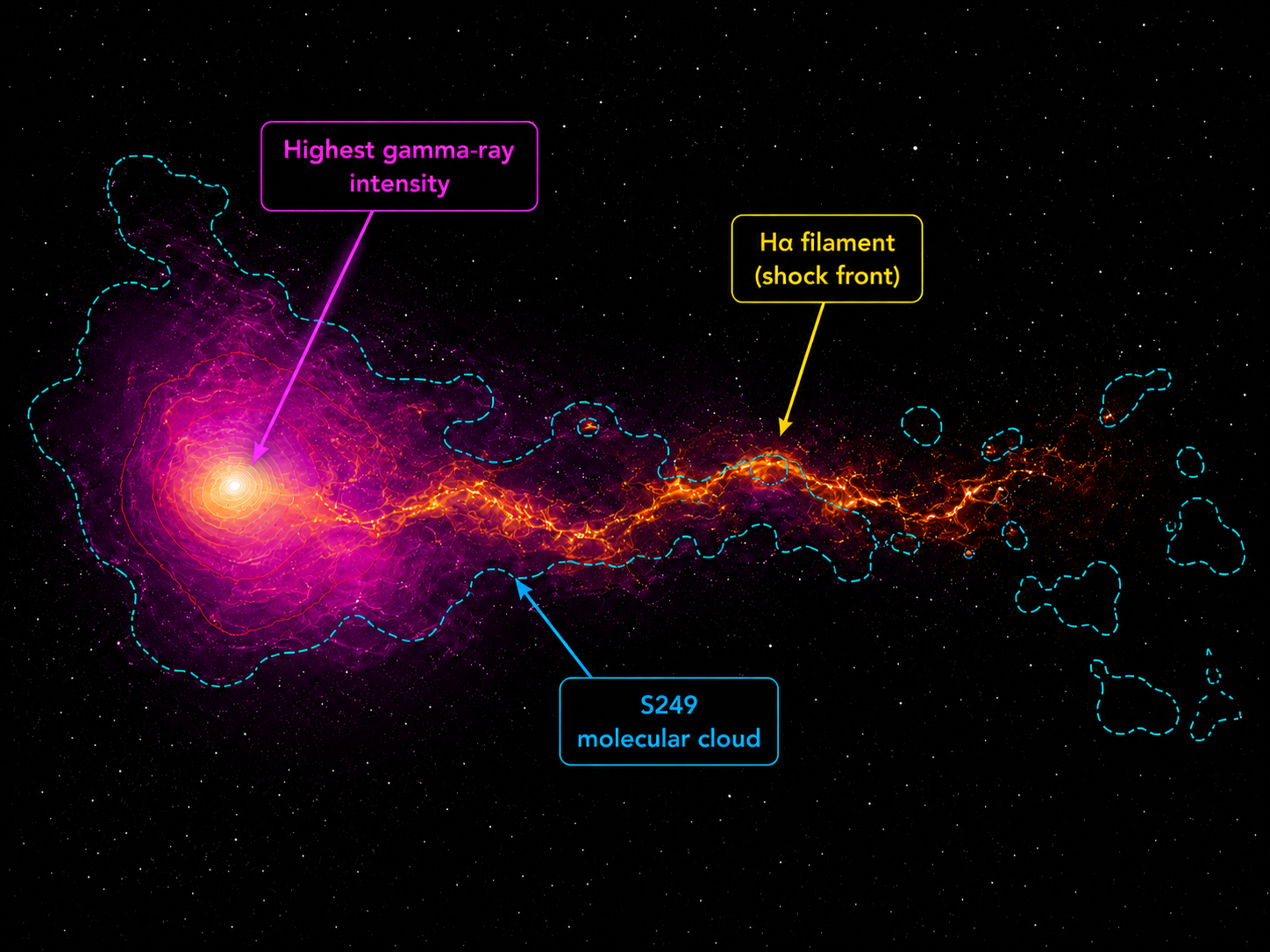
A dense cloud of hydrogen gas helped astronomers uncover clues that two neighboring supernova remnants may share the same origin.
(Image credit: M. Michailidis et al. 2026)
Michailidis, M., Lemoine-Goumard, M., Willcox, R., Gabici, S., Di Lalla, N., & Omodei, N. (2026). Shared cloud interactions unveil a candidate binary-system supernova pair with no known analogue. Nature Communications, 17(1). https://doi.org/10.1038/s41467-026-74978-x