
Most bands don’t like being assigned a genre. They’re all unique, they say, as one.
Now, regular readers may recall that a genre called “shoegaze” cropped up here recently. I rather liked the name. You probably know the classic joke about how to tell the difference between a shy Finn and an outgoing Finn. The extroverted Finn looks at your shoes instead of his own.
That’s me, that is. Only recently have I made an effort to hold my head up, after years of scolding from parents, teachers and photographers. Fail to focus for a second and my gaze goes back down.
According to contemporary arts peeps Berklee, “where punk was angry and riled up, shoegaze was ethereal and blissed out”. The name came from music reviewers complaining about inexpressive guitarists onstage simply staring down at their many effects pedals.
It was also billed as “the genre that celebrates itself”, but began to be reappraised when indie crossover bands like Beach House and Coldplay adopted similar vocal and guitar styles.
The early recordings of this week’s Icon, the Cocteau Twins, were classified as “gothic rock” and “post-punk”. But, as their sound developed, they were dubbed creators of shoegaze before becoming classified definitively as “dream pop” (though sometimes also “darkwave”).
In 1991, the New York Times said dream pop defined the times in Britain. Not that the band would happily be defined.
Indeed, the band’s self-reverential official website delights in recording that the music press never could quite find the words. Even the band itself could not, though AllMusic website essays no more than 26 adjectives, the first six being atmospheric, detached, ethereal, lazy, airy and autumnal.
In their early years, the official website avers, questions about their music “were often met with muffled non-sequiturs, inaudible whispers, uncomfortable laughs, and Scottish expressions like, ‘I dinna ken’”. Fair enough, though the website notes generously that sceptical critics detected “disingenuousness or even fraudulence”.
Grey matter
BOGGED down in genre titles – mea culpa – we’re almost forgetting the music and the pleasure and sense of identification that it brought to many.
In the latter part of their active career, vocalist Elizabeth Fraser said: “Our music started as an escape from the greyness and emptiness of our town, our past, but now it feels very healing.”
Read more
That “grey, empty” town was Grangemouth, the St Moritz of the Central Belt, where the band was first formed in 1979 by Robin Guthrie (guitars, drum machine) and Will Heggie (bass). The name came from a Simple Minds song, later rewritten as No Cure, about two Glaswegians obsessed with French poet, artist, and filmmaker Jean Cocteau. (Maybe they should have called themselves Genre Cocteau. Too late now).
In 1981, Guthrie and Heggie met 17-year-old Fraser at a local disco, The Hotel International, where Guthrie was DJing, and she became the vocalist. AllMusic has described her as a “unique performer whose swooping, operatic vocals relied less on any recognisable language than on the subjective sounds and textures of verbalised emotions”. I see.
At any rate, the Cocteau Twins were now a trio, inviting a variation on the classic joke about Mike and Bernie Winters playing the Glasgow Empire: “Christ, there’s three of them!”
The official website says they were “young, shy, self-effacing, awkward, taciturn, frequently profane and circumspect working class teens who … had little else to do but have a go at making music, despite, or perhaps because of, their lack of musical training. Boredom, after all, can be a great motivator.”
Critical garlands
EXCITINGLY, in 1982 the trio signed to arty label 4AD and released their “atmospheric” debut album, Garlands, which reached 14 in the indie charts and prompted Helen FitzGerald to write in Sounds: “Where have these creatures sprung from, what dastardly corporate skulduggery can explain their unannounced and almost unprecedented leap to the forefront of our attention?”
The album was followed by two EPs, Lullabies and Peppermint Pig. Shortly after the latter’s release, and having shifted base to London, the band parted ways with Heggie, leaving Guthrie and Fraser to cut 1983’s Head Over Heels as a duo, perfecting what AllMusic called the Cocteaus’ “gauzy formula”. Gauzy, aye.
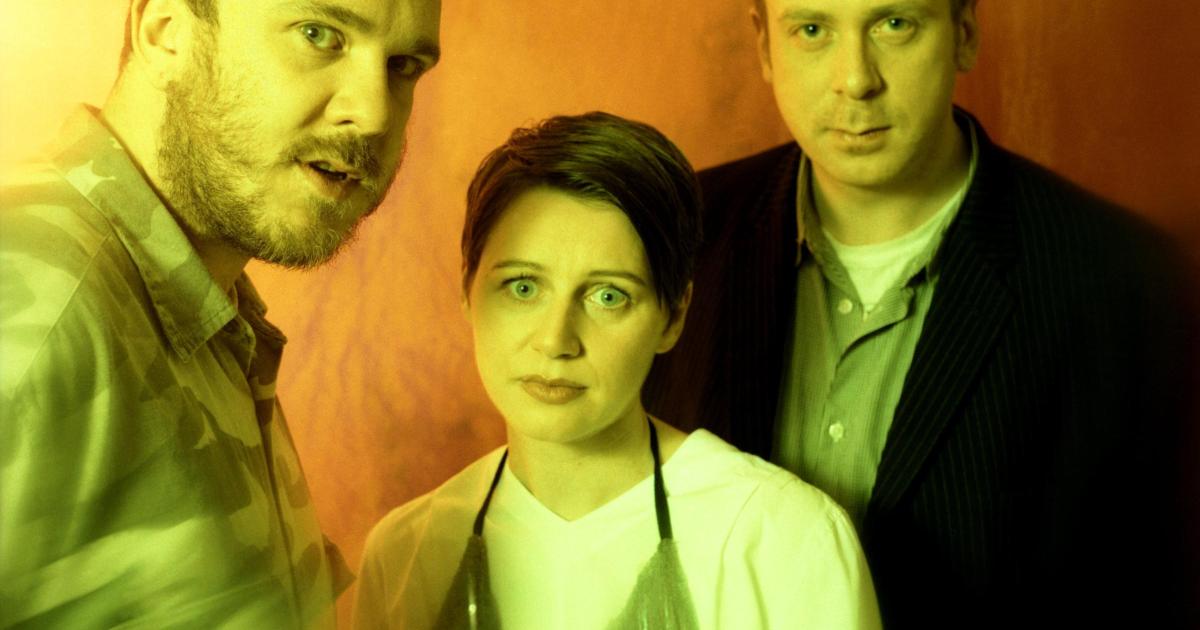
In 1983, former Drowning Craze bassist and multi-instrumentalist Simon Raymonde joined the band to record the EP The Spangle Maker and solidify the best-known lineup and sound: a soprano voice singing deliberately indecipherable lyrics, effects-laden guitars, drum machine.
A single, Pearly-Dewdrops’ Drops, reached 29 in the charts, while a subsequent LP, Treasure, became the band’s first top 40 album and prompted Melody Maker’s Steve Sutherland to gush: “Surely this band is the Voice of God.”
Religiously, they turned down invitations to appear on Top of the Pops, mostly – the website acknowledges – out of fear, “but certainly also because the idea of bright lights, balloons, and dancing didn’t feel right, either”. That’s the spirit.
In 1984, they did agree to appear on yon Old Grey Whistle Test, after which they were labelled, er, “difficult”.
More EPs followed while a fourth LP, the mainly acoustic Victorialand, became their first top 10 album, eclipsed in 1990 by Heaven or Las Vegas, their most commercially successful album, reaching number seven.
All in all, they made eight LPs. By the seventh, Guthrie was in rehab and Fraser undergoing psychotherapy. That’s the way of it, pop pickers. In 1997, partly fuelled by the relationship breakup of Guthrie and Fraser, the group disbanded.
In the meantime, they’d gone from being “the Voice of God” to purveyors of “music you can bonk to”, having acquired a reputation as coitus-friendly. Interestingly, among the two dozen artists they are said to have influenced, one was an outfit called Cigarettes After Sex.
Taking the bliss
YEP, no doubt about it, the music still confounds serious categorisation. It was not, according to the official website, something “you danced to at the club”. Amen to that. It was, says the site, “almost objectively beautiful, even joyful – blissful, sublime, choose your superlative”.
Well, I think that’s enough to be going on with, apart from two more which say the band is now being rediscovered by “new generations yearning for something seminal or transcendent”.
Earlier this year, after selling the publishing rights of his entire body of work for the “iconic dream pop band” (Billboard), Simon Raymonde noted: “The enthusiasm for our music appears to be strong 30 years after our last studio album!”, adding: “I’m sure all the fans want is for us to play shows and make new music. While that still seems a long way off, there’s a lot to be done with the music we have left behind.”
And, whatever it is, the world is grateful for it.