
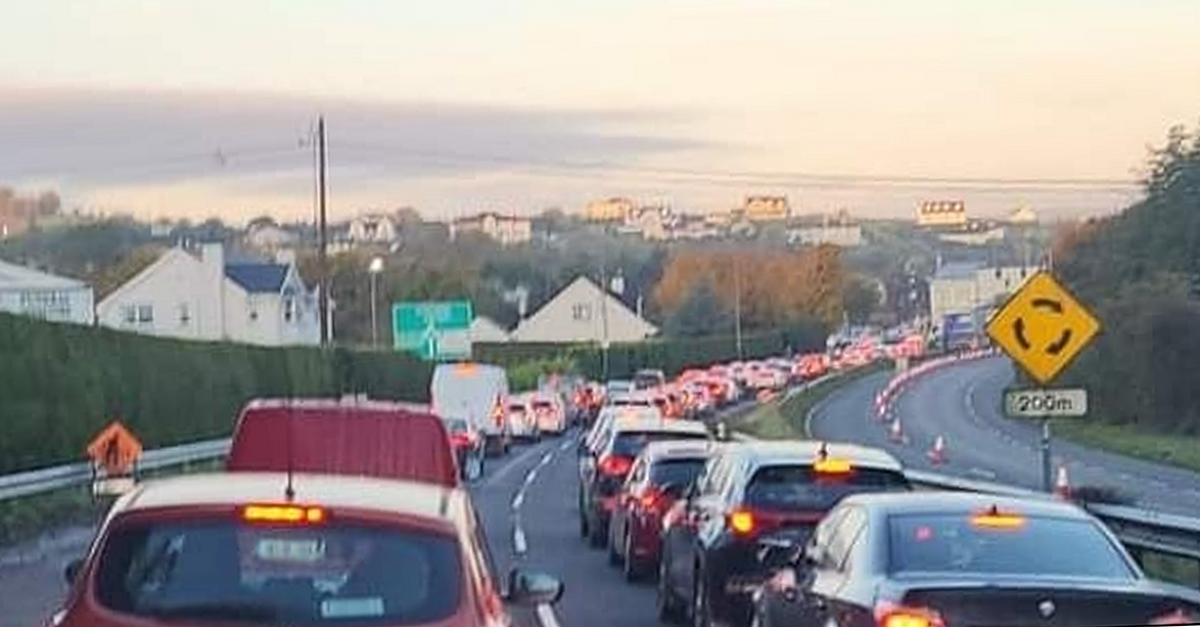
Letterkenny is the economic heartbeat of Donegal, but it has severe issues when it comes to traffic.
Once again today, social media platforms were awash with discussion and complaints after another afternoon of gridlock in the Cathedral Town.
Despite several investments in new road infrastructure projects designed to take the pressure of the town’s existing transport network, the situation has only got worse.
As the old adage goes, “All roads in Donegal lead to Letterkenny.”
But why is the management of traffic in Letterkenny so difficult?
Here’s a look at some of the problems plaguing the town’s transport network.
Letterkenny’s Rapid Growth:
Over the last few decades, Letterkenny has evolved from a market town into the county’s primary location for innovation and economic activity.
Its expansion has simply outpaced the infrastructure required to support that rapid growth.
Letterkenny is home to Donegal’s largest hospital, and the Atlantic Technological University is also expanding.
It also boasts a number of major retail centres, and is the county’s largest employment hub.
However, the underlying road structure was never designed for transformation on that scale.
Poor Planning
There has been widespread criticism around planning when it comes to the topic of Letterkenny’s traffic problems.
Underinvestment in regional infrastructure has been a common trend throughout Ireland, so Letterkenny is not unique in that regard.
However, one of the major problems when you examine Letterkenny’s traffic woes is the fact that planning policies in the 90s and 00s opted for development over transport.
During the Celtic Tiger boom, a number of housing estates, retail parks and business developments were all given the green light without planners acknowledging that this was actually increasing the reliance on cars.
Essentially, the road network in Letterkenny was never configured to be aligned with the town’s development as a whole.
Those decisions made walking, cycling, and public transport less practical for many trips across Letterkenny.
Many towns across Ireland have undergone a similar transformation as Letterkenny, so again it’s not unique.
However, on the flip side of that, the council is now undertaking a series of measures to encourage cycling and walking throughout the town in the form of cycling lanes and wider footpaths.
But crucially, most other towns that grew significantly have developed a full bypass, or an orbital road.
However, Letterkenny has instead remained dependent on a handful of key routes and junctions.
As new developments connect to the existing network, more traffic was funnelled through the same bottlenecks rather than being dispersed across a larger system.
You may also be interested in


The Four-Lane Road Bottleneck
The N56 ‘Four Lane Road’ is one of the most congested parts of Letterkenny.
Despite being relatively wide it does not function well due to the volume of different roundabouts and junctions.
Far too many trips in and around Letterkenny depend on the N56.
Official planning documents state it now carries traffic volumes comparable to large-city access routes but without equivalent alternatives.
That inevitably creates stop-start traffic, and if one roundabout slows then a traffic bottleneck is created throughout the entire corridor.
That’s why even the most minor of accidents in Letterkenny can create so many traffic problems.
Going around in Roundabouts
Many experts that review the traffic situation all come to the same conclusion, Letterkenny has too many roundabouts.
Letterkenny relies heavily on interconnected roundabouts such as the Polestar, Ballyraine, Mountain Top, and the Dry Arch.
In moderate traffic the system works effectively, but under heavy demand it collapses.
Queues form all over the town and one junction subsequently blocks another.
The problem is exacerbated by the fact as mentioned above that Letterkenny’s most important routes all intersect instead of being grade-separated.
There are several major projects either underway, or in the pipeline to try and resolve Letterkenny’s traffic problems.
Below is a list of some of the transport projects that planners believe can get Letterkenny’s traffic flowing, and where traffic congestion is a rare occurrence and not the daily norm.
Letterkenny Southern Network Project:
The Lettterkenny Southern Network Project is designed to improve connectivity to and from West Donegal, which would result in reduced congestion and support alternative travel routes.
Letterkenny Northern Network Project:
It is hoped that when completed in 2027, it will drastically improve northern circulation, connect key areas, and add much needed walking and cycling infrastructure across the town.
TEN-T Priority Route Improvement Project:
The TEN-T Priority Route is a €800m development project that will tackle three major sections of Donegal’s national road network.
The mega-project is expected to start in 2028, and will take several years to completed, with conservative estimates saying it could be completed between 2032-2034.
The major strategic upgrade intended to improve regional connectivity, resilience, and traffic reliability.
In summary, Letterkenny functions like a regional city, whilst still relying on a road structure closer to that of a much smaller town.
So, the traffic issues in Letterkenny are likely to get worse before they get better.