
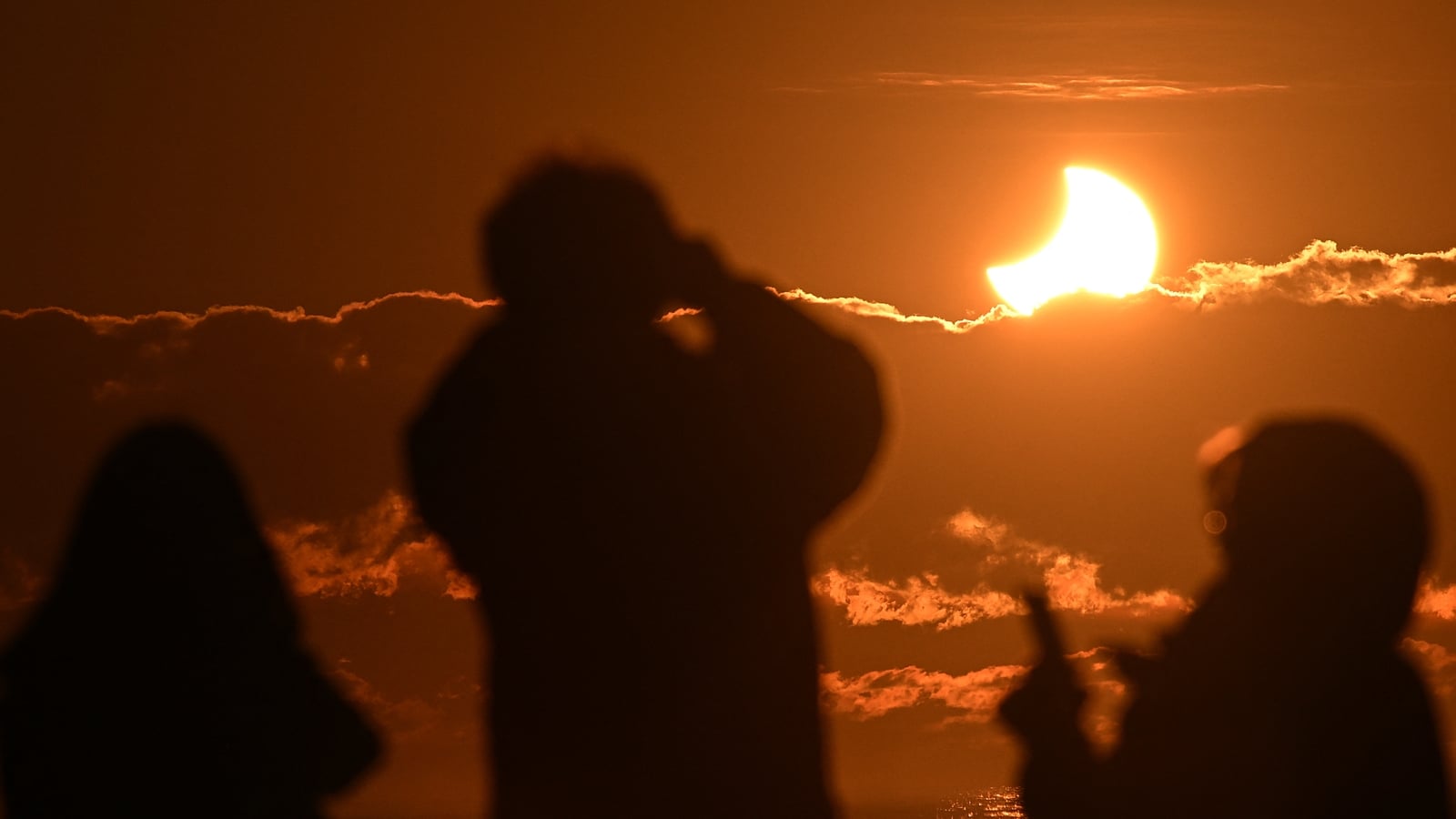
Analysis: The solar eclipse is a rare event at any location and it will not occur again in Ireland until 2090
On Wednedsday 12 August, our routine will be interrupted by one of nature’s grand, quiet spectacles: a solar eclipse. For about two hours just after 6pm, the Moon will move in front of the Sun and its shadow race across Ireland – a rare event at any location and one that Ireland will not see again until 2090.
What is a solar eclipse?
Through history, the unexpected shrouding of the Sun by the Moon caused anxiety, even ending wars and hastening treaties. Norse mythology imagined Loki’s descendent wolves Skoll and Hati catch and bite the Sun, while ancient China envisaged dragons devouring it. Over time, our fears and myths have been replaced by an understanding that eclipses, rather than interrupt nature, gracefully reveal its precise and perpetual dynamism.
So what is a solar eclipse? Though the Moon’s orbit about Earth is tilted, every 18 months or so the Sun, Moon and Earth align, where the Moon’s shadow then falls upon Earth. By cosmic coincidence, the Moon’s width is 1/400th that of the Sun but it is also 400 times closer so that during alignment the Moon covers the Sun immaculately from our viewpoint, causing an eclipse. The shadow cast onto Earth has two parts – a central umbra that over several hours sweeps a path along Earth’s surface within which the eclipse is total. The wider penumbra shadow delivers a partial eclipse.
From Science ABC, a beginner’s guide to solar and lunar eclipses
From the ground, we see the Sun increasingly blocked until at totality it is completely covered by the Moon, and for a few minutes, day becomes night. As the Moon passes, the Sun reappears and daylight returns. For those under the penumbra, a partial eclipse is witnessed with day becoming twilight, the Sun never completely disappearing from view. Even such a spectacle reveals the harmony of the spheres beautifully, and is what we in Ireland will witness next week.
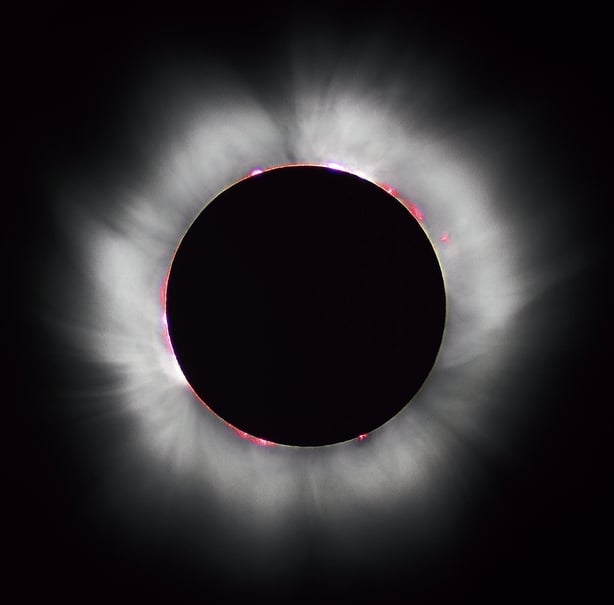
A Total Solar Eclipse, revealing the Sun’s outer atmosphere or Corona. While the Sun’s surface temperature is 5500oC, the Corona is at 2 million oC, a mystery to us, and what Prof. Gallagher of Dunsink will investigate during this eclipse (Image: Luc Viatour)
This month’s eclipse
This month’s eclipse will be total just beyond Ireland’s western shores with the Moon’s umbra commencing in the Arctic, passing through Greenland and Iceland, down the Atlantic Ocean just 250km west of Ireland and ending in Spain. While we won’t see totality, a daring mission lead by Prof Peter Gallagher, the director of Dunsink Observatory, and the Air Corps, will fly into the umbral path west of Ireland and use innovative onboard telescopes to analyse the Sun’s mysterious outer atmosphere or Corona, visible only during totality.
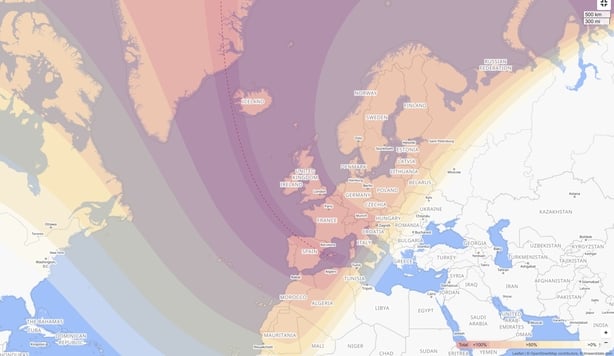
The path of the eclipse of August 12th 2026. Darkest purple shows the path of totality, not far off the west coast of Ireland (Image: Kevin Nolan, TU Dublin)
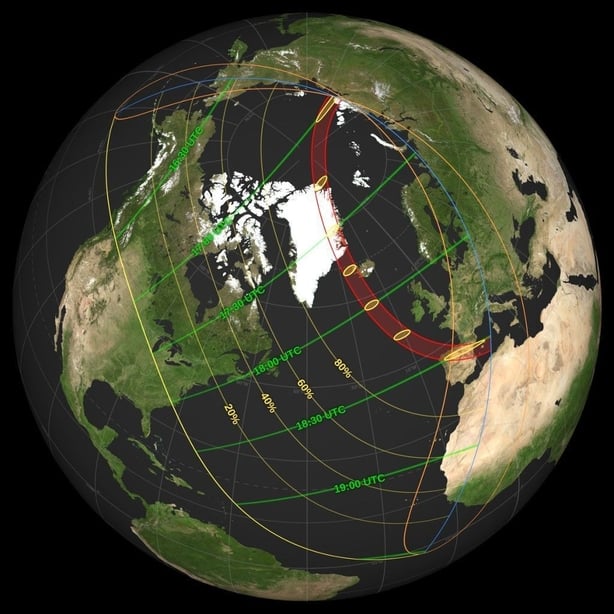
The path of totality of the eclipse of August 12th 2026, not far off the west coast of Ireland (Image: NASA)
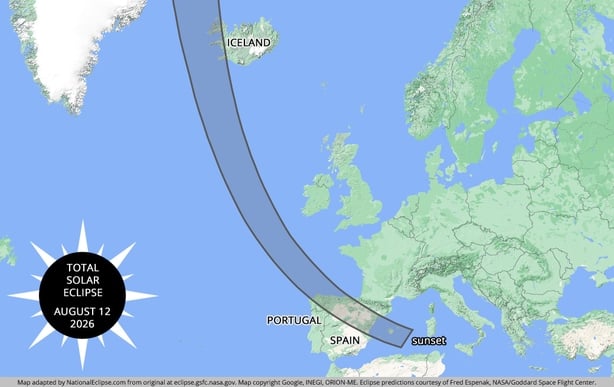
The path of totality of the eclipse of August 12th 2026, not far off the west coast of Ireland (Image: Google, INEGI, ORION-ME. Eclipse predictions courtesy of Fred Espenak, NASA/Goddard Space Flight Centre)
Although only partial for Ireland, it will be what is termed a deep partial eclipse – very close to totality, and the further west the better! During maximum eclipse, Belfast sees 93% of the Sun’s globe covered, while West Cork sees 97% of the Sun blocked by the Moon. The eclipse begins around 6.10pm, with maximum eclipse about an hour later, varying slightly by location: 7.08pm for Belfast and Sligo, 7.10pm for Galway and Dublin and 7.12pm for Wexford and Cork.
What will we witness during the eclipse?
Being an early evening eclipse, the Sun will be about 15 degrees above the western horizon, so be sure to find a spot where the Sun is visible after 7pm. At around 6.40pm, we’ll notice light levels drop, with maximum eclipse becoming eerily twilight-like. Colours will fade as our eyes adapt, the temperature may drop and shadows will sharpen.
One beautiful effect will be countless dappled thin crescent images within the shadows of trees, each rustling gap in the leaves acting like a pinhole projector of the eclipsed Sun onto the ground. Take a photo of this rarest of visual delights, and listen to the quietening panorama as everyone shares the occasion and perhaps bird-song quietens? The sky will darken sufficiently to reveal Venus to the left, and perhaps Jupiter to the lower right of the crescent Sun.
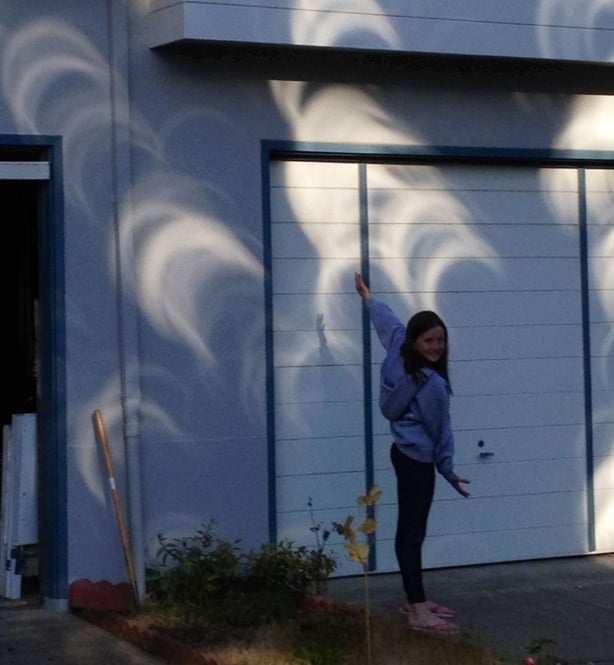
Crescent images of a partially eclipsed Sun made through gaps in a nearby tree. Image: J & F Flannery
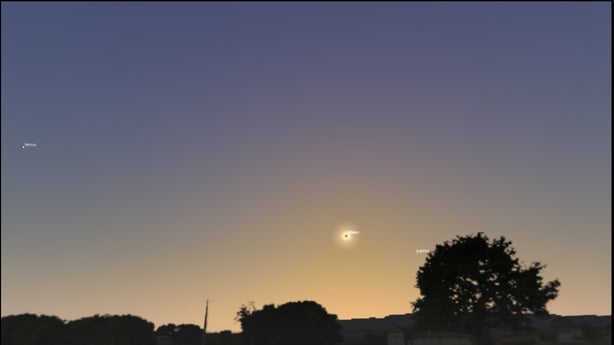
Where Venus and Jupiter lie in relation to the eclipsed Sun during maximum eclipse (Image: Stellarium)
Protect your eyes!
At maximum the Sun will appear as a spectacular thin crescent only. Here, safety is paramount – don’t be tempted to look directly at this crescent Sun as it’s still thousands of times brighter than the brightest head lamp; where staring will permanently damage eyesight and using any optical aid will guarantee blindness.
Sunglasses offer no protection either. The only way to look directly at the Sun during an eclipse is through certified Eclipse Glasses conforming to the ISO 12312-2 standard, which can be widely purchased at low cost.
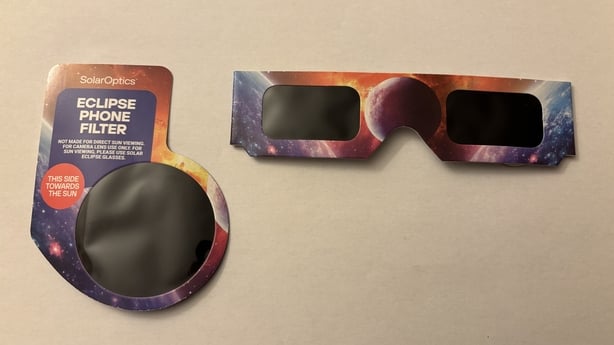
Typical eclipse glasses and a hand-held phone filter to take photos of the eclipse, multiples of each typically provided in one cost-effective pack. (Image: Kevin Nolan / TU Dublin)
Public eclipse events
Many organisations are running viewing events. Blackrock Castle Observatory in Cork will be doing so at three locations where they’ll distribute 6,000 pairs of eclipse glasses. Dunsink and Armagh observatories will be doing so at their respective locations, while Maynooth University is running a viewing event accompanied by public talks on their campus and the Irish Astronomical Society will run a public event in Dublin’s Phoenix Park. You’ll find more info on Irish events here, where you can also download a guide including activities for children.
Purple rain and a red moon
As if on cue, later that night is the maximum to the Perseid meteor shower. With the Moon below the horizon next to the Sun, this year’s meteor shower will be spectacular. To observe, head out when dark. The shower lasts all night, so just look around the sky generally northward where you will be treated to a multi-coloured shooting star shower of upwards of 100 shooting stars per hour.
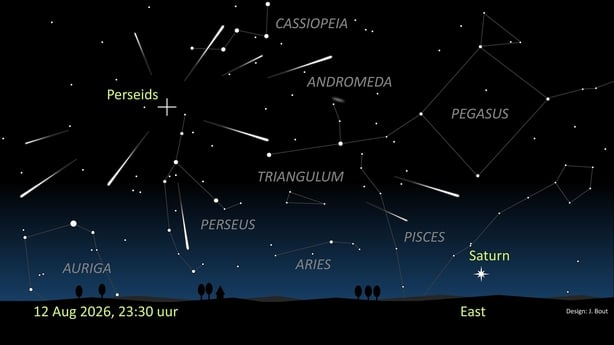
Sky map showing the Perseid meteor emanating from a point in the sky centred on the constellation of Perseus in the northern sky on August 12th 2026 Image: J. Bout
As a final celestial treat, the early hours of August 28th gifts us an eclipse of the Moon. This time, the Moon will be passing through Earth’s shadow and more than 93% of the Moon’s surface will be covered, then appearing a deep red colour in the sky. This will commence at about 2.20am in the southeastern sky, and the maximum will be at 5.10am.
Both eclipses are a reminder of the beauty of nature, and of the laws of nature. We find them fascinating because they are rare yet tangible reminders of the extraordinary universe we inhabit. For the younger generations these eclipses are perhaps a first, potent introduction to a universe that is knowable – and that we are coming to know – and where such occasions bring us all together in our millions to witness this grand, unfolding Cosmos in all its splendour.
The author would like to acknowledge the assistance of John Flannery of the Irish Astronomical Society and Terry Moseley of the Irish Astronomical Association with this article.
Follow RTÉ Brainstorm on WhatsApp and Instagram for more stories and updates
The views expressed here are those of the author and do not represent or reflect the views of RTÉ