
EDITOR’S NOTE: Call to Earth is a CNN editorial series committed to reporting on the environmental challenges facing our planet, together with the solutions. Rolex’s Perpetual Planet Initiative has partnered with CNN to drive awareness and education around key sustainability issues and to inspire positive action.
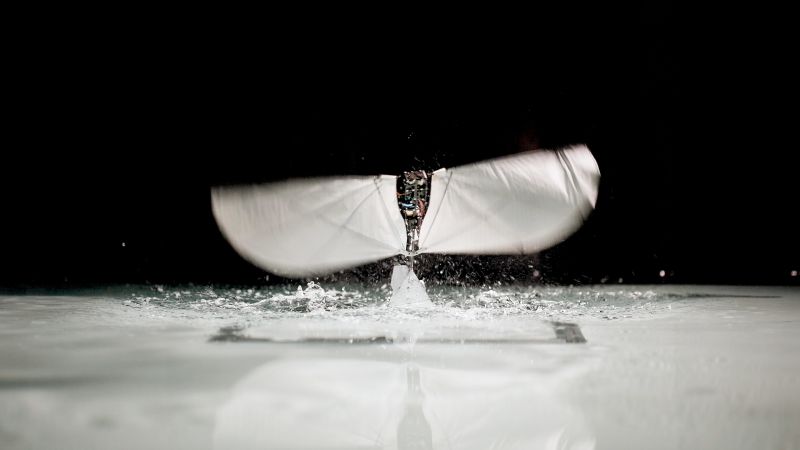
A lab at MIT has engineered a $300 flapping robot that can fly and swim underwater. Its creator believes the lightweight robot could one day be used to monitor and ultimately help protect the ocean.
The team of aero-aquatic roboticists looked at petrels, puffins and other diving birds, that use their wings to propel them through air and water. It also examined the complex dynamics that allow them to transition between the two.
Raphael Zufferey, lead author of the study and an assistant professor of mechanical engineering at MIT, said that while previous research existed on diving birds’ wings and how they both swim and fly, “no one had ever figured out how to transform that into a fully moving robot.”
The team studied “the entire literature on (diving) birds,” he said, mapping the flap frequency of different birds’ wings in air and water, and how they varied by wingspan (the larger the bird, the lower the flap frequency).
It devised a 250-gram (9 ounce) flapping aerial-aquatic vehicle (FAAV), powered by a battery-operated motor, with nylon wings and a tail coated with water-repellent nanoparticles.
Despite first appearances, the FAAV isn’t a straight case of biomimicry, stressed Zufferey.
Water is many hundreds of times denser than air (variables include temperature, pressure and air humidity). Diving birds have wings that partially fold in underwater, minimizing amplitude — how high and low the wings move during a single flap — and minimizing drag, and generating the necessary force to propel themselves forward. To do the same with a robot would require four more joints, more complex engineering and more mass. Instead, the team created a wing that doesn’t fold, but is more flexible than a diving bird’s, to minimize amplitude.
Zufferey said the FAAV does not know that it’s in water or air, merely that it is programmed to try and hit a certain frequency of wingbeats per second, irrespective of what it is moving through.
The robot can fly at just over 6 meters per second (13.4 mph) and swim at nearly 1 meter per second (2.2 mph). In theory it can fly 6 kilometers (3.7 miles) or swim 2 kilometers (1.2 miles) on a single battery charge, though this has not been tested.
The lab tested the FAAV for a year in a water tank in Massachusetts and later Lake Geneva, Switzerland. Much of the fine-tuning involved working out the best angle for it to dive into water (70 degrees) and launch out of it. The robot can operate in mild wave and wind conditions, said Zufferey, but not rough conditions in its current iteration.
“From an engineering perspective, this is genuinely an impressive design,” said Maaten Furlong, director of engineering science at the National Oceanography Centre, who was not involved in the project.
“Developing a vehicle capable of operating effectively in both air and water is a significant technical challenge, and successfully integrating these two modes of operation is a notable engineering achievement,” he said.
After the initial breakthrough, the lab is now pursuing grants and other means to develop the robot further.
“In this paper, we show that individually all of this is possible: we can fly, we can swim, we can transition, we can dive. But we haven’t been able to piece it all together in one autonomous mission,” said Zufferey.
“We’re really trying to understand better how birds do this,” he added. “The other reason we’re doing this is we’re hoping that this becomes (a) future tool for oceanography.”
Scientific sampling at sea is expensive, he contends, and there are use cases for a relatively cheap, lightweight aerial-aquatic vehicle.
The FAAV could be launched from sea or land and programmed to fly autonomously on set routes and dive underwater to collect samples, Zufferey hypothesized. “I like the idea of bringing these robots into more dangerous scenarios,” he added — collecting samples from toxic algae blooms, volcano lakes or close to icebergs, for example.
The vehicle could also be fitted with cameras for wildlife monitoring, Zufferey said.
Furlong had questions about the vehicle’s payload capacity, robustness, regulatory approval and how it would operate in open ocean environments.
“This class of combined aerial and underwater vehicle remains relatively unexplored, largely because it is technically difficult to develop and the operational advantages have yet to be clearly demonstrated,” he said.
“Bio-inspired vehicles” are hardly new, he added, and relatively few progress from laboratory to operational use: “In practice, conventional electric motors and propellors are highly efficient, reliable and inexpensive, making them difficult to outperform on cost, performance and practicality.”
That said, he didn’t rule out flapping robots in ocean research entirely. “Ocean scientists are generally technology-agnostic,” Furlong said.
“They are less interested in how measurements are made than in obtaining high-quality data using the most reliable, cost-effective and operationally practical method. If this platform can demonstrate those attributes, it is likely to find adoption.”
Zufferey calculates that with carbon fiber and other lightweight materials, the design could scale up to a 15-meter (49 feet) wingspan.
With the size as-is, the cost of the components is $300. Even with an improved motor and more robust design, the cost to build would be $1,000 at most, said Zufferey — “very cheap for anyone doing ocean science.”
The study’s lead author has already established a new lab at MIT with a larger water tank and high ceilings for future testing.