
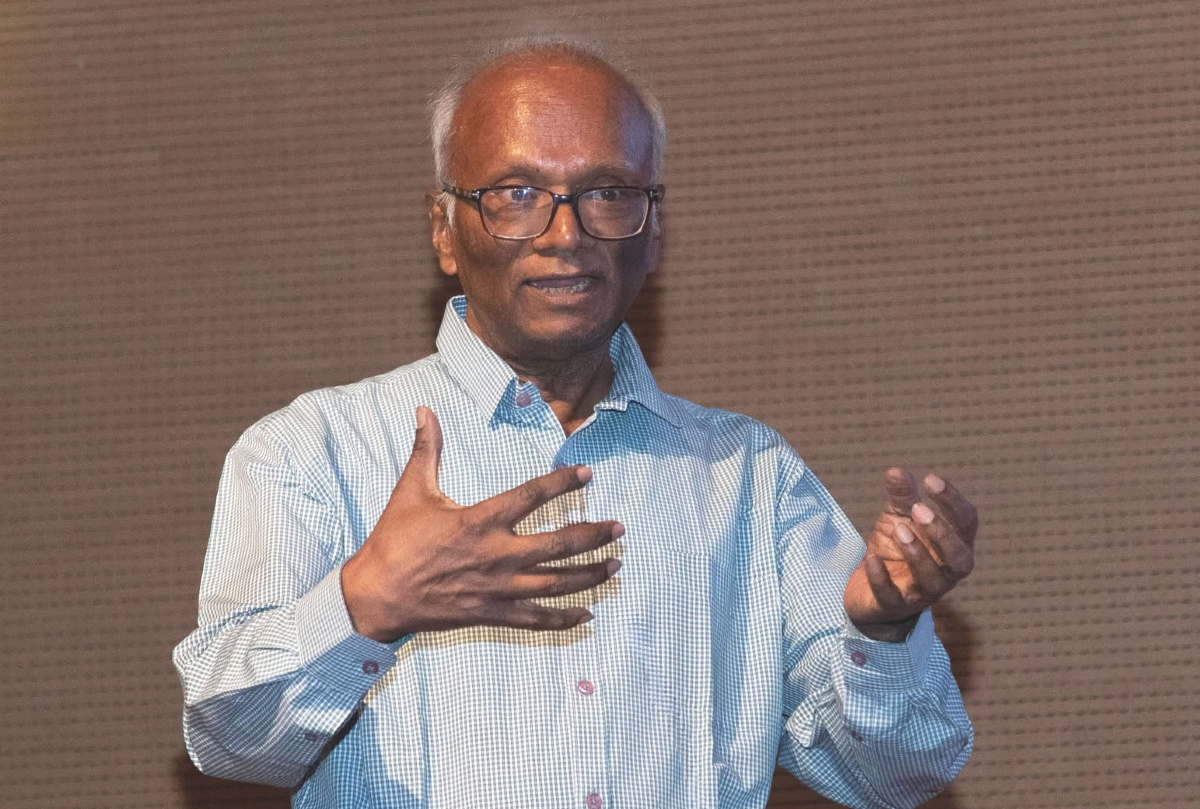
Deepak Dhar. Credit: IISER Pune
Deepak Dhar is a professor at the International Centre for Theoretical Sciences, Tata Institute of Fundamental Research. He is the recipient of the 2026 Dirac Medal, instituted by the International Centre for Theoretical Physics in Trieste, Italy, for his work in statistical mechanics.
Q. I am curious about your work on the sand pile model, the statistical physics concept that helps understand such varied things as earthquakes and stock market crashes.
A. The sand pile model, or the self-organized criticality model, was proposed by Per Bak, Chao Tang, and Kurt Wiesenfeld in 1987. They suggested that there are many natural systems, such as earthquakes, forest fires or stock markets, that exhibit a lot of ‘burst-like relaxation events’.
Consider this – if you take dry sand and make a pile, and then keep adding small grains one at a time, sometimes they just stick there, but sometimes they can cause an avalanche. There is a steady state in which the avalanches occur with some irregularity. Bigger avalanches are fewer and smaller ones are more. They showed that many natural systems agree with this general scenario. This model was studied by computer simulations in two dimensions; people still haven’t been able to find the exact distribution of sizes of such events.
There have been substantial developments to the idea since then. We defined a directed version of the model in which the effect of gravity, which can actually be solved in all dimensions, is included. So, some problems of the sand pile model remain unsolved, some other problems have been developed and solved.
Q. How did you get interested in the sand pile model?
A. Around 1979, Per Bak came to India and he gave a lecture at our institute, TIFR Mumbai. He was a very provocative speaker. He said the sand pile theory could explain the fluctuations of River Nile, earthquakes and biological extinctions. We were not very convinced. I studied their model and realised that there was an Abelian group structure to it. What it means is that if we add sand particles at different times, the order in which they are added does not matter, the result remains the same. This can then be used to solve some properties of this model exactly. It was very useful then since there were no other exactly solved models of self-organized criticality. Then we showed that this model can be related to a lot of other previously studied models.
Bak et al noted for the first time that long-ranged correlations occur without any fine-tuning of parameters. They called it ‘self-organized criticality’ – you could reach a point of criticality without fine-tuning something to a critical point.
I think it is unfair to call it ‘the theory of everything’, as some people do. It provides a basic framework for describing systems. But if you really want to understand stock markets, the theory of stock markets is not identical to the theory of earthquakes. They will all be slightly different, but some basic principles are the same in all of them.
Q. The utility or need for this model in theoretical physics is well known, but how does it apply to real life? Can you give us some examples?
A. It provides a conceptual basis for understanding real world problems. It doesn’t always lead to predictable consequences. You can take the philosophy of this model and apply it to earthquakes. But to tell you when the next earthquake will occur, it may need additional local observation from seismographs and geographical inputs. Those variables are not part of the theory, they are elaborations of it. But it helps understand the general principle of these big and small events. The general principle here is that in a steady state, big events happen. It is valid for earthquakes and stock market and forest fires, but its detailed application is not identical. You have to add special features of the specific problem to predict them better.
People have used the theory in stock markets to predict crashes. Others estimated the region most affected by lava flow from a volcanic eruption of Mount Etna in Italy a couple of years back. There are claims of significant progress in the prediction of Southern Californian earthquakes over a 30-day window.
Q. How do you see the growth of such fundamental research in India?
A. Currently, there is more emphasis on applications and results-oriented research with monetary outcomes within three to four years. I am not against applied research, it’s very important with real applications in the market. But I think, there should be a component of not-so-immediate applications in how the country funds research. There should be a judicious mix of pure research and applied research.
Some types of pure research are like cultural inputs. Just like we support people who write novels, even though it doesn’t lead to immediate monetary gains for the country. It’s, nonetheless, a useful activity. Similarly, some kinds of sciences are also useful as they raise the intellectual level of the country and not just of the person doing it.
Scientists raise this issue from time to time, but they are treated as a vested interest group. There should be some degree of accountability for blue skies research, as there should be provision for it.
Q. What are you concerned about in India’s science ecosystem right now?
A. There is a lot of anti-science in the country and we do not adequately counter it. That is deeply worrying for me. If some senior minister says something very strange like, there were a lot of flying machines in India 2000 years ago, then it is worrying. We don’t want our ministers to be like that.
It’s also very hard to separate misinformation from correct information. In the old days, we used to read newspapers, and we took them to be true. But now it turns out that half the news in newspapers may be untrue. I don’t know which to trust.
Q. What is the next frontier in theoretical physics that excites you the most?
A. Non-equilibrium systems and how they differ from equilibrium systems. And how they are important in our understanding of the world. The general framework to describe these, at the level of generality of equilibrium phenomena, does not exist even now.
To explain equilibrium in simpler terms – if you look at a system now and you look at it after a short time, and it looks roughly the same, it is in equilibrium. For example, the properties of a box full of gas remaining unchanged over a period of time means it is in a system of equilibrium. But if systems are not in equilibrium – say, the properties of the gas in the box are changing – there is a turbulence. It would be interesting to study such turbulent systems. And if the systems are quantum mechanical, like superconductors, which have some macroscopic quantum behaviours, we try to understand them with the principles of ‘quantum entanglement’.
The most immediate application of quantum entaglement is in quantum computation. While large scale quantum computation is still not reachable in the foreseeable future, people can make computers to do calculations to the tune of hundred qubits. Perhaps small, but still useful things, such as quantum cryptography for secure transmission will be possible in near future.