
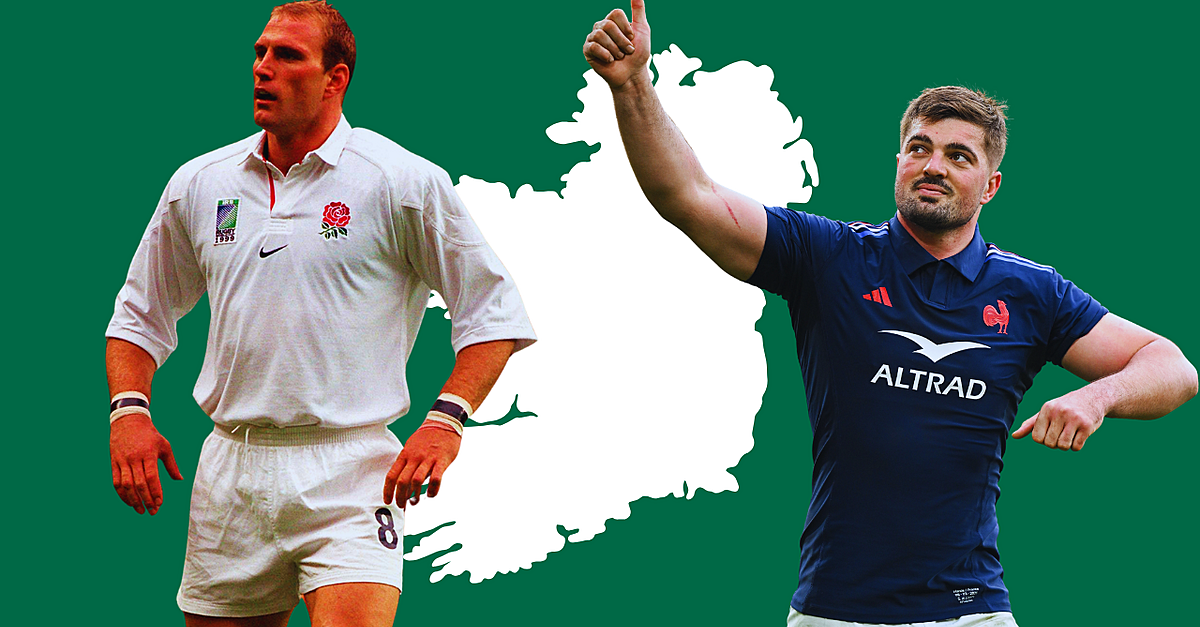
Down through the years, Irish rugby has made the most of World Rugby’s eligibility rules to convert some top-class players to represent Ireland at test level.
To name but a few, CJ Stander, Bundee Aki, Jamison Gibson-Park, James Lowe, and Mack Hansen have been integral parts of Irish rugby’s golden era over the past decade or so, all having become naturalised Ireland players through various routes.
Recommended
They have all left their mark on Irish rugby in different ways, but there are plenty of examples of players who opted against representing Ireland when the opportunity was there.
Here are 9 of the best players who were eligible to play for Ireland but chose not to.
Sean Fitzpatrick (New Zealand)
Sean Fitzpatrick starred as New Zealand claimed World Cup glory on home soil in 1987, but could easily have been wearing a green jersey singing ‘The Rose of Tralee’ at that tournament instead.
One of the greatest front-rows in test rugby history could have lined out in an Ireland shirt, tracing his roots back to County Tipperary.
Fitzpatrick’s grandfather Jimmy was born in Tipp and moved to Opotiki, a small town in the Bay of Plenty on New Zealand’s North Island. Fitzpatrick holds an Irish passport, and has spoken fondly of his connection to the nation of his grandfather’s birth, returning on regular visits. His daughter even studied in Trinity College in Dublin.
Isa Nacewa (Fiji)
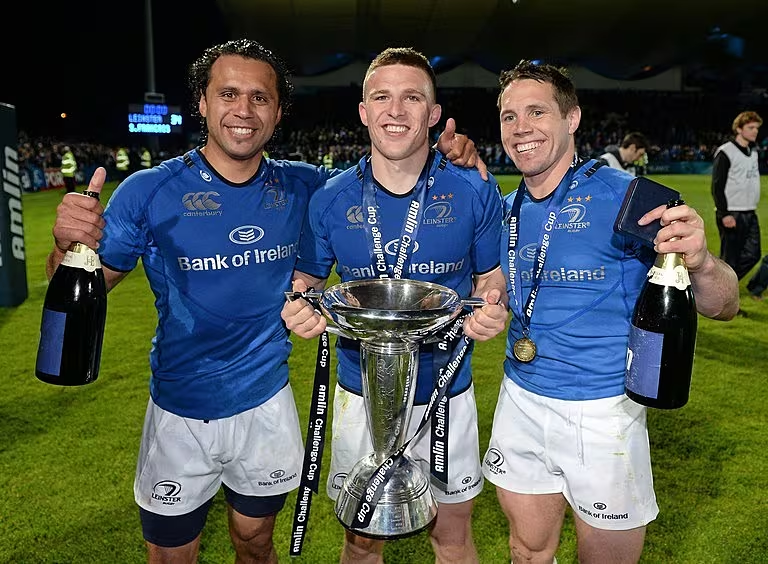 17 May 2013; Leinster’s, from left, Isa Nacewa, Andrew Conway and Isaac Boss celebrate with the cup. Amlin Challenge Cup Final 2012/13, Leinster v Stade Francais, RDS, Ballsbridge, Dublin. Picture credit: Stephen McCarthy / SPORTSFILE
One of the great “what could have been” players in Irish rugby history.
Isa Nacewa was one of the defining players of Leinster’s greatest ever era, starring in the Heineken Cup wins of 2009, 2011 and 2012. He would later return from retirement to spearhead their fourth triumph in 2018, kicking the winning penalty against Racing 92.
Nacewa was born in New Zealand but opted to play for Fiji. However, he would earn just a single cap for Fiji, playing less than three minutes and failing to touch the ball in a 2003 friendly against Scotland.
The utility back would have met the modern criteria to switch to Ireland, but the new rules which permitted such changes only came into effect after Nacewa’s retirement.
What an addition he could have been to the Ireland setup.
Lawrence Dallaglio (England)
A pantomime villain to many Irish rugby fans, Lawrence Dallaglio actually came incredibly close to lining out in green.
Dallaglio’s mother was born in Mallow, County Cork, and the back-row was approached to play for Ireland ahead of the 1994 summer tour by then-head coach Noel Murphy.
However, as he mulled over his decision, he was approached by England, and ultimately opted to play for the nation of his birth. Years later, he would admit that he may well have chosen Ireland had that call not arrived.
Dallaglio in an Ireland shirt is a hard image to wrap one’s head around.
Jack Willis (England)*
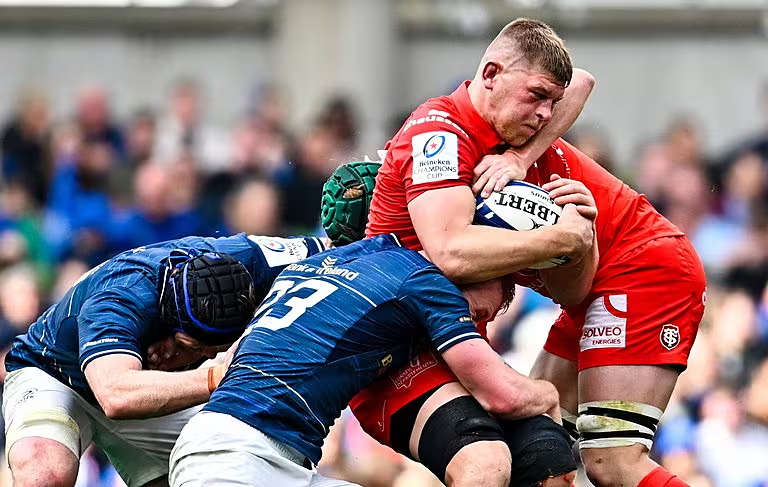 29 April 2023; Jack Willis of Toulouse is tackled by Caelan Doris and Ciarán Frawley of Leinster during the Heineken Champions Cup Semi Final match between Leinster and Toulouse at the Aviva Stadium in Dublin. Photo by Ramsey Cardy/Sportsfile
Jack Willis’s eligibility for Ireland is a particularly hot topic, considering the English flanker is still active and could opt to line out in green in the future.
The English back-row boasts 14 caps for his country, but has not played for England since the 2023 World Cup, on account of playing his club rugby for Toulouse in France.
Willis is eligible for Ireland (along with his brother Tom) through his grandfather, and could conceivably play for Ireland should he move to a provincial team, given it has been three years since he last played for England. However, that does not appear to be a possibility he has entertained.
“I am quarter-Irish. My grandad is from Northern Ireland so he’s fully Irish,” Willis said in a 2024 interview.
“But I’ve always grown up supporting England, my brother (Tom) the same. You are always looking into possibilities, you want to be playing international rugby but, for us, we see ourselves as English.
Grégory Alldritt (France)*
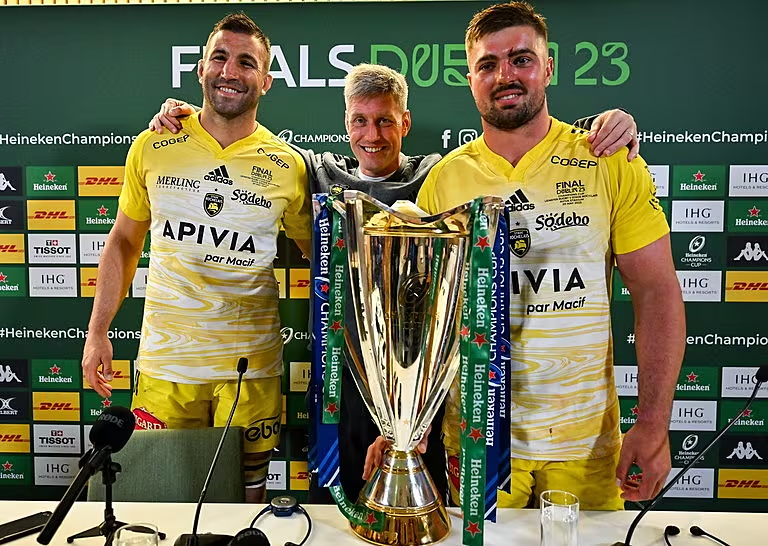 20 May 2023; La Rochelle head coach Ronan O’Gara, centre, with Romain Sazy, left, and Grégory Alldritt after the Heineken Champions Cup Final match between Leinster and La Rochelle at Aviva Stadium in Dublin. Photo by Brendan Moran/Sportsfile
Grégory Alldritt’s Irish connection is one of the more surprising in world rugby.
The La Rochelle back-row did reveal, though, that his grandfather was born in Dublin, and so he could have chosen to play for Ireland. However, he explained that he did not feel “Irish enough,” preferring either France – or Scotland, who he also traces his roots back to.
To be honest, I’m not feeling Irish enough to play for them.
I’ve got lots of respect for this team. I love this team and this country, but if I had a choice to make, it would have been between Scotland and France.
Alldritt was dropped from the French squad earlier this year in a bombshell call, but it still seems hugely unlikely we’ll ever see him play for Ireland.
Bobby Skinstad (South Africa)
Surely the only Rugby World Cup winner with a parent from County Louth, Bob Skinstad could easily have opted to line out in a different green jersey.
Skinstad was part of the Springboks team which won the 2007 World Cup, but could easily have opted to play for either Ireland or Zimbabwe due to his family lineage. His mother hailed from Louth.
Austin Healey (England)
Like Dallaglio, Austin Healey is a figure widely disliked by Irish rugby fans, but things could have been oh so different.
Again like his England teammate Dallaglio, Healey was once approached to play for Ireland. His explanation for opting against playing for Ireland, though, was a touch less classy than Dallaglio’s.
“I have Irish blood and I’d been approached to play for Ireland some years before,” Healey wrote in his autobiography.
I’d asked myself, ‘Could I sit in an Irish changing room at Twickenham and say ‘Let’s smash these English bollocks’. The simple answer was no, I couldn’t.’
Joshua Brennan (France)*
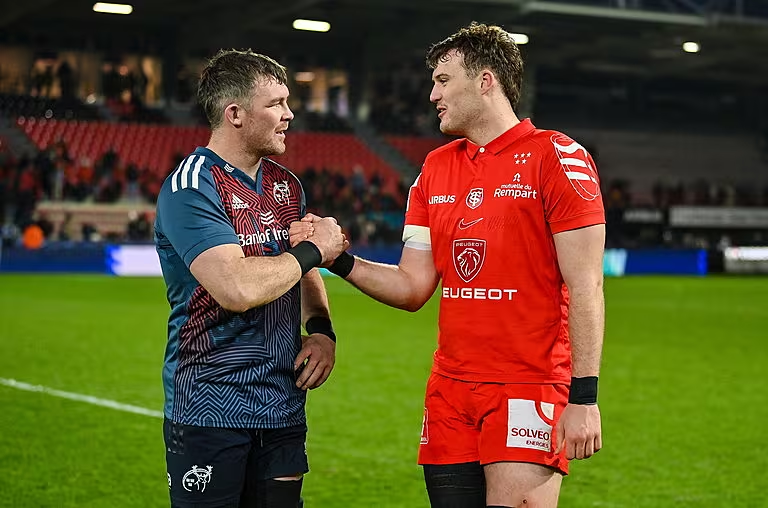 22 January 2023; Joshua Brennan of Toulouse, right, meets Peter O’Mahony of Munster after the Heineken Champions Cup Pool B Round 4 match between Toulouse and Munster at Stade Ernest Wallon in Toulouse, France. Photo by Brendan Moran/Sportsfile
Another currently active player, Joshua Brennan’s father Trevor was a trailblazer for Irish rugby fans, moving to Toulouse in 2002 after the conclusion of his Ireland career.
Brennan Jr and his brother Danny both grew up in France, and both represented Les Bleus through their underage careers.
Josh Brennan has established himself as a star of his father’s old club, and has now earned three senior caps for France. He scored a try during last summer’s tour of New Zealand, and earned a Six Nations winner’s medal this year after featuring off the bench in the decisive game against England.
Tommy Seymour (Scotland)
One of Scotland’s most prolific try scorers of all time could have been running them in for Ireland.
Tommy Seymour mostly grew up in Northern Ireland, and began his career with Ulster. He came up through the province’s academy, before making seven senior appearances for the Ulstermen.
However, he spent the majority of his career with Glasgow, and ultimately opted to play for Scotland, scoring 20 tries in 55 test appearances.
Honourable mention: Owen Farrell (England)*
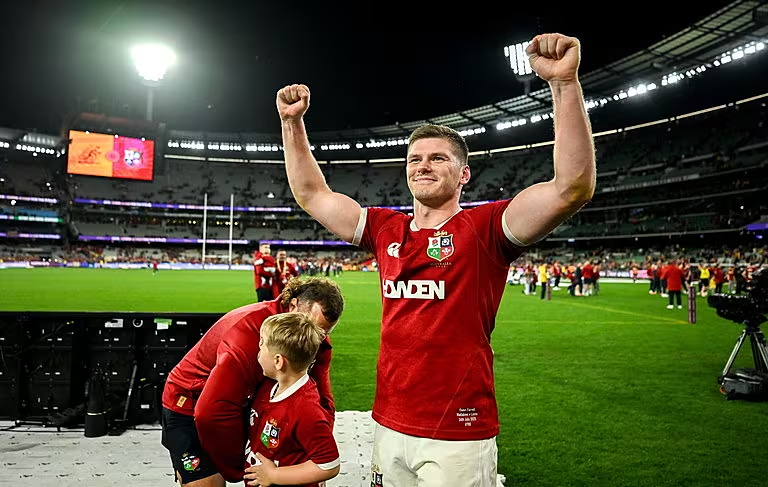 26 July 2025; Owen Farrell of British & Irish Lions celebrates after the second test match between Australia and the British & Irish Lions at the Melbourne Cricket Ground in Melbourne, Australia. Photo by Brendan Moran/Sportsfile
An honourable mention because Owen Farrell’s international eligibility is still something of a mystery.
There is definite Irish lineage in Farrell’s family (we’re not talking about his father being head coach), but it appears to have been confirmed that it is not a direct enough link to make him eligible to play for Ireland.
Like Willis, this year will mark three years since Farrell’s last appearance for England.
* = Currently active player