
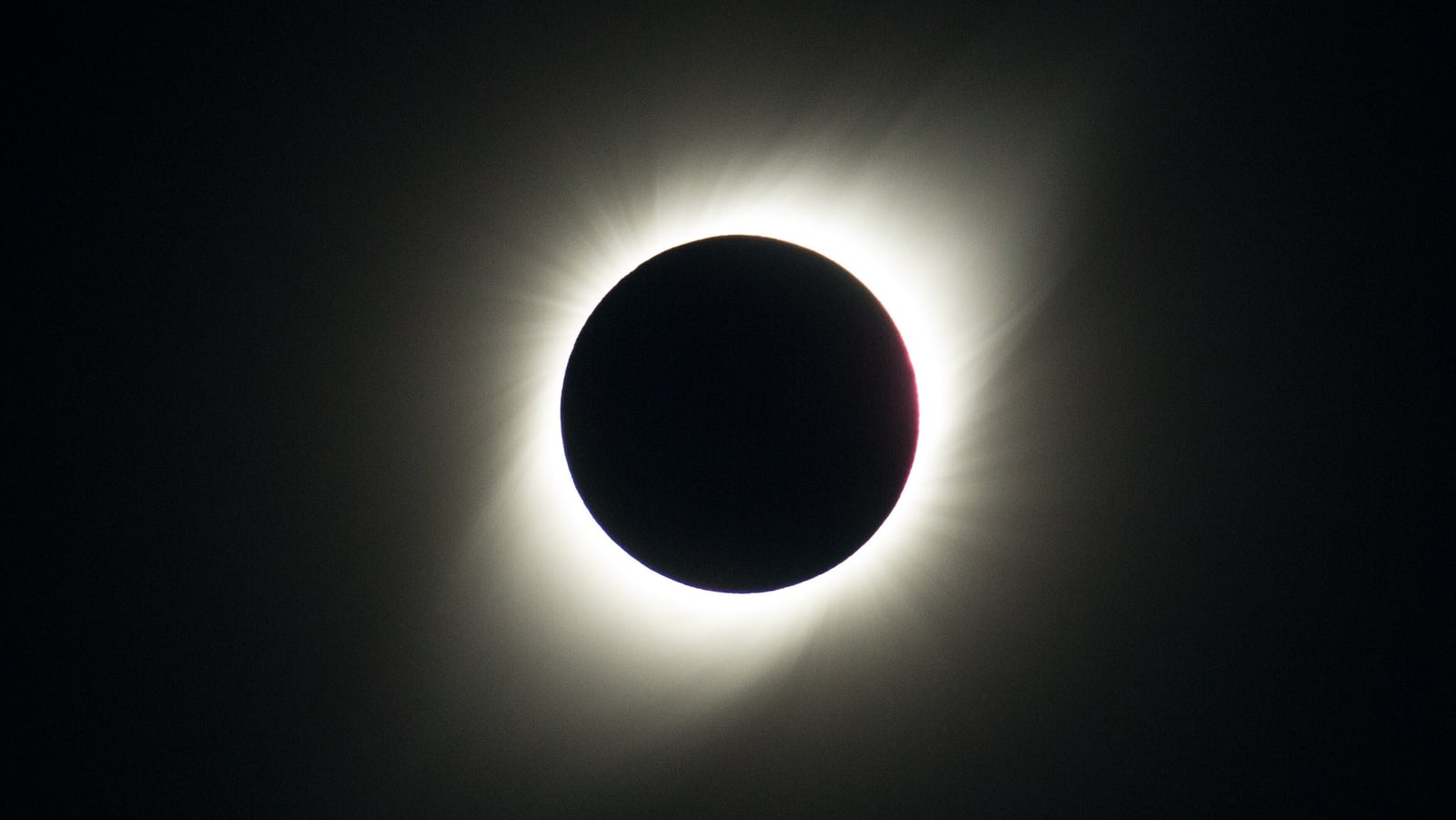
Analysis: An eclipse gives the opportunity to learn more about the sun, moon, stars, and exoplanets which orbit stars outside the solar system
A solar eclipse, like the one that will be visible from Ireland on the evening of the 12th of August, is a spectacular and thought-provoking sight. The more you think about eclipses, though, the more questions you have – these questions have fascinated astronomers from the time of Newgrange right up to today, when eclipses help us learn about the Sun and the fundamentals of the universe.
How do eclipses Happen?
The Moon orbits the Earth once a month, and the Earth orbits the Sun once a year. A solar eclipse occurs when the Moon passes between the Earth and the Sun, blocking sunlight from reaching us. Where the Moon lines up perfectly with the Sun, the Sun is completely blocked out, giving a brief period of Total Solar Eclipse, as will be the case in Greenland, Iceland and Spain. Away from that perfect line-up, some of the Sun can be seen “peeking out” from behind the Moon, giving a Partial Solar Eclipse, which is what we will see in Ireland.
From YouTube channel Dartmouth, what’s the Difference Between a Partial and Total Solar Eclipse?
Why don’t eclipses happen every month?
The orbit of the Earth and Moon are slightly tilted against each other. This means that most of the time, the Moon passes above or below the Sun from our perspective. Only when the Moon and Sun line up perfectly do we get an eclipse. Ancient astronomers, such as the people who built Newgrange, would doubtless have known this by tracing the paths of the Moon and Sun across the sky. They may have attributed these events to supernatural causes, but knowing the sky allowed them to make practical predictions about the tides and seasons.
From YouTube channel VideoFromSpace, why Solar Eclipses Don’t Happen Every Month
Why are our eclipses special?
Eclipses on Earth are special, because the Sun and Moon appear about the same size in the sky. Long before the invention of the telescope, astronomers from China to Egypt to Greece worked out that this meant their distance and size must be proportional. Modern techniques confirm that the Sun is about 400 times bigger than the Moon, but it’s also 400 times further away from us. Elsewhere in the Solar system, Mars’s tiny moons, Phobos and Deimos look like potato-shaped blobs crossing the Sun, while for Jupiter, the distant Sun is blocked out entirely by its large moons Io, Europa, Ganymede and Callisto.
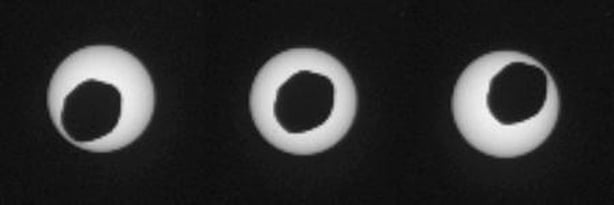
An eclipse of the Sun by Phobos viewed from Mars (Image: NASA)
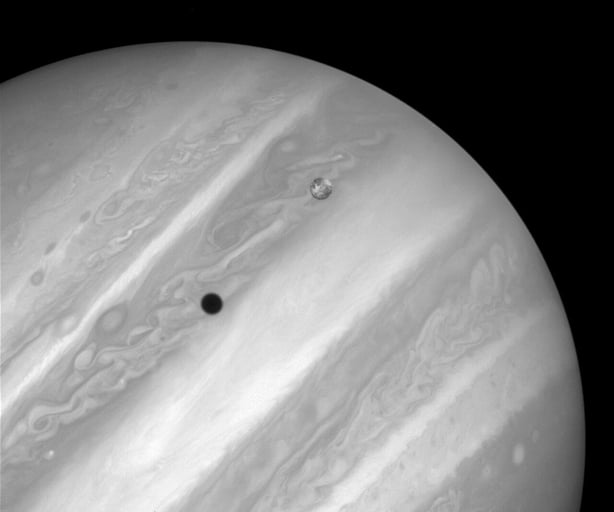
Jupiter with its moon Io casting a shadow (eclipse) on the giant planet (Image: NASA/ ESA)
What else can eclipses teach us?
The close match in apparent size means that, during a total solar eclipse, we can see very close to the Sun without being blinded by its bright surface. This allows us to study the Corona (meaning crown). This is a thin and wispy layer of extremely hot gas surrounding the Sun. Its irregular shape is governed by the Sun’s magnetic field. During an eclipse, we can study the corona and learn a lot more about the interior of the Sun by studying these patterns.
An eclipse was at the heart of one of the first proofs of Einstein’s theories of relativity. We’re used to light travelling in straight lines. Light reflects off mirrors, and deflects when it enters and leaves lenses, but it follows straight paths between those points. However, gravity does actually pull on light, and causes its path to bend.
The effect is too small to notice unless you have a lot of mass, and thus a lot of gravity. Close to the Sun, there’s enough gravity to cause the light from stars in the background to appear to be pulled slightly towards it. Unfortunately, the light from the Sun usually drowns out those stars.
We need your consent to load this rte-player contentWe use rte-player to manage extra content that can set cookies on your device and collect data about your activity. Please review their details and accept them to load the content.Manage Preferences
From RTÉ Radio 1’s News At One, scientists to study upcoming total solar eclipse
During an eclipse, the Moon blocks the sunlight, allowing us to see the stars behind it. In 1919, two teams of astronomers visited Príncipe (now São Tomé and Príncipe) and Sobral, Brazil. Their grainy, black-and-white photographs showed the stars close to the Sun out of place by exactly the amount that Einstein predicted. One of the instruments used in this experiment is kept at Dunsink Observatory.
Is there something to learn beyond eclipses?
Exoplanets are planets that orbit stars outside the solar system. When they line up just right with their star, we see a transit, a sort of mini-eclipse. This has allowed astronomers to discover thousands of alien worlds. During a transit, some of the light from the star passes through the planet’s atmosphere. This imprints a distinct chemical signature on the light. Using the James Webb Space Telescope and the upcoming ARIEL telescope, we can study this signature, and look for signs of life.
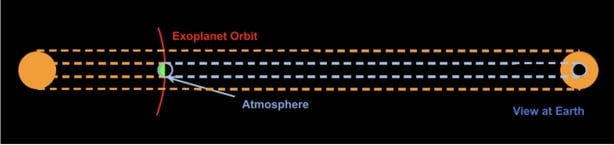
An illustration of an exoplanet transit, showing light passing through its atmosphere
Eclipses and their cousins the transits still have a lot to teach us about the universe. I look forward to watching the upcoming eclipse using solar glasses (free from colleagues at MTU), using a pinhole camera or a number of other safe methods. Just make sure not to look directly into the Sun, and definitely not through a telescope!
Follow RTÉ Brainstorm on WhatsApp and Instagram for more stories and updates
The views expressed here are those of the author and do not represent or reflect the views of RTÉ