

“He approaches his job the way I approach my job, which is completely all-in—viewing it as a psychological, spiritual, emotional, physical endeavor,” says Bruce Springsteen, who got to know Strong when he played Jon Landau, the Boss’s longtime manager, in Deliver Me From Nowhere. “You’re using your complete self to manifest something that’s basically magical.”
Other friends described him as a lifeline call and a lodestar. “He’s sent me some of the most helpful thoughts around what it is that we’re doing,” his friend Oscar Isaac says—thoughts about acting as a calling, as opposed to a career.
I can testify to his thoughtfulness. He’s a sender of multi-paragraph text messages, big blocks of considered words—addendums on things previously discussed, book recommendations, quotes from Joseph Campbell. (Strong is big on quotes—in the course of our conversations, he cited Bob Dylan, Robert Musil, Simone Weil, Al Pacino, Goethe, an email he got from Anthony Hopkins, and the Saturday Night Live sketch where Adam Sandler plays a travel agent warning depressed people that they’ll still be depressed in Italy. He feels his propensity to epigrammatize gets misconstrued as pretension. He’s just a magpie, he says. “It’s not about the shininess of the objects, but it’s about their usefulness. The magpie is just trying to build their nest, y’know?”)
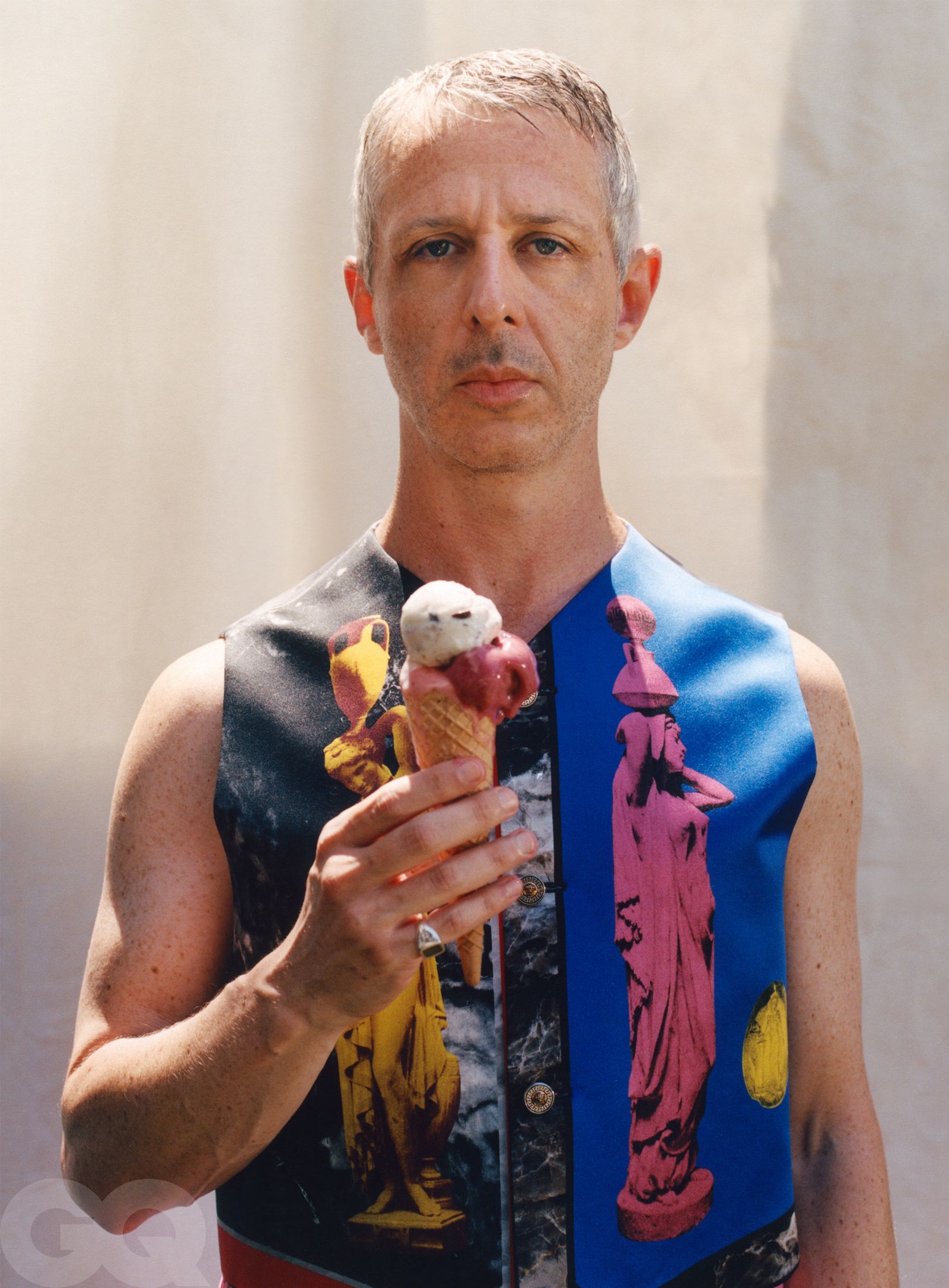
Vest by Versace.
Back in 2017, a few months after Donald Trump was sworn in for the first time, I went to see the documentary filmmaker Adam Curtis do an onstage Q&A with Mad Men creator Matthew Weiner after a rep-theater screening of Michelangelo Antonioni’s The Passenger. As artists, Weiner asked Curtis toward the end of the night, what should we do now? Curtis answered: Go and tell us how the rich live. I wrote this down, and after my first meeting with Strong, I find it in my Notes app and send it to him—thinking of Succession, and all the other projects where he’s explored the spiritually impoverished inner lives of the one percent.
Strong replies that he’s not sure he agrees with Curtis that this is all artists should be doing—that he thinks artists, in this historical moment, “should tell us what is irreducibly human and worth fighting for.” He sends me a picture of a quote he kept taped to his dressing room mirror when he did Henrik Ibsen’s An Enemy of the People on Broadway; it’s the line about “forc[ing] our brothers to see themselves as they are, to cease fleeing from reality and begin to change it.” It’s like Strong is saying, Don’t even try going quote for quote with the Quotemaster. (Just kidding: He is unfailingly polite and considered in his texts, and makes only an irreducibly human number of typos.)
Bradley Cooper laughs when I mention Jeremy sending voluminous text messages. “Yeah, dude,” Cooper says, delighted. “He’s my friend. I can’t say I have that many in this business, but I consider him my friend.” Cooper sends Strong work-in-progress drafts of scripts and shows him cuts of movies he’s editing. They’ll watch, Cooper says, and they’ll talk, “and then the choice text, or the choice thought, will usually come [when he’s] on his way home on the subway, or he just got home [and] he has a second to meditate on it. He’s so insightful about story and character and truth.”