
Welcome to Fast Company Daily, our daily newsletter on LinkedIn, featuring a free article selected each day by our editors as well as a roundup of great advice on careers, hiring, innovation, and technology.
Visit fastcompany.com for our top stories and breaking news. First time seeing this? Please subscribe.
[Illustration: FC]
At the beginning of the summer, Figma, the popular design platform, hosted a funeral for design. “Come pay your respects,” the company posted on X, inviting visitors to a pop-up on Rivington Street in New York City. Attendees found a site adorned with funereal flower arrangements and received black hats that read “Design Is Dead.” On Instagram, the company posted, “we mourn design—killed, according to X, approximately 847 times this year alone.”
The pop-up, part of a larger advertising campaign from Figma, came (at least in part) as a response to Claude Design, Anthropic’s new tool for creating visuals from presentation slides to interface prototypes. Before the release, Mike Krieger, Anthropic’s chief product officer, resigned from Figma’s board, putting the two companies on a collision course. (Anthropic’s launch prompted a temporary 7% decrease in Figma’s market cap.)
The “Is this the end” narrative has followed Figma, now considered an incumbent in the design tooling world, since its 2025 initial public offering. Despite 48% year-over-year revenue growth, its stock is still down roughly 80% from its all-time high, underscoring the uncertainty around how designers will work—and with what tools—in the AI era.
Design has always been a strangely insecure profession, and Figma’s tongue-in-cheek response tapped directly into the uncertainty around what the future of design looks like.
The existential dread started in earnest in 2021 when OpenAI launched DALL-E, an image generator that could create realistic images from simple text prompts. DALL-E opened the floodgates and was quickly followed by other image generator products, from Midjourney to Adobe Firefly.
With each new advancement in AI, it can feel to designers like they are steadily marching toward the end of . . . something. If we’re to believe the doomsday narrative, AI seems to signal not just the end of our jobs, but the end of design itself.
Yet as I’ve spoken to leaders across design and AI over the past few months, the future of design feels less dire than our doomerist thinking leads us to believe. Besides, design has survived technological innovation many times before. Is this time really any different?
Read more on Fast Company Premium.
A Fast Company Premium subscription offers readers full access to subscriber-only stories including exclusive reporting and trend analysis on technology, business innovation, future of work, and design.
Get the details and subscribe here.
Levain Bakery just dropped a Crate & Barrel collab for all your cookie needs
Levain Bakery used to use Crate & Barrel products to display its cookies because the home goods brand’s serveware looked clean, simple, and elevated.
“We weren’t finding some sheet pans or something at a restaurant supply place,” Levain Bakery’s cofounder, Pam Weekes, tells Fast Company. “We kind of wanted something that was a little more unique and special.”
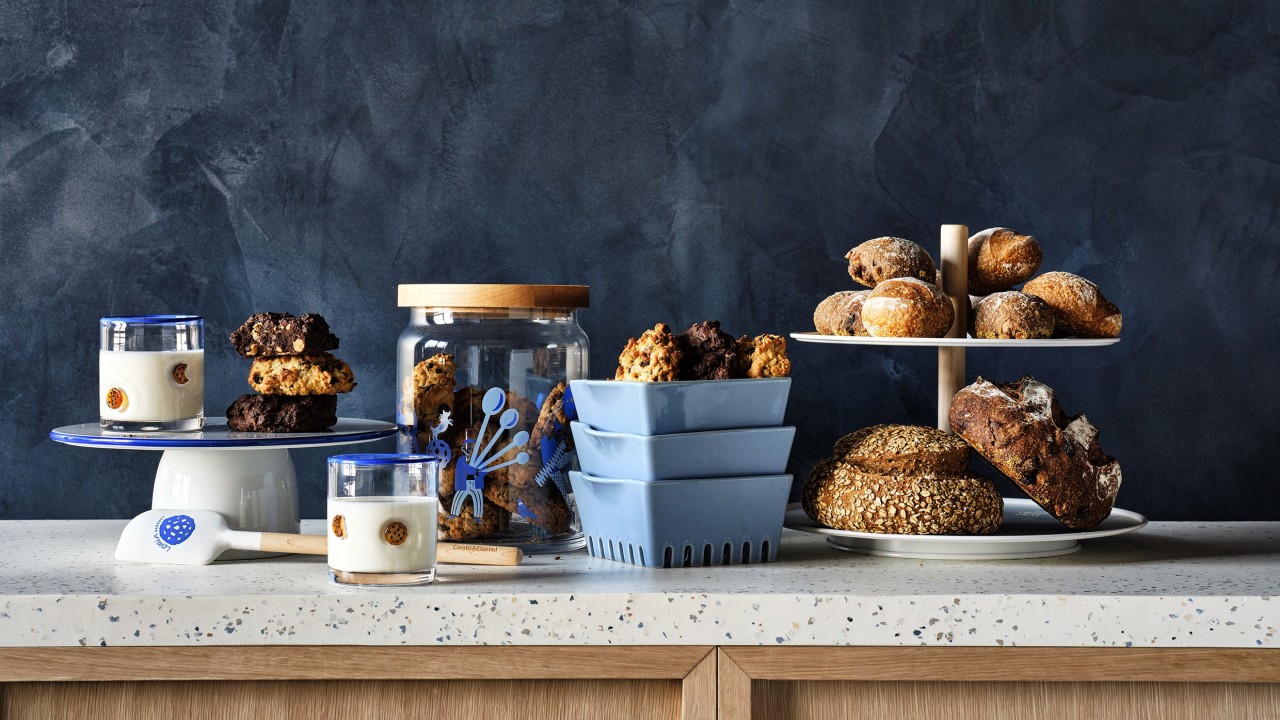
Now the bakery has collaborated with the home goods brand on a 17-piece collection.
The two brands announced their collaboration Tuesday, which includes items like plates, glasses, dish towels, spatulas, mixing spoons, and a $15 ceramic Mini Crate inspired by the berry box colanders Levain Bakery has long used to display their cookies. The collection’s $18 Cookie Glass is hand-blown, and the $20 Perfect Silicone Cookie Mat was designed to make Levain-sized cookies at home.
Everything in the collection is something the bakery’s cofounders would use themselves.
“It was a real collaboration, which was really nice because I think we’re pretty particular, and we’re pretty clear about what we like and what we don’t like,” Weekes says. “But they’re pretty particular as well.”
The design process brought together Levain Bakery’s baking know-how and playful visual identity with Crate & Barrel’s manufacturing expertise and functionality.
When the bakery said they wanted to make a cookie jar, for example, Crate & Barrel had plenty of experience with making them. And when they wanted to make a bench scraper, a tool used to cut dough and scrape messy counters clean, Weekes and her team could explain their specific needs. Bench scrapers at restaurant supply stores are typically too big and clunky, so Levain Bakery has gotten theirs from France. (The bakery also got its name from France, as levain means leavening.)
Read the full story on Fast Company.