

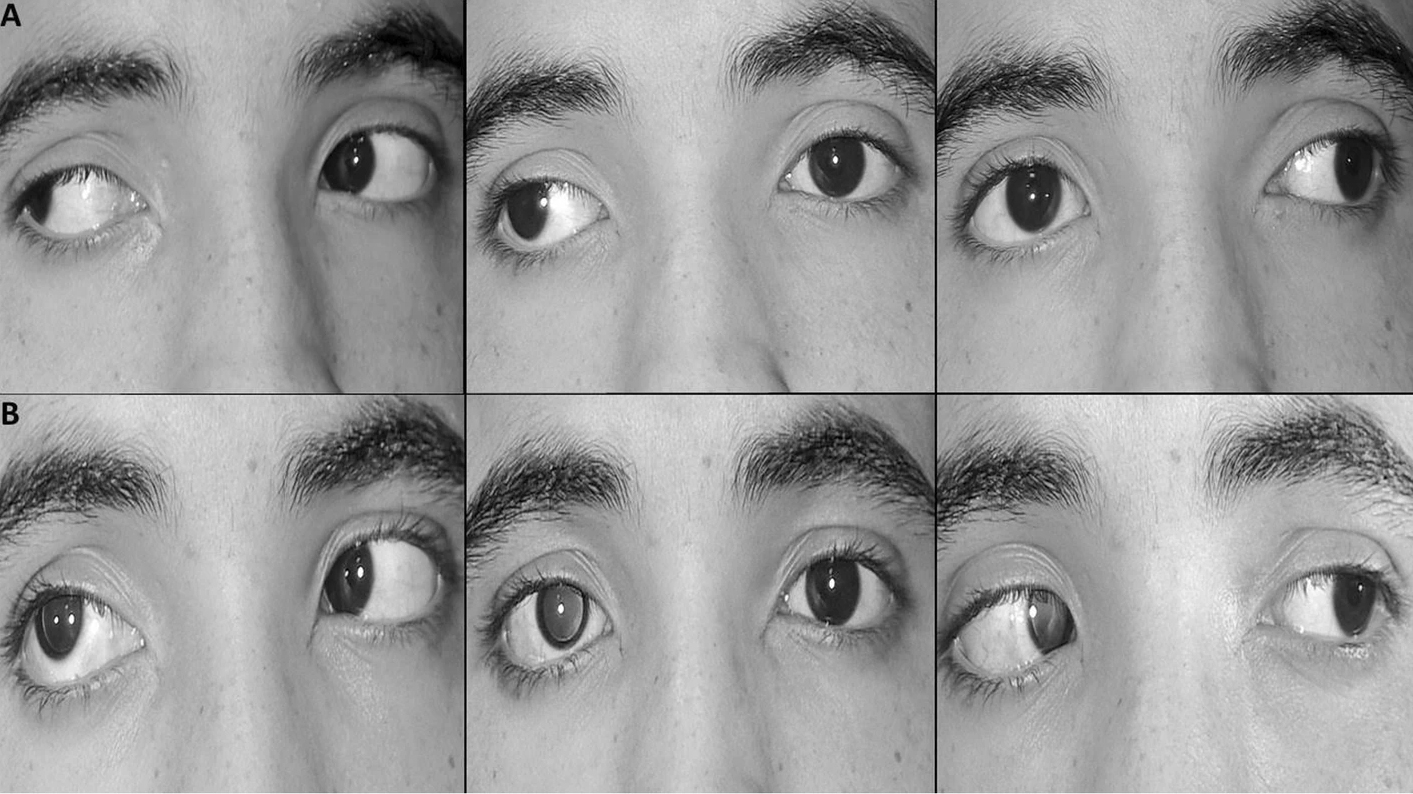
Better baseline stereoacuity and distance fusion were associated with better treatment outcomes in patients with intermittent exotropia who underwent office-based VT, as these findings indicate stronger baseline sensory fusion. This study suggests that baseline convergence amplitude alone may be less predictive of functional recovery following VT than sensory measures. Photo: Mohamed F. Farid. Click image to enlarge.
Intermittent exotropia (IXT) is the most common form of strabismus in Asian populations, with vision therapy (VT) being a promising nonsurgical treatment for the condition. However, the relationships between VT dosage, baseline characteristics and treatment outcomes in IXT remain unknown. In a recent study, researchers investigated the efficacy of office-based VT for treating this condition and identified factors associated with positive treatment outcomes, including higher session frequency and better baseline binocular function. The findings were reported in Ophthalmology and Therapy.
A total of 636 patients (aged four to 34) with IXT who completed office-based VT between 2020 and 2024 in China were included. They were stratified into three groups based on the number of sessions completed: 10 sessions (n=65), 20 sessions (n=486) and ≥30 sessions (n=85). Recovery was defined as a composite measure requiring stable fusion (Worth Dot test; 33cm, 1m and 3m), near and far stereoacuity of ≤100 arcseconds and convergence amplitudes of ≥25°.
Overall, 46.5% of patients achieved functional recovery. Recovery rates were 38.5% in the 10-session group, 46.5% in the 20-session group and 52.9% in the ≥30-session group. After adjusting for baseline characteristics, each additional 10 VT sessions was associated with a 5% increase in the odds of functional recovery.
While completing at least 20 VT sessions was associated with better treatment outcomes, no significant association was found between weekly VT frequency and outcomes. “Given that treatment intensity was clinically determined rather than randomly assigned, these results may be confounded by indications such as baseline status,” the authors explained in their paper. When VT is prescribed for intermittent exotropia, office-based sessions are commonly supplemented with home-based exercises, increasing overall treatment exposure. “However, important questions remain regarding optimal VT protocols, including which treatment procedures are most effective and the role of diplopia awareness training,” the authors added in their paper. They noted that further research is needed to determine the optimal VT dosage, frequency and treatment procedures.
Better baseline Worth Dot fusion at 3m significantly increased the likelihood of recovery, while worse baseline near and far stereoacuity were associated with a reduced likelihood of recovery. The authors weren’t surprised that better baseline stereoacuity and distance fusion were associated with better treatment outcomes, as these findings indicate stronger baseline sensory fusion. “In contrast, the lack of an association between baseline convergence amplitudes and treatment success may be more surprising, given that convergence is the compensatory vergence mechanism in IXT, and prior studies have reported an association between convergence ability and IXT control,” the authors explained in their paper. “However, our findings suggest that baseline convergence amplitude alone may be less predictive of functional recovery following VT than sensory measures.”
In addition, convergence demand varies with the magnitude of the exodeviation, with larger deviations presumably requiring greater amplitudes that may be difficult to achieve with VT. Importantly, after adjustment for baseline sensory and motor measures associated with functional recovery, a greater number of VT sessions was associated with higher recovery rates, supporting a dose-response relationship between the number of VT sessions and functional recovery.
The authors recommend future prospective, randomized trials to confirm these findings and identify optimal treatment protocols.
Click here for the journal source.
This article was developed by the editorial staff in conjunction with experts in the field. In the process, AI may have been among the editorial tools used to meet the goals of human editors, who approved all content.