
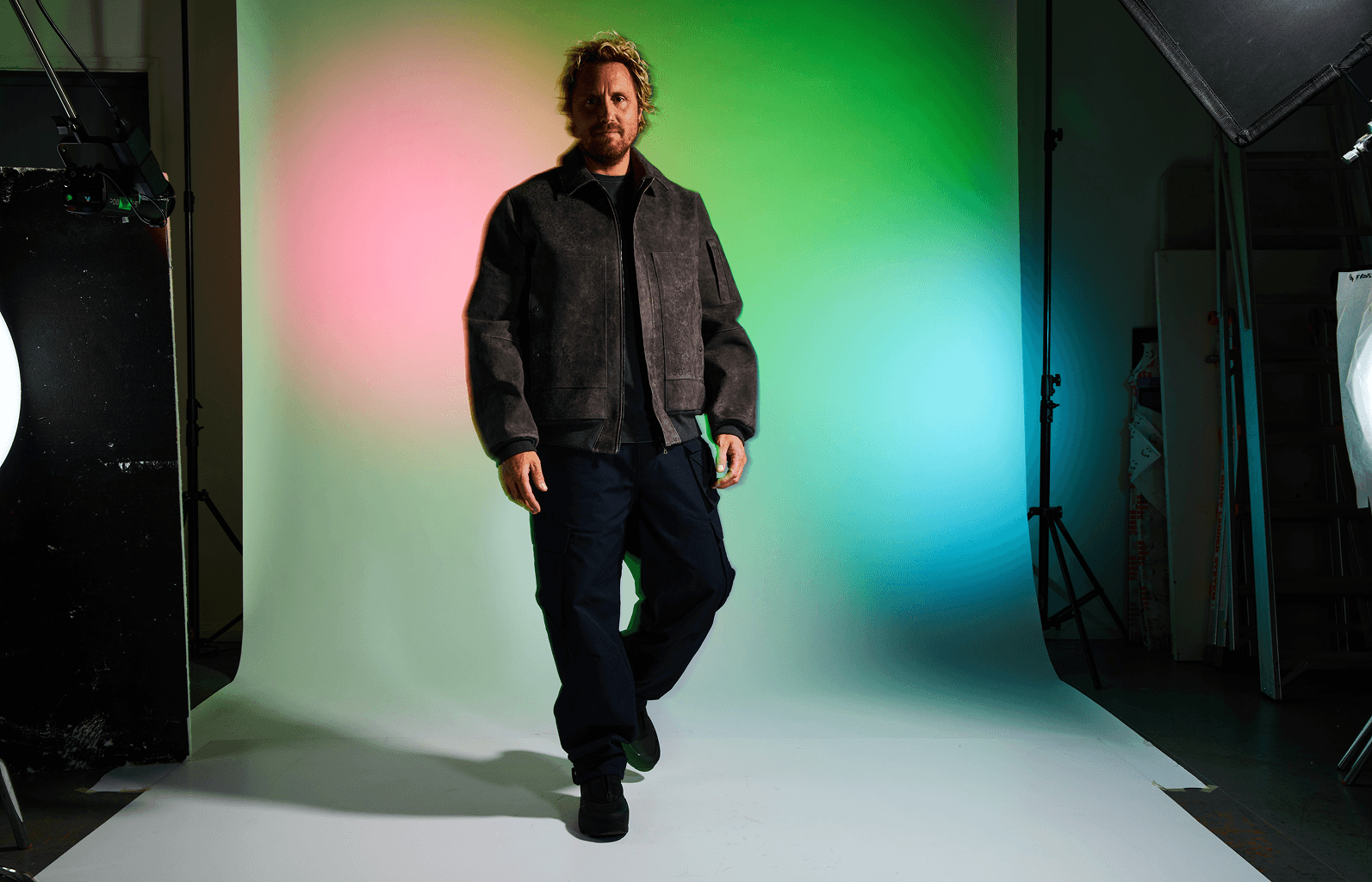
SK: Your work often looks to nature for inspiration—whether it’s butterfly wings or squid skin—while staying deeply futuristic. Where do you see the line between copying nature and going beyond it, if there is one at all?
NT: Nature is the smartest scientist you’ve ever seen. If people had to recreate a bumblebee now—we can’t do it. We can’t do anything. We probably can’t recreate a worm. Nature is so utterly, fantastically clever, because as far as I’m aware it’s had about 780 million years to get good.
I don’t think there was much complex life on Earth until relatively recently. Say the Earth has been around for 4.5 billion years. Nature, in terms of complex life, has been evolving for hundreds of millions of years. There was the Cryogenian period, one of the most extreme ice ages on Earth, which lasted a few hundred million years. After things began to warm, life started to evolve in increasingly complex ways. It’s almost as if nature said, “Oh my God, I’d like to start now.” So nature has essentially been practicing for hundreds of millions of years. And humans—in a civilized way, for argument’s sake—for maybe 40,000 or 100,000 years. So our advancements in the last ten years are truly astonishing, but nature is still the greatest inventor ever.
All I like to lean into is people who’ve created incredibly clever technologies. Sometimes the technology is inspired by nature. Trees can be set on fire and then give rebirth to themselves—it doesn’t matter that they’re on fire, it’s almost the way they germinate. They have these incredible survival properties. So let’s say we make clothes like that. And then we probably also make clothes which are strictly technological—take the Martian Aerogel Jacket, which uses a parachute they use to land the Mars rover. But then, honestly, they made those parachutes inspired by seeds that flew.
So I’d imagine if you were to write a PhD on it, the idea that everything is not inspired by nature is probably impossible. You could draw every technological revolution in clothing back to this: them trying to mimic something in nature, or create something incredibly tough. There isn’t really a distinction—science and nature are the same thing. It’s a fascinating thing to think about.
As we move forward, there’s going to be an inevitability that biology and science will almost merge, with people working with biology at the most fundamental level to build materials that have never existed before. I think it’s called atomic layering, where different materials are layered together at an atomic, microscopic level to create these quantum materials. But again, you’re probably just doing something that nature has been doing for 500 million years and is already very good at. I’d imagine that’s what it will come down to.
I also think in the next thousand years—or maybe two thousand—you really will start to grow most materials. You’ll have self-healing materials, and they’ll simply become more like nature. You’ll be able to change things at a molecular level. That’s probably just an inevitability, where we scientifically change our environment. And maybe the more we advance, the closer to nature our materials get.
In the same way, you eventually might make things that fly through the air powered by the universe, as opposed to oil or petrol or gas. It might be that our clothes are powered by—I don’t know—they’re built by the equivalent of grass, and they grow through sunlight. The idea that we can predict what’s going to happen in the next 5000 years is impossible. It might actually go back to when the original caveman was found with a grass skirt and bare-skin shoes. It might revert to that, when we use nature even more. We just understand how to harness it.
SK: In your experience, what actually drives real innovation more: technical possibility or imagination?
NT: It has to be imagination, in my opinion, because the technical comes from “one plus one equals two” answers. I take this and this and I make this. The best ideas in the world forever are going to come from people’s brains. I was looking at what the human brain is capable of: in one second, it can do a 100 trillion computations per second. So imagination is always going to be king, because it’s the fundamental architecture that creates the new idea—and then the engineering simply catches up. Someone will have an idea so radical that then they have to work out how to do it. That’s the difference between science and imagination, and I’m always going to say imagination is better, because science will catch up to it. You can imagine anything. I can imagine a world where I jump through a portal and suddenly I’m on Mars. Maybe in 2,000 years, that happens, and that is simply the way we travel. But the engineering is not there yet. Engineering is the thing that responds to the imagination.
SK: AI is starting to enter every creative field. How is it already touching your process—if at all—especially when it comes to ideas, materials, or prototyping?
NT: AI is a funny one. If you take the sentence, the limit of your world is limited by your language—the AI can currently only know everything that’s been fed into it. Unless I’ve got something wrong about AI, which is possible. Its limit is therefore everything it’s been fed. Say it’s been fed fifty percent of the knowledge of all humanity, because it’s pretty hard to feed in all the stuff of past civilizations. You can’t feed into it everything the Aztecs did, because they might have done ninety percent of stuff we don’t know about. So you’re feeding it a part of the world that’s happened in the last, say, ten, twenty years—everything that exists digitally. Which is still a lot of resource.
I personally love it. It’s simply a tool; it’s simply how you use it. At Vollebak, currently the only thing I’m using it for is very fast visualizations of ideas. That’s it. But it’s only fast if you have really good taste. Say you have terrible taste and a terrible idea—it’s going to spit out some terrible things. But if you have really nice taste and a really nice idea, with a bit of tweaking it can produce some fairly good things. The visualization of a world or an object is useful, but that’s about it for now.
On Sonic Jacket, we used AI to visualize some really fast ideas, but essentially it was us feeding it: now I’d like the wires thicker and yellow. Now more like this. I want it black. It’s just a very fast tool. It’s like having access to a brilliantly fast painter—but one who can paint your portrait in two minutes, like Michelangelo. Well, maybe not Michelangelo—it definitely lacks some of the art. It lacks some of the imagination. It lacks human brilliance.
There will also be a bit of a—not a war, but a thing—in the world of high-end stuff: high-end AI art versus high-end human art. Some people go, I love this, because it’s pure human touch, this is a wine grown from a grape in a field here. Other people might use AI to create the greatest wine ever in the greatest glass bottle ever. You’ll have some who go, I love the humanity of this, and some who go, I love the technology of this. At Vollebak, it’s quite easy—I use it as a tool, the same way I’d use Photoshop, or Illustrator, or a great art director. Obviously, it’s changing very fast, and in the past two or three months, AI has become extraordinarily good at video. Ridiculously good.
I made the first AI video for Sonic Jacket. That was an incredible experience. I worked with Maxim Kelly, and he creates incredible dystopic AI views of America that look maybe like the nineteen sixties, black and white. I got him to create an imagined time where the Sonic Jacket has existed for quite a long time. It was very fun, very interesting to do, and it felt like a very modern thing. But I wouldn’t want to become overly reliant on it—in the same way I got my friend Henrik, who’s Swedish, to paint me three aliens. If it’s used in conjunction with everything else, it’s great. If you say it’s the only thing, in an industry like ours—it’s just a tool currently.