
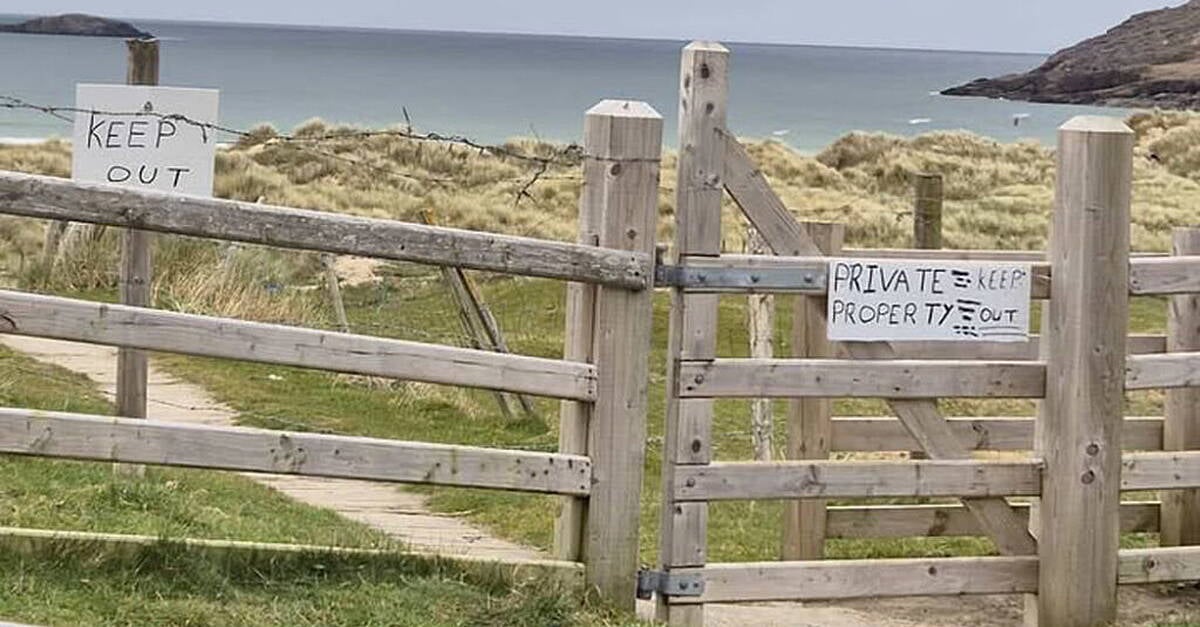
Older people and families are being hardest hit by the closure of the traditional access route to Trá na Rossan beach outside Downings, according to a local campaigner.
A boardwalk from the car park to the scenic beach has been closed since April, when signs stating “private property” and “keep out” were placed at the entrance.
The path, which runs through privately owned farmland, was earmarked for a much-needed upgrade in recent years.
Donegal County Council is planning a new boardwalk entrance and fencing once a lease agreement with the landowner is finalised.
While the council says it is continuing to engage with the landowner in an effort to secure a lease for a public access route to the beach, there is still no date for the works to begin.
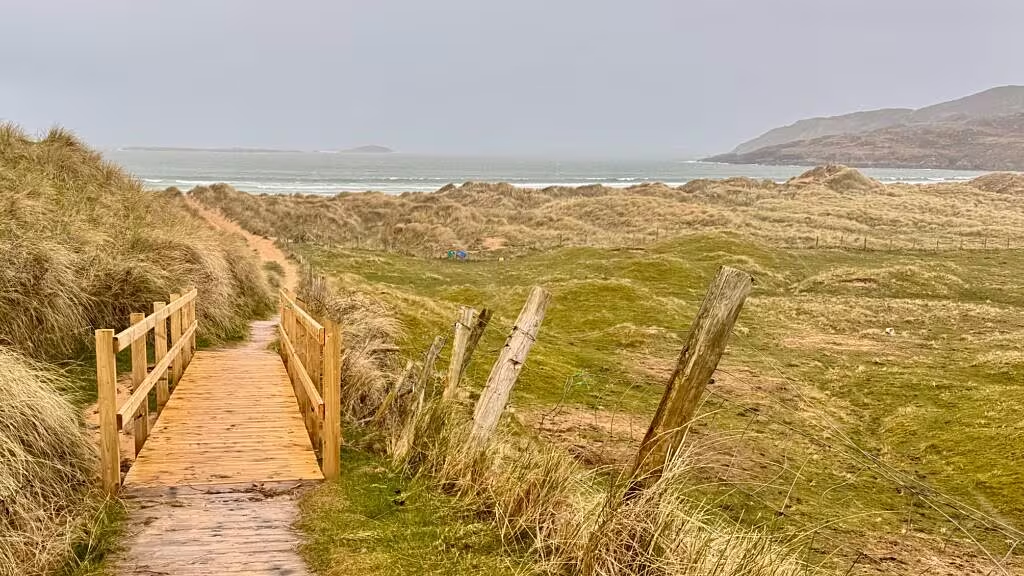
The now-closed access route to Tra na Rossan Beach Downings from the car park. Photo: Donegal Daily
Six months ago, the council confirmed that funding was in place and a contractor had already been procured.
While the beach may still be approached by more difficult routes, one campaigner says these are not a realistic alternative for older people, families and those with limited mobility.
Brian Gallagher, a lifelong user of the route, who is based in the US, has launched a campaign over the continued closure.
Mr Gallagher submitted a detailed 17-page document to Donegal County Council outlining what he says is the personal and public impact of the situation.
He says his own father and uncle cannot reasonably be expected to climb hills, cross fences or negotiate rough terrain to reach a beach they have known for decades.
“A difficult indirect route is not equivalent to safe, usable access,” he adds.
“A young, fit person might negotiate steep hills or rough ground. Older people, disabled visitors, people with limited mobility, families and small children may not,” he states.
He also argues that the closure affects accessibility, tourism, community life and wellbeing, rather than simply causing inconvenience.

Trá na Rossan is one of Downings’ most breathtaking beaches
In response to queries from Donegal Daily, the council confirmed that the proposed lease agreement has not yet been legally executed.
“Discussions between the council and the landowner are continuing, and a number of matters remain subject to agreement between the parties,” the spokesperson said.
“Once all terms have been agreed and the necessary legal formalities have been completed by both parties, the lease can be executed and the proposed access works can proceed.”
You may also be interested in


The council has confirmed that funding identified for the project remains available and that the contractor previously procured for the works remains in place.
“Subject to the completion of the necessary lease arrangements and the securing of access to the site, the contractor will be in a position to commence the works,” the spokesperson said.
There is still no definitive start date.
The anticipated construction period remains approximately one to two weeks, subject to weather conditions and any unforeseen site issues.
The council has also considered interim and alternative access options since the traditional route was blocked in April.
However, it said that no route has been identified that can currently provide public access in a manner that is safe, practical and compliant with its public health and safety obligations.
“The council will continue to monitor the situation and remains committed to securing a long-term solution as quickly as possible,” the spokesperson said.
Mr Gallagher’s submission also asks the council to examine the historic status of the route, including whether it may constitute a public right of way.
The council said it is aware of the long-established use of the route by members of the public and has considered the historical context surrounding access to the beach.
It stressed that no formal determination has been made on whether the route is in fact a public right of way.
“The question of whether a route constitutes a public right of way is, however, a complex legal matter that depends on the assessment of a range of factors, including historical evidence, landownership records, the nature and duration of use, and other relevant legal considerations,” the spokesperson said.
“At present, the council’s priority remains the progression of negotiations aimed at securing a practical and permanent access solution for the public.”
Funded by the Local Democracy Reporting Scheme