
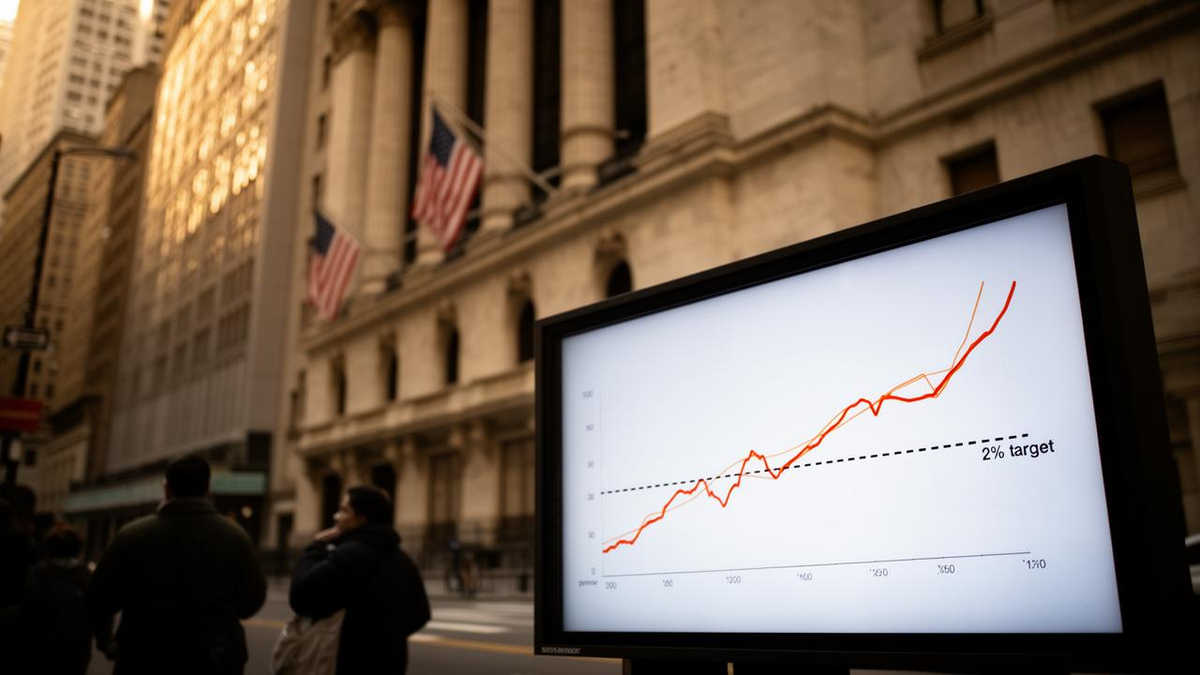
The U.S. Bureau of Economic Analysis will release the July Personal Consumption Expenditures (PCE) price index report at 8:30 a.m. Eastern Time on Wednesday (8:30 p.m. Taipei time). As the Federal Reserve’s core gauge for assessing inflationary pressure, this data will provide critical guidance for markets to evaluate the interest rate trajectory ahead of the September policy meeting, and could serve as a major catalyst for repricing U.S. rate expectations.
Market consensus expects that after June’s first month-over-month decline since 2020 (down 0.11%), headline PCE will rebound in July with a modest increase of approximately 0.1%. The year-over-year rate is expected to ease slightly from June’s 3.7% to around 3.6%. However, core PCE — which strips out food and energy prices — remains under significant pressure, with markets expecting the July core PCE year-over-year rate to hold steady at 3.3%, matching June’s reading. The month-over-month rate is projected to accelerate from 0.1% in June to 0.2%.
Notably, U.S. core PCE has now exceeded the Federal Reserve’s 2% long-term target for 65 consecutive months. This means policymakers still lack sufficient justification to declare final victory in the battle against inflation.
Christopher Hodge, chief U.S. economist at Natixis, noted that while “there is no longer evidence that tariffs are affecting inflation data,” price pressures in specific categories continue to push core inflation higher. He emphasized that upward price pressure on computer hardware and software related to artificial intelligence and large-scale data center construction continues to emerge.
Economists at UBS Group have observed a similar trend, noting that the AI factor’s presence in the inflation basket is slowly rising. While not yet sufficient to completely disrupt the overall inflation picture, as AI technology accelerates its adoption across industries, rising software and IT costs are directly pushing up prices of core durable goods such as computer hardware.
The buoyancy of financial markets also constitutes another driver of inflation. David Mericle, senior economist at Goldman Sachs, expects that higher equity market valuations have directly boosted portfolio management fees, which could contribute 0.11 percentage points to July’s core PCE month-over-month increase. He forecasts July core PCE to rise 0.20% month-over-month and 3.24% year-over-year.
Institutional forecasts for July PCE are as follows:
InstitutionHeadline PCE MoMHeadline PCE YoYCore PCE MoMCore PCE YoYFactSet Consensus+0.07%3.6%+0.18%3.20%Natixis+0.14%3.70%+0.20%3.30%UBS Group+0.16%3.60%+0.25%3.30%Goldman Sachs——+0.20%3.24%
Note: FactSet consensus represents market expectations; Goldman Sachs only published core PCE forecasts.
Beyond the immediate data, a potentially larger concern for Wall Street lies in a major overhaul of statistical methodology. The U.S. Bureau of Economic Analysis plans to comprehensively revise the PCE report’s calculation methods at the end of September, aiming to more accurately capture price dynamics in areas such as computer hardware, equity portfolio management, and legal services. This means the July PCE data is highly likely to face retrospective revisions, adding uncertainty to market interpretation.
Regarding the rate outlook for the September policy meeting, the CME FedWatch Tool shows that markets currently assign approximately a 60% probability to the Fed holding rates steady in September, and roughly a 40% probability of a 25-basis-point hike — a notable increase from the 36% hike probability seen last week. For the December meeting, market divergence is even more pronounced, with approximately 45% of investors betting on a 25-basis-point hike by then, while only about 27% expect rates to remain unchanged.
Josh Jamner, senior investment strategy analyst at ClearBridge Investments, believes inflation expectations overall remain fairly stable, and the inflation uptick seen in recent months is likely a short-term phenomenon. He expects the Fed to wait for August CPI and nonfarm payrolls reports before the September meeting, making the status quo the most probable outcome. “The Fed is more likely to stand pat than to take any action, but there is still a long way to go before a policy shift,” he said.
Natixis’s Hodge similarly leans toward the Fed holding rates steady in September, but added that given recent macroeconomic data, the market’s current pricing of rate hike expectations is entirely reasonable. “If the PCE data comes in surprisingly strong — assuming it’s not some kind of statistical anomaly — that would increase the likelihood of a September hike. But I don’t think that will happen; I think we’ll get a fairly benign number,” he said.
Meanwhile, market participants are turning their attention to the Jackson Hole Economic Symposium later this week. Investors are eager to glean the latest signals on inflation stance and monetary policy from Fed Chair Kevin Warsh’s speech. The previously released July FOMC minutes showed that several officials believe further rate hikes may still be necessary if inflation remains persistently elevated.
External geopolitical risks to supply chains also cannot be ignored. The situation in the Middle East, particularly conflicts related to the Strait of Hormuz, has triggered a surge in energy costs and significantly pushed up energy settlement prices. Whether these premiums ultimately transmit further to goods and services will determine whether U.S. inflation can cool smoothly.