

A new report shows that the commercial vacancy rate experienced an annual decline in the second quarter of this year – the first such decline since reporting on the issue began in 2013.
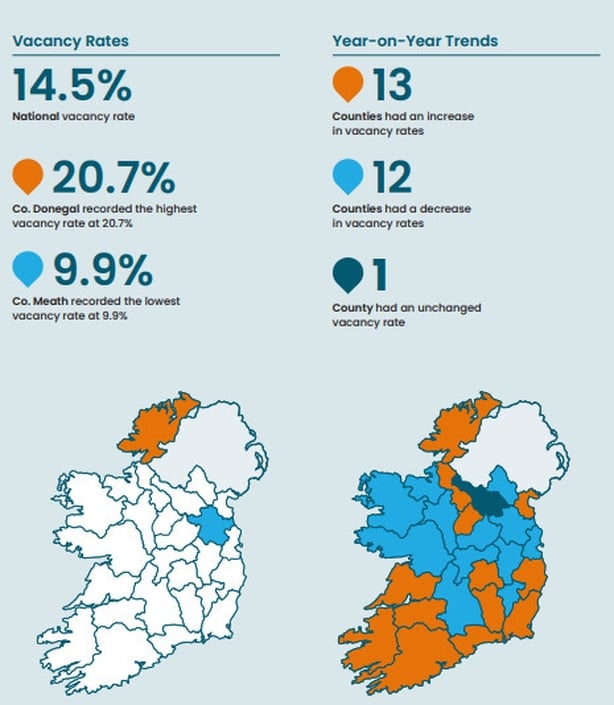
GeoDirectory Commercial Vacancy Rates Report’s shows that the national commercial vacancy rate dropped marginally by 0.1 percentage points year-on-year to 14.5% in the second quarter of 2026.
The analysis, prepared by EY, revealed that a total of 30,611 commercial properties were classified as vacant across the country during the second quarter of this year.
But it said that despite the overall national drop, localised variance persists, with vacancy rates increasing in 13 of the 26 counties surveyed, falling in 12, and remaining unchanged in one county – Cavan.
GeoDirectory said the highest commercial vacancy rates continue to be concentrated in the West and North-West of the country.
Donegal recorded the highest vacancy rate in the State at 20.7%, meaning that over one in five commercial properties in the county lie vacant. Sligo at 20.2%, Galway at 18.6%, Leitrim and Limerick – both at 18.1% – made up the remainder of the top five highest county vacancy rates.
At the other end of the scale, Meath recorded the lowest commercial vacancy rate in the country at 9.9%, making it the only county under the 10% mark.
Wexford (11.2%), Westmeath (12%), Kerry (12.3%), and Cavan (12.7%) rounded out the counties with the lowest rates.
GeoDirectory noted that 13 counties had a vacancy rate below the national vacancy rate of 14.5%.
Meanwhile, the commercial vacancy rate in Dublin stood at 13.3% in the second quarter of the year, a 0.6 point reduction on the same time last year, and below the national average of 14.5%.
Of the 80 towns and urban areas analysed nationwide, Shannon in Co Clare registered the highest commercial vacancy rate at 34.9%. Ballybofey in Co Donegal recorded the second-highest rate at 34.5%, followed by Boyle in Co Roscommon at 30.1%.
Carrigaline in Co Cork at 5.1% and Greystones in Co Wicklow at 7.3% recorded the lowest commercial vacancy rates among the sampled towns.
Dara Keogh, CEO of GeoDirectory, said that while the national commercial vacancy rate edged down slightly to 14.5%, the broader picture remains one of significant local variance.
“With over 30,611 commercial units lying vacant across the country and 13 counties still seeing vacancy increases, commercial property owners and local high streets need to continue to adapt to shifting consumer habits,” he said.
Simon MacAllister, Partner at EY Ireland, said that while the decline in the national commercial vacancy rates is modest, it is significant as it marks a break from a long period of steadily rising commercial vacancies since 2013.
“The data highlights a growing divide between areas benefiting from population growth, employment and investment, particularly in the East, and those that continue to face challenges sustaining commercial activity, especially in the West and Northwest,” he said.
“This underlines the need for sustained investment and policy measures to support town centre vitality and long-term economic growth,” Mr McAllister added.