
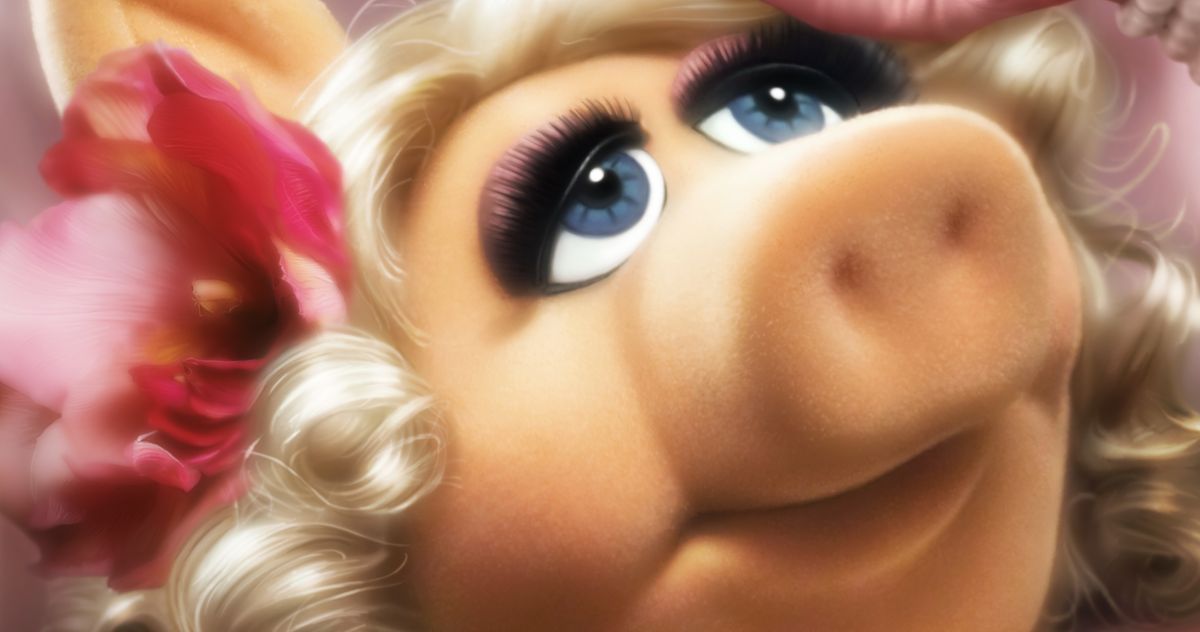
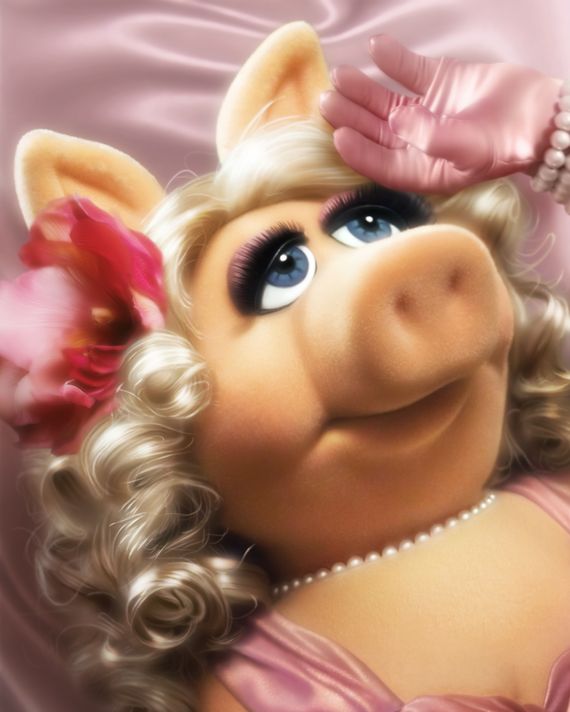
I am a blonde because of three women: my mother, Lil’ Kim, and Miss Piggy. The last in particular has shaped my understanding of womanhood and its possibilities since I was a child in the ’90s; every holiday season, I admired her aggressive and assured demeanor as our home wore out the VHS tape of The Muppet Christmas Carol. I am not alone in my estimation of Miss Piggy.
“For me, growing up, there was a woman who I just related to. She just felt very strong. She had a really specific POV. She asked for what she wanted. She always had good jokes. And that woman was Miss Piggy,” Amy Poehler said last spring on an episode of Las Culturistas. Her comment was met with shrieks from Bowen Yang and praise from Matt Rogers. After Tim Curry’s death this week, a clip of the actor talking about his affair with Miss Piggy on the set of Muppet Treasure Island began to circulate: “Once you’ve had pork, you never go back.” On Poehler’s own podcast this year, the actress Da’Vine Joy Randolph said, “That lady, I am who I am today because of her. At a young age, that being instilled in you: You don’t take shit from men. You do your thing. Be fabulous.” She added, “That’s my girrrlll.” During Sabrina Carpenter’s Short n’ Sweet tour, Miss Piggy made a cameo as the celebrity who got “arrested” during the singer’s last show. The crowd’s response was uproarious. Jennifer Lawrence and Emma Stone are spearheading a new Miss Piggy–focused movie, set to be written by Cole Escola. When asked by W magazine earlier this year if she would be playing the diva, Stone scoffed in disbelief: “First of all, that is the biggest insult to Miss Piggy I have ever heard, and I will not have her name dragged through the mud, I’m sorry. Why would I play a literal star?” She continued, “Of course I’m not playing Miss Piggy … Miss Piggy is playing Miss Piggy.” Who else could?
To say Miss Piggy is having a moment would be inaccurate. Since the mid-1970s, she’s been a cultural icon, bridging the gap between comedy and the world of fashion. She’s been dressed by Marc Jacobs, Donna Karan, Vivienne Westwood, and Zac Posen, among others. She has reported from New Year’s Eve ceremonies and written a best-selling book. She’s appeared on the covers of Elle, Life, and even New York in 2011. But Miss Piggy is the last woman movie star. She is part of a lineage that has gone dormant: larger-than-life, carefully curated personas bolstered both by their market value at the box office and by how their sheer artistry shapes the texts that end up on the silver screen. These are women like Elizabeth Taylor, Joan Crawford, Bette Davis, and Mae West. During their reign in Hollywood’s Golden Age, their lives and cinematic work played out ideals about femininity and its expectations in American culture writ large. It’s a legacy Miss Piggy carries on.
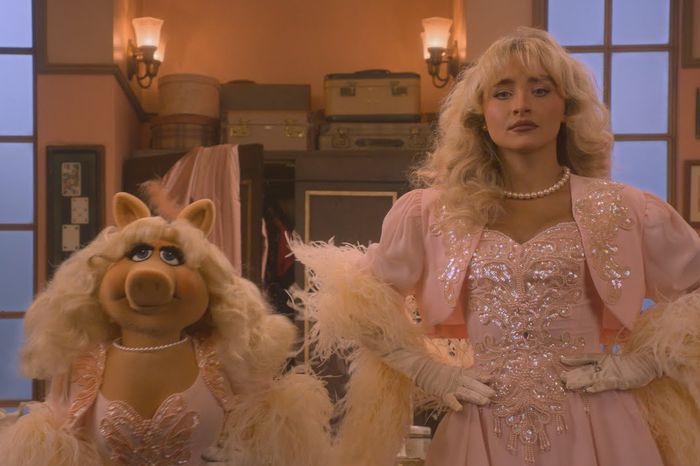
With Sabrina Carpenter in The Muppet Show 2026 special.
Photo: YouTube
Miss Piggy has spent the past five decades building an image of delightful contradictions: She’s glamorous and insecure, bold and vulnerable, domineering and high femme. Whether sparring with Joan Rivers on Fashion Police in 2012 while wearing Louboutins (“Please, Joan, have some dignity. Or did it get sucked out the last time you had lipo?”); yearning for romance with her on-again, off-again beau, Kermit the Frog; or asking Carpenter if she’s wearing her wig in The Muppet Show 2026 special, Miss Piggy has made these contradictions into high comedic art.
Her presence is an argument: A woman can make herself into her greatest artistic work. Being full of yourself isn’t detrimental but necessary for survival. Humor is a means of self-definition. Within the oeuvre of the Muppets’ cinematic and televisual work, Miss Piggy hasn’t ever wholly been a punch line — her image is too dexterous for that. But aspects of her persona have been. Consider the 1982 song “Snackcercise,” featured on Miss Piggy’s Aerobique Exercise Workout Album. In the video, dressed in the workout gear du jour, Miss Piggy lounges while dancers flank her. “I maintain my dynamite figure with a daily aérobique workout,” she explains. “Now you go to your refrigerator and get your exercise equipment and get ready to snackcercise.” Workout moves like “banana splits” advise one to “lift the dish, grab the spoon, take a bite and chew, chew, chew, chew, swallow.” Her weight and notable appetite are integral to the musical number. But something has shifted within this decade. The Miss Piggy attributes that were once gags are now the very aspects of her character that millennials (and, to a lesser extent, younger Gen-Xers) deify her for.
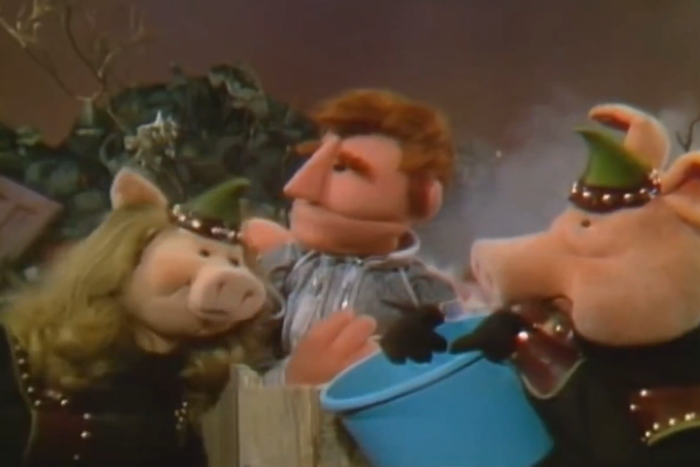
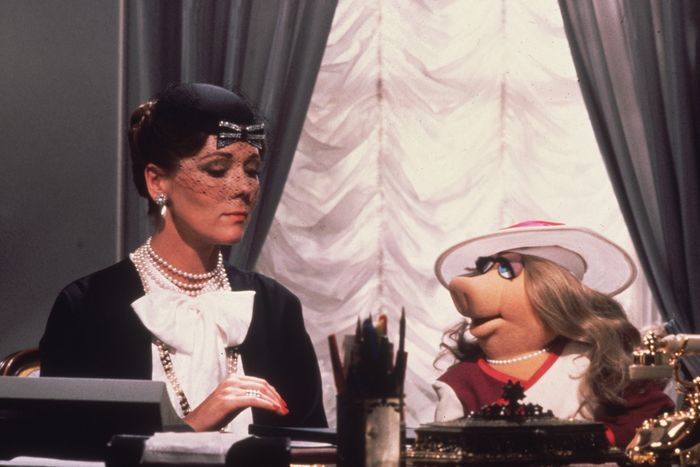
From left: One of her first appearances in 1975. Photo: YouTubeIn The Great Muppet Caper from 1981. Photo: Hulton Archive/Getty Images
From top: One of her first appearances in 1975. Photo: YouTubeIn The Great Muppet Caper from 1981. Photo: Hulton Archive/Getty Images
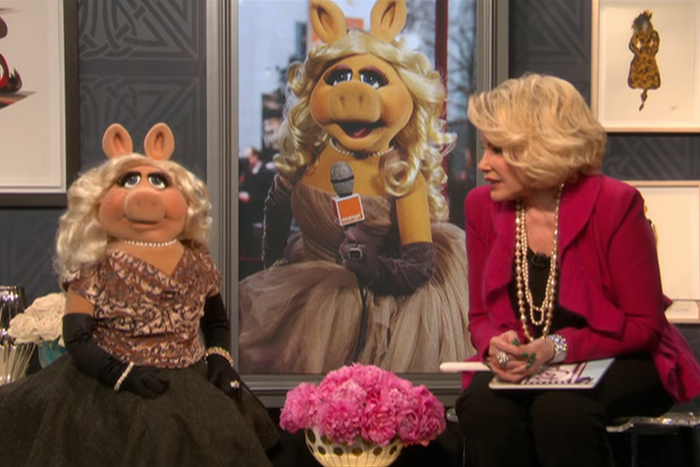
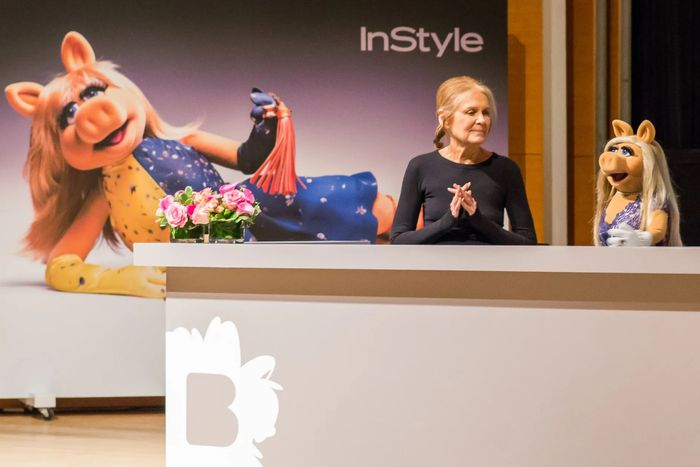
From left: With Joan Rivers on Fashion Police in 2012. Photo: YouTubeWith Gloria Steinem receiving a feminist award in 2015. Photo: Brooklyn Museum
From top: With Joan Rivers on Fashion Police in 2012. Photo: YouTubeWith Gloria Steinem receiving a feminist award in 2015. Photo: Brooklyn Museum
One of the earliest incarnations of Miss Piggy was an unnamed, blonde, beady-eyed puppet in 1975’s The Muppet Show: Sex and Violence who spoke in a nasally whine during a film parody, “Return to Beneath the Planet of the Pigs.” By the time The Muppet Show premiered the next year, Miss Piggy was reborn. She was given a distinctive look by designer Bonnie Erickson: a flowing gown, satin opera gloves, and large light-blue eyes framed by thick eyelashes. She is one of the few Muppets with irises, which go a long way toward making her seem human. And thanks to her puppeteer Frank Oz, who performed the character from early in her history until the beginning of the aughts, her highly romantic and vivacious personality came to life. What’s fascinating about Miss Piggy’s journey from chorus girl in 1976 to Muppets star is how quickly her persona coalesced once Jim Henson & Co. saw her potential.
In the 1979 New York Times article “The Muppets in Movieland,” pegged to the then-upcoming fourth season of The Muppet Show, Oz shares her origin story: Miss Piggy “grew up in a small town; her father died when she was young; her mother wasn’t that nice to her. She had to enter beauty contests to survive. She has a lot of aggressiveness, but she needs a lot to survive — as many single women do. She has a lot of vulnerability, which she has to hide, because of her need to be a superstar.” All her fabulousness comes with a current of complication and sorrow: “Although Miss Piggy’s essentially humorous, to me she’s had a sad, difficult, painful life,” Oz says. On a class level, Miss Piggy is a striver, a self-made woman who acts as an argument for the power of self-determination.
In the 1981 film The Great Muppet Caper, we see this self-determination in action. Haughty fashion designer Lady Holiday (Diana Rigg) is talking about the failure of recent designs: “We have to make drastic changes in the new line before the show tomorrow. All my girls are going around looking like barnyard animals.” Off-camera, someone clears their throat.
“Good heavens, who are you?” asks Lady Holiday. That someone is Miss Piggy. Blonde hair flowing. Pearls gleaming. She casts a saucy gaze from beneath a white hat with pink florals. Her dress is white, magenta, and burgundy, matching her hat. She poses, leaning against the door. “My name is Miss Piggy, and I would like to be a high-fashion model.”
“Doesn’t surprise me. Seems to be the way we’re heading,” Lady Holiday volleys, but Miss Piggy is undeterred.
“I’ve always dreamed of being a Holiday model,” she says. “May I come in?”
“Absolutely not.”
Miss Piggy comes in anyway. She practically hops around the desk.
“May I show you my portfolio?”
“No.”
Miss Piggy plops her black-cover portfolio on the desk: “Good. Here.” Noticing Lady Holiday’s trepidation, Miss Piggy says, “You may open it.” Lady Holiday listlessly turns the pages, barely glancing at Miss Piggy in various outfits.
“This is me reeking grandeur. Being aloof. Being demure,” Miss Piggy narrates. “Ah” — her voice drops a few octaves from its typical prissy, preening softness — “Daring.” While the clothes change, her pose and expression remain the same.
“Interesting range of emotions,” Lady Holiday says sarcastically.
Miss Piggy is as confident as ever: “Modeling is my life. It is my destiny. I shall accept nothing less.” She gets a job as a receptionist and screams with pleasure at the prospect. One step closer to her goal of stardom.
Oz once said his way of understanding Miss Piggy was she’s a “truck driver wanting to be a woman.” These rough-hewn aspects of Miss Piggy’s femininity feel incongruous only if you believe a woman’s natural state is to be coy and demure, that things happen to you but you never drive the action. It’s the way Miss Piggy renders her femininity as an arch spectacle, twisting expectations by incorporating notes culturally associated with the masculine, that makes her a star. A movie star isn’t merely a title bestowed upon those whose box-office numbers back it up. A star affects the reading of a film as much as the cinematography, direction, and costume design. And a true one turns their contradictions into a cohesive art form.
Miss Piggy’s greatest ancestor in this regard is Mae West. With a career spanning seven decades, starting in vaudeville before turning toward pre–Hays Code Hollywood, West established her stardom her own damn self as an actress, comedian, screenwriter, and playwright. Her first lead role on Broadway was in the 1926 play Sex, which she also wrote. Her work was so incendiary she was arrested for it. She battled censorship onstage and onscreen to explore sexuality and femininity in all its colorful, bawdy permutations. She liked her necklines low and gowns tight on her Rubenesque frame. F. Scott Fitzgerald is said to have deemed her the “only Hollywood actress with both an ironic edge and a comic spark.” I’m partial to how West herself put it: “It isn’t what I do but how I do it. It isn’t what I say but how I say it. And how I look when I do it and say it.”
It would be easy to stop at the superficial similarities between these outsize characters: blonde, petite in height but full-figured, defined by their appetites. But Miss Piggy and Mae West share an interesting tension: West was inspired by female impersonators, including Bert Savoy, who was a figure in The Greenwich Village Follies, a musical revue from 1919 through the 1920s. She plucked inspiration from his campy excess for her signature strut. In the 1930s, West was simultaneously deemed the “Siren of Sex and Sensation” and, by a writer in Vanity Fair, “the greatest female impersonator of all time.” It’s femininity through the looking glass. Miss Piggy, too, is the product of female impersonators. There is a friction between the earnestness of the character, her cutting humor, her radical femininity, and the fact that only men have performed her: first Oz and then, after he mostly stepped away from his work with the Muppets in 2001, Eric Jacobson, who has performed her ever since.
Jacobson is a 55-year-old with a gentle countenance who has been with his wife since they met when she was a production assistant on Sesame Street. He wasn’t initially a Miss Piggy acolyte. “I did not grow up with Miss Piggy as my favorite character from the Muppets,” he tells me. “I was more of a Kermit guy. More of a Fozzie Bear guy. As a child, I was drawn to characters that I thought I could be friends with or that I wanted to be like. And Miss Piggy, she was just a little too much for me.” It was only over the years, as he matured as a human being and performer, that he became enamored: “I saw all the fascinating complexities to the character and became a huge fan of hers.”
Jacobson does a lot of improv as Miss Piggy — and he’s especially able to cut loose on live television and in other less-scripted appearances. (Leigh Slaughter, vice-president of the Muppets Studio, noted that for the performers, scripts are sometimes more suggestions than rule of law.) It is during Jacobson’s tenure that Miss Piggy’s image has become an emblem of empowerment and prowess for her women and queer audiences, although prior viewers were starting to glean the nuances of the character. In her 1995 book, The Unruly Woman: Gender and the Genres of Laughter, Kathleen Rowe Karlyn writes, “In Miss Piggy’s Guide to Life, a mock self-help and etiquette book, Miss Piggy borrows Cosmopolitan magazine’s style of using imperatives and checklists (‘do this, check that’) to tell women how to improve themselves. On the surface, she seems to accept the norms of femininity. But when she tells women how they can ‘snack’ their way to ‘slimness,’ she abandons Cosmo’s line on deferred gratification in favor of the pleasure principle, mocking the bourgeois Protestant ethic of work and investment that pervades women’s magazines and that helps support the identity of self-sacrifice and masochism with femininity.”
In 2015, the Elizabeth A. Sackler Center for Feminist Art at the Brooklyn Museum presented Miss Piggy with a Sackler Center First Award. The ceremony can be found on YouTube and includes Gloria Steinem lavishing the character with praise. Jacobson was initially resistant to the award: “I thought, Surely there must be any number of actual women out there who would be more deserving of a feminist award than a fictional character — and, on top of that, one who’s performed by a man.” But Jacobson came around. He says women came up to him to tell him how deeply Miss Piggy inspired them. “And that’s when I realized, Wow, this character is so much more than just a character — and just how important symbols can be to a society.”
The public perception of Miss Piggy has continued changing; she’s become a signifier of confidence rather than female delusion. The artisans and producers at the Muppets Studio are well aware of this fact. “Miss Piggy’s delusions of grandeur have been somewhat accepted and even reinforced by the media and by different people. It’s become more of a challenge to play her as delusional, which is a really important aspect to her character. So many people now have bought into her delusions: that she’s a big star and a true talent,” Jacobson says. It has led to a challenge for him and the bevy of people who bring her to life. “We have to find new ways to make her even more over the top,” he says. “It’s fun because it just pushes us to be more absurdist. And that’s part of the DNA of the Muppets.” It also comes through in what she wears and how she carries herself. “We like to say ‘Those pearls are not real,’” Dani Iglesias, the Muppets Studio creative director, tells me. “She would never let anyone know that. But it’s that sense of showmanship, of wanting to project the idea of what it is to be a diva and a successful actress and fashionista that drives a lot of the decisions we make for her wardrobe. There’s that Coco Chanel saying of ‘Get dressed and then take one accessory off.’ Miss Piggy is the opposite, and she would put three more on.”
Miss Piggy’s influence thrives in the present through characters like Cole Escola’s Mary Todd Lincoln in Oh, Mary! There’s a glint of Miss Piggy’s quick wit in the comedic edge and blonde ambitions of Jennifer Coolidge. I also see Miss Piggy in Jennifer Tilly. Whether stunting on The Real Housewives of Beverly Hills or embodying the homicidal sex symbol Tiffany Valentine in the Chucky franchise, Tilly is a distinctively voiced, exceedingly attractive representation of what confidence can get a woman who strives to move beyond her fraught beginnings. But unlike these flesh-and-blood examples, Miss Piggy doesn’t experience the discrimination of aging. She’s seasoned, yes. (I’ve always felt she’s in her mid-to-late 40s.) But she’s also ageless. If a woman star lives long enough, she may get lucky, like Barbra Streisand and Cher, in that the aspects of themselves deemed too much in the middle of their careers become worthwhile and beloved in their 40s and 50s. Miss Piggy will never receive retaliation from her audience for not existing in life as the unchanging fantasy they hold in their minds. She won’t have a partner whose mistreatment tarnishes her goddesslike image. That’s the bittersweet undercurrent of her fame: She can reach a level of consistent public adoration and respect that no living woman would ever be able to embody. After all, flesh has its complications. But Miss Piggy is a star nodding to an era in which women were much more than they’re allowed to be now: vivid, dynamic, larger than life. Shirking relatability for something mythic. She is one of our last. And the rest of the world is finally realizing it.
Thank you for subscribing and supporting our journalism.
If you prefer to read in print, you can also find this article in the August 24, 2026, issue of
New York Magazine.
Want more stories like this one? Subscribe now
to support our journalism and get unlimited access to our coverage.
If you prefer to read in print, you can also find this article in the August 24, 2026, issue of
New York Magazine.