
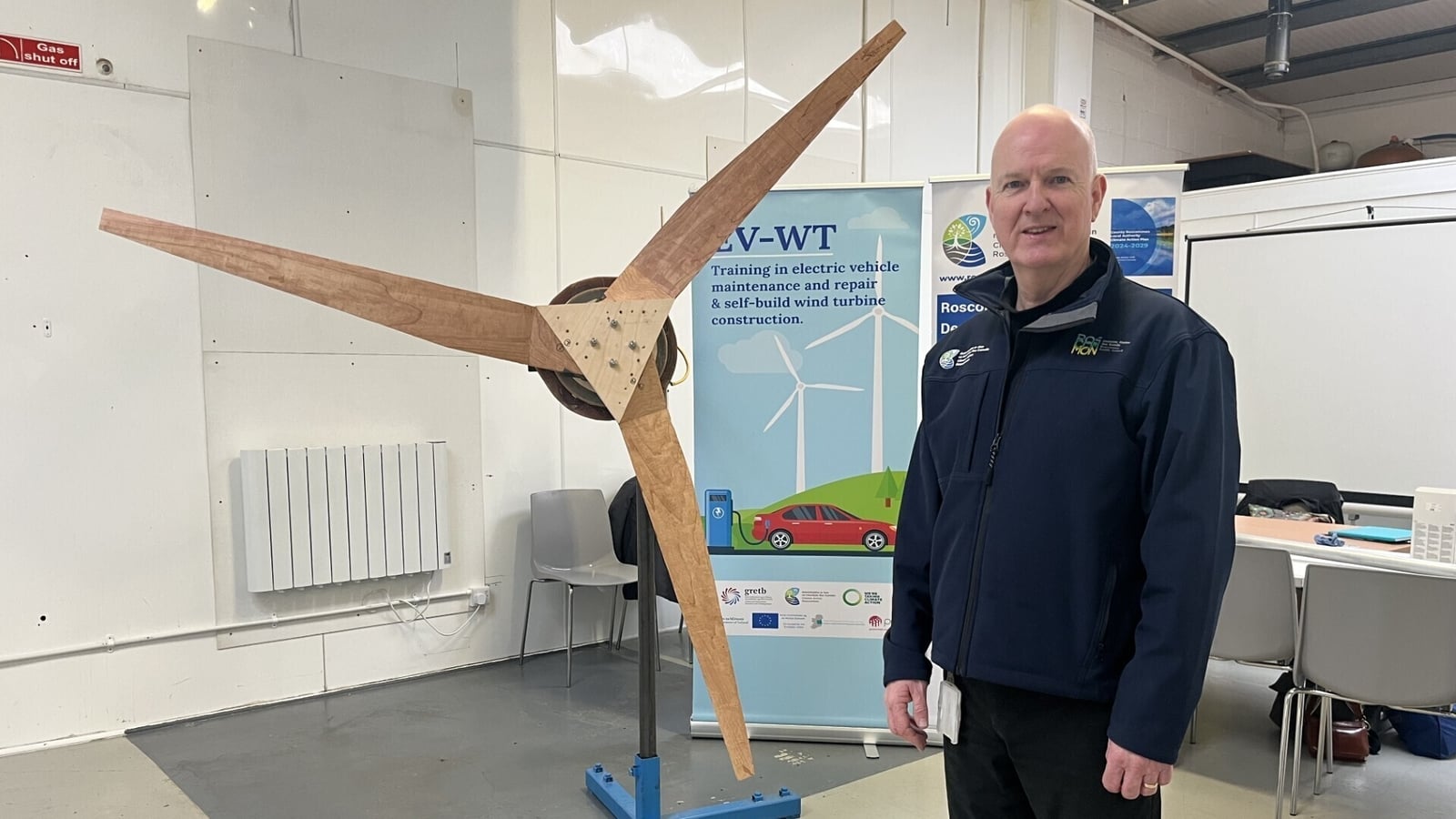
A new course is helping people to make their own wind turbine from scratch to ease the uncertainty in the cost of energy and fuels.
With energy prices continuing to rise amid ongoing international energy market instability, many consumers are looking at ways at becoming more sustainable.
In Co Roscommon, the local authority is running climate action courses focusing on skills that people and communities can adapt to help them become more resilient.
The courses are delivered through Galway Roscommon Education and Training Board (GRETB) and funded by the EU Just Transition Fund (JTF).
One of the courses is an eight-day DIY wind turbine construction course, which shows participants how to construct their own domestic turbine to generate renewable energy.
Small-scale turbine construction enables communities to better adapt to the impacts of climate change by making them more self-sufficient, the local authority said.
Others also use the turbines as an alternative power source following outages resulting from storms.
The council said training of local people to make wind turbines empowers communities and increases their resilience to the impacts of climate change and rising fuel prices.
“There has been a lot of interest in the course from retired people to people with an interest in alternative technologies, and people who are concerned about energy prices at home” explained Barry Tapster, Climate Action Officer with Roscommon County Council.
“During the eight days, people will learn how to build a small-scale wind turbine around 2.4 metres in diameter, totally from scratch.
“We learn the welding, we carve the blades out of wood, we use a wide variety of different tools and at the end, there’s a wind turbine built.
“They’re very robust models. They will stand up to gale force winds, the windier the better really,” he added.
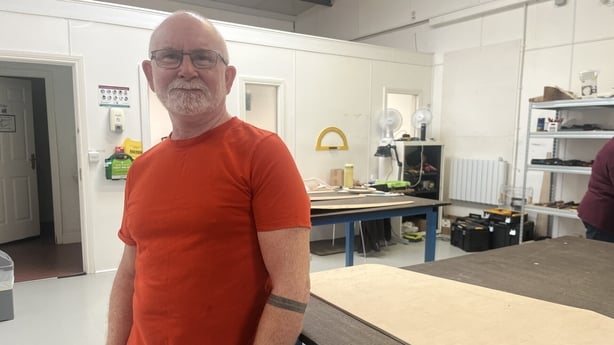
Eamon McCarthy is ideally positioned for wind power beside the coast
Participants who have completed the course have gone on to build their own wind turbines, explained Mr Tapster.
“Some of them are using them for isolated properties on farms, others have built them and put them into their backyard and use them at home,” he said.
“Now you need a bit of space to do that, and there’s planning regulations, but they are often used to supplement solar panels that are already in place.
“When the sun is out, it’s sometimes windy, but at nighttime it’s windy, but the sun isn’t out, so they work quite well together.”
‘Plenty of wind’
Eamon McCarthy from Miltown Malbay in Co Clare completed his eight-day course on Thursday and plans to construct a wind turbine in the coming weeks.
“On the west coast of Clare and I’m only five miles from the coast, we have plenty of wind,” he said.
“This wind turbine which we’re making here today, in conjunction with batteries in particular, will be a great way to store wind energy during the day, during the winter, and be able to release it into the house at nighttime for heating or whatever is needed.”
Mr McCarthy is hoping that financially, it will make a huge difference.
“We do have a lot of wind so I’m hopeful that we might even level out with the payments, which is what I’m aiming for,” he laughed.
Shannon Copland’s eco-farm close to Rathconrath in Co Westmeath is fully off-grid.
She supplies some of Ireland’s top restaurants with rare and unusual vegetables.
“What I do is fine dining restaurant supplies,” she explained.
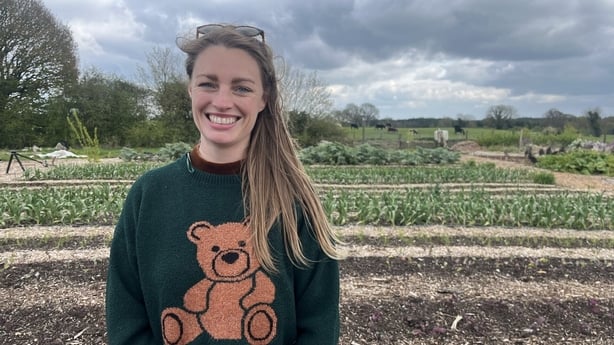
Shannon Copland aims to combine wind and solar
“It’s the more unusual heirloom crops that I grow, and I’m trying to keep some things alive that are being lost because they’re not being grown in normal agricultural senses.
“Because I don’t use a tractor, everything is hand grown from seed, hand transplanted, and hand harvested.”
Always looking at new ways of making her farm more sustainable, Ms Copland recently completed the DIY wind turbine course run by Roscommon County Council.
“I’d like to include wind turbines here and power it with solar as well, so a combination of both,” she said.
“I want to be covered for different sorts of weather and during the nighttime and the daytime as well.”
“Because I am off-grid here and I don’t have mains power, this is a no brainer.”
The course is part of Roscommon County Council’s wider plan to address climate change.
“We were quite badly hit by a lot of the different climate scenarios that we’ve had in recent years,” explained Mr Tapster.
“Storm Éowyn hit us very badly, and this is really a way that people can be not just independent of the electricity supply, but also independent from having to worry about the cost and the international impacts that we in Ireland have very little control over.”
Read more: Half of generated electricity came from renewable sources last year – CSO