
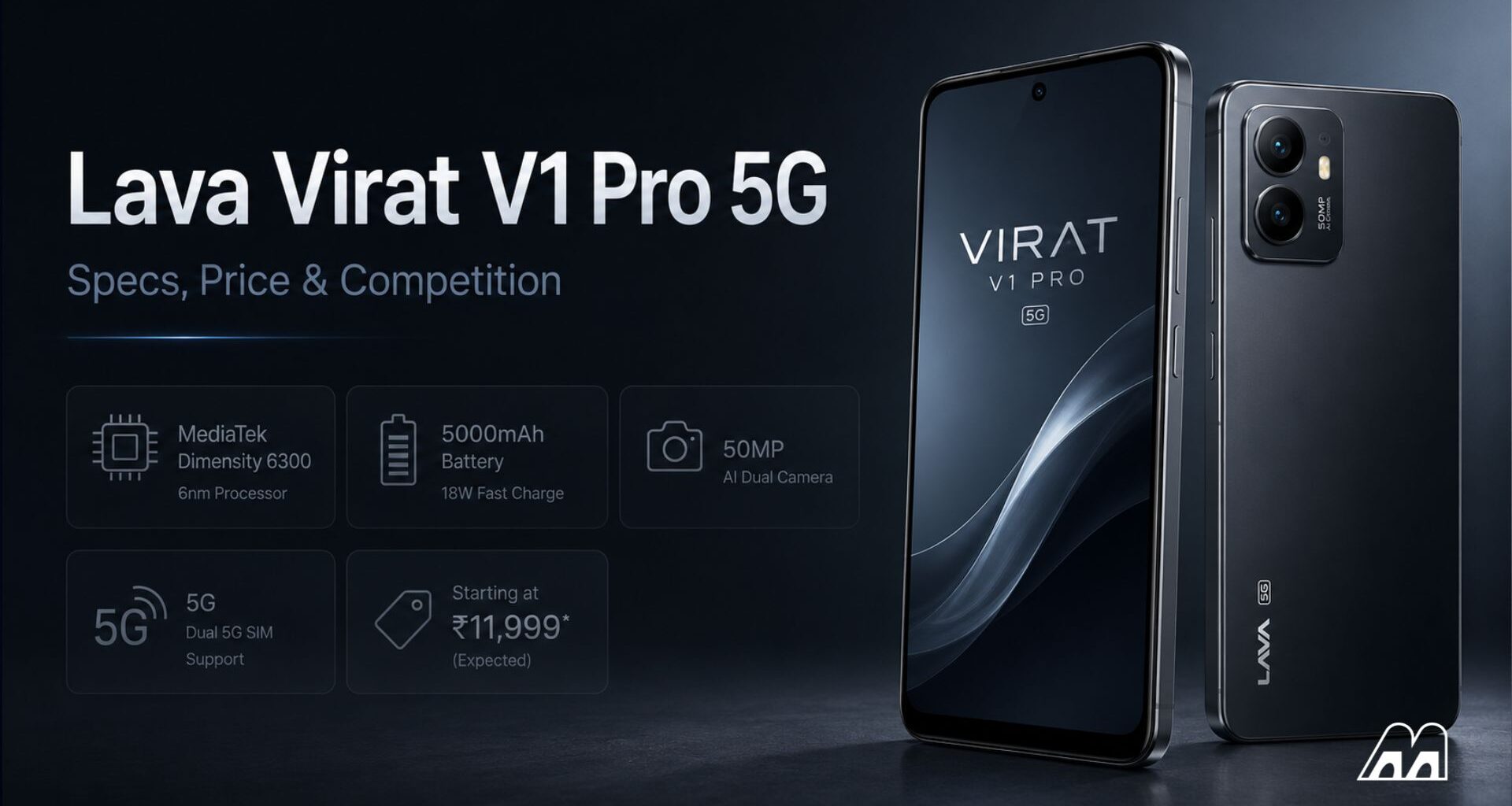
Lava Virat V1 Pro 5G Full Specs
A 6.74-inch HD+ LCD (1,612 x 720) with 120Hz refresh rate and 550 nits peak brightness. The Unisoc T8200 on a 6nm process, clocked at 2.3GHz, paired with a Mali-G57 MC2 GPU. 6GB RAM with 6GB virtual RAM extension. 128GB storage expandable to 1TB via microSD. A 50MP main camera with night mode, HDR, and portrait shooting. A 6,000mAh battery with 18W USB-C charging. IP64 dust and splash resistance. Side-mounted fingerprint sensor. Dual 5G SIM support. Android 16 out of the box. 168.29 x 77.64 x 8.68mm, 207 grams. Colours: Sikkim Midnight, Spiti Frost.
Lava claims an AnTuTu score above 500,000. For context, the Snapdragon 6 Gen 1 in the cheaper iQOO Z9x scores above 600,000. The T8200 handles WhatsApp, YouTube, and light browsing without issue. A Smartprix reviewer tested the non-Pro Virat V1 5G (identical chipset) on BGMI and reported 30 to 60 FPS on low graphics settings. This is not a gaming phone.
The INR 21,999 “Discount” Is Not What It Looks Like
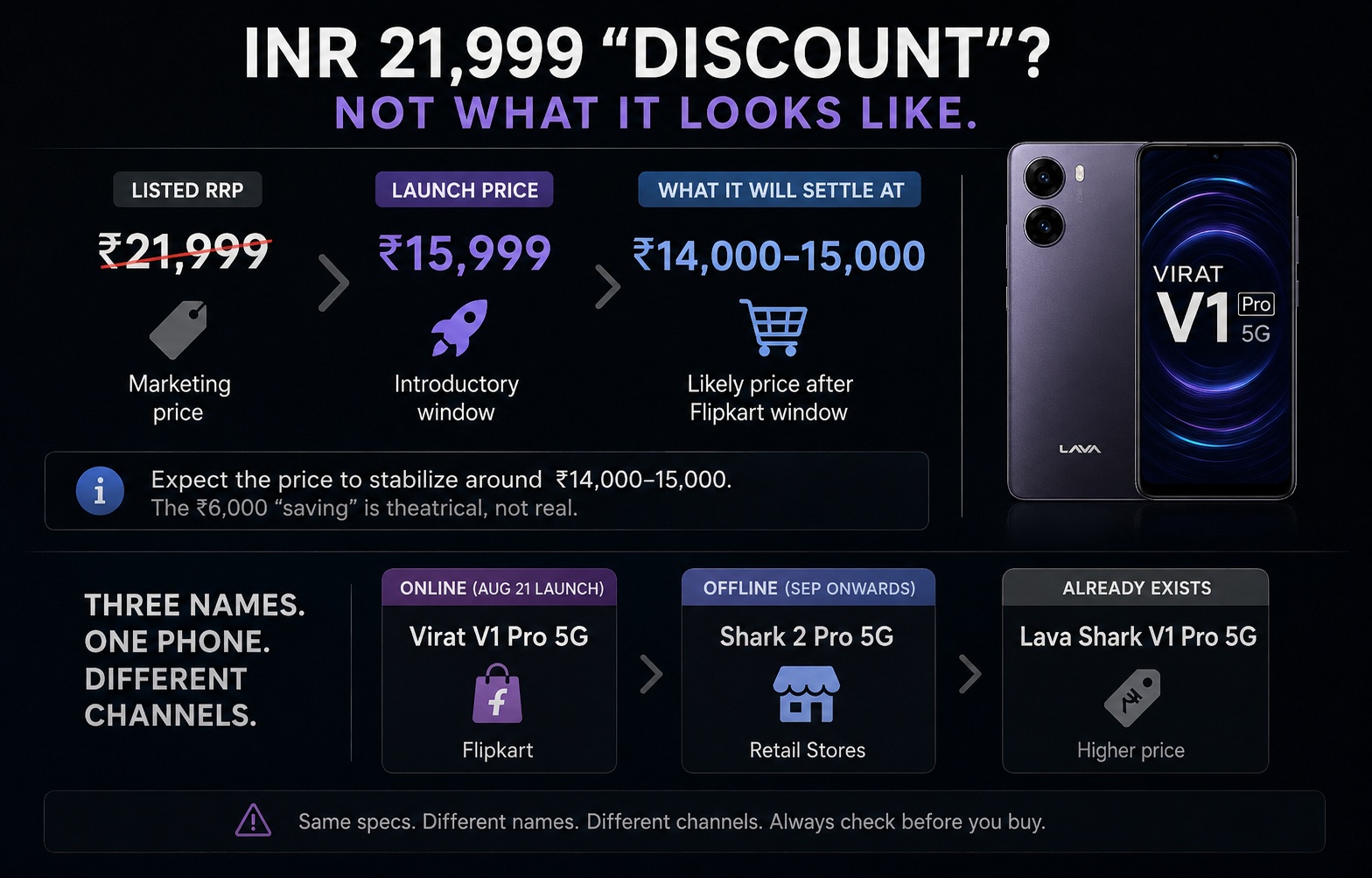
Lava listed the Virat V1 Pro 5G with an RRP of INR 21,999 and a “launch price” of INR 15,999. That looks like a INR 6,000 saving. It is almost certainly not.
When the non-Pro Virat V1 5G launched in July, Lava used the same playbook: INR 14,999 RRP, INR 11,999 launch price. Within a week, the phone settled at INR 12,999 on Flipkart and has stayed there since. The “discount” was baked into the marketing, not the economics.
Expect the same trajectory here. The Pro will likely settle around INR 14,000 to 15,000 after the Flipkart launch window closes. That is still competitive for what you get, but the INR 6,000 “saving” is theatrical.
There is another wrinkle. The phone will be sold offline in September under the name Shark 2 Pro 5G. Same device, different name, different channel. 91mobiles noted that a phone called the Lava Shark V1 Pro 5G already exists with identical specifications but at a higher price. Lava is running at least three naming variants (Virat V1 Pro 5G, Shark 2 Pro 5G, and possibly Shark V1 Pro 5G) across online and offline channels. This is not unusual for Indian OEMs, but it makes price comparison harder for buyers who do not know the names map to the same hardware.
How the Virat V1 Pro 5G Compares to Its Real Competitors
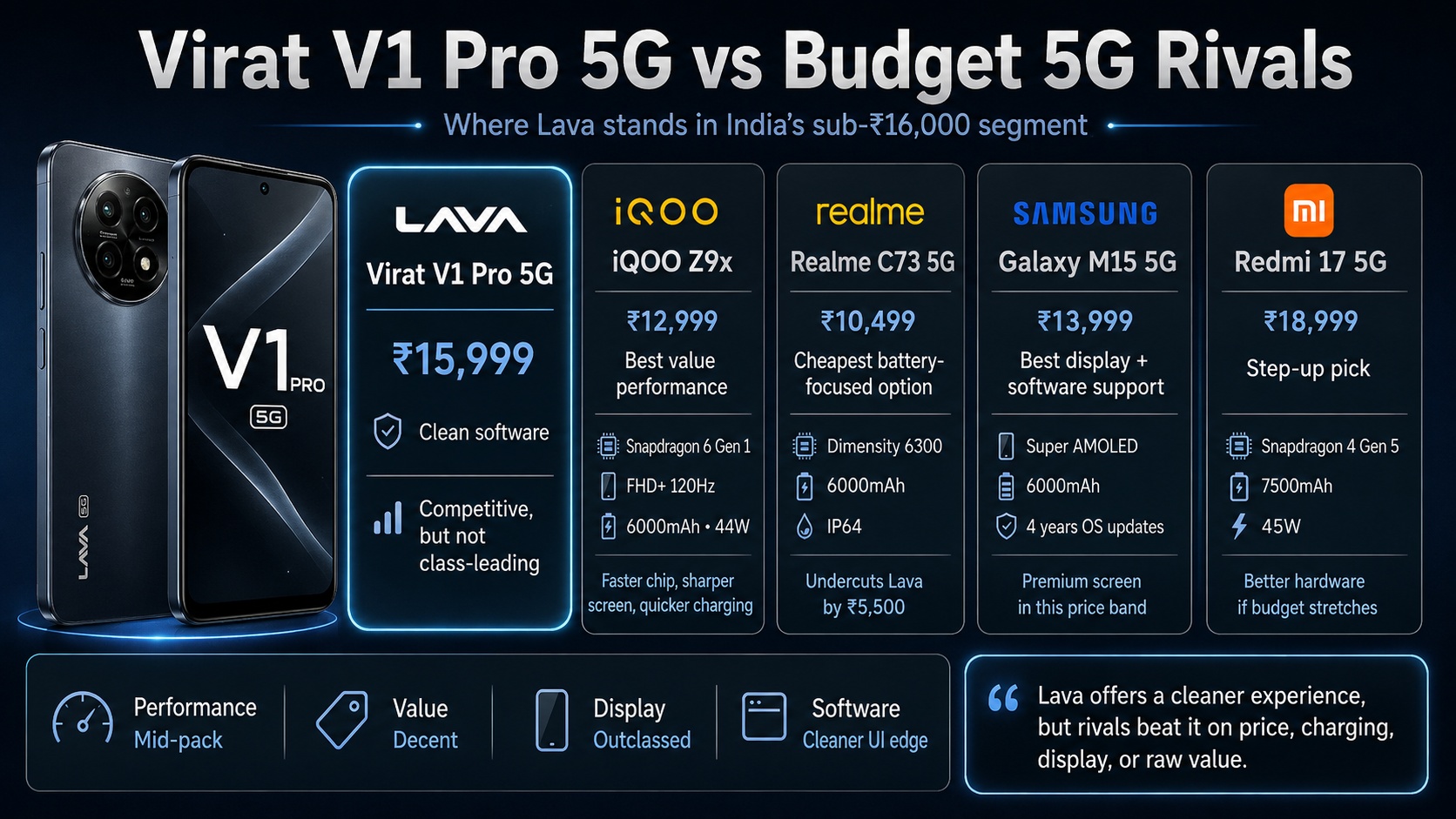
The budget 5G segment in India under INR 16,000 is one of the most crowded phone markets on earth. Here is where the Lava actually sits:
iQOO Z9x (INR 12,999): Snapdragon 6 Gen 1, 6.72-inch FHD+ 120Hz, 6,000mAh, 44W fast charging. Costs INR 3,000 less than the Lava and delivers a faster chip, a sharper screen, and charging that fills 6,000mAh in about 50 minutes versus the Lava’s estimated two-plus hours at 18W. The Z9x runs Funtouch OS with pre-installed apps. If bloatware does not bother you, this is the better phone at a lower price.
Realme C73 5G (INR 10,499): Dimensity 6300, 6.67-inch HD+ 120Hz, 6,000mAh, IP64. Matches the Lava on battery and dust resistance, undercuts it by INR 5,500, and runs a more capable chipset. Heavier Realme UI with ads in the notification shade.
Samsung Galaxy M15 5G (INR 13,999): Dimensity 6100+, 6.5-inch FHD+ Super AMOLED, 6,000mAh, 25W charging. The only phone in this bracket with an AMOLED display, and Samsung promises four years of OS updates. The chip is slightly weaker than the T8200 in benchmarks, but the display and update commitment are in a different class.
Xiaomi Redmi 17 5G (INR 18,999 global): Snapdragon 4 Gen 5, 7,500mAh, 45W charging. The step-up option for buyers who can stretch the budget. Everything is better except the software experience.
The “Clean Android” Promise and Lava’s Track Record
Lava’s strongest marketing claim is also its most fragile. Clean Android 16, no bloatware, no notification ads. In a segment where Redmi, Realme, and iQOO all inject promotional content into the system UI, this is a genuine differentiator.
But “clean Android” only stays clean if the manufacturer keeps it updated. And Lava’s history on that front is mixed.
The good news: Lava’s Agni 4 (launched November 2025) received Android 16 by April 2026, roughly five months after launch, and has gotten consistent OTA updates since, including a June 2026 security patch with Jio and Vi network optimisations. That is a credible update cadence for an Indian OEM.
The bad news: Lava’s older track record includes the Pixel V1, an Android One phone launched in 2015 that was supposed to receive two years of guaranteed updates. Users on GSMArena forums reported the phone stalled on the February 2017 security patch while Micromax’s competing Android One device continued getting timely updates. The Blaze 2 5G received Android 14 in December 2024, more than a year after Android 14’s public release. The Lava Blaze (2022) promised two years of security patches.
The pattern is that Lava’s flagship line (Agni) gets reasonable attention, while its budget lineup gets slower and less predictable support. The Virat V1 Pro 5G sits in the budget lineup. Whether “clean Android 16” stays clean and patched through 2027 is an open question that no spec sheet answers.
None of the other articles covering this launch mention Lava’s update history. They should.
Who Should Buy the Lava Virat V1 Pro 5G
Buy this phone if you genuinely dislike notification ads, pre-installed shopping apps, and heavy UI skins, and you are willing to pay a premium over the Realme C73 (INR 5,500 more) and the iQOO Z9x (INR 3,000 more) for that experience. That is a valid preference, and the Lava is one of very few phones in India that serves it under INR 16,000.
Do not buy this phone if you game, care about display sharpness (HD+ in 2026 is a real compromise), or need fast charging. The iQOO Z9x at INR 12,999 is better in all three areas. If you want update longevity, the Samsung Galaxy M15 5G with four years of guaranteed support at INR 13,999 is the safer bet.
Lava Virat V1 Pro 5G Price and Availability
On sale August 31 at 12 PM IST on Flipkart at INR 15,999. Offline availability from September under the name Shark 2 Pro 5G. Single configuration: 6GB + 128GB.
Lava includes doorstep repair through its Free Service@Home programme, which covers both remote and urban areas. That is a meaningful after-sales differentiator in a market where many budget phone buyers are hours away from a service centre.
FAQIs the Lava Virat V1 Pro 5G worth buying over the iQOO Z9x?
For most buyers, no. The iQOO Z9x costs less, charges three times faster, has a sharper FHD+ display, and runs a faster Snapdragon chipset. The Lava wins only on software cleanliness: stock Android 16 with no ads or bloatware. If that single factor is your top priority, the Lava justifies its price. Otherwise, the iQOO is more phone for less money.
Does Lava actually update its phones?
It depends on the model. The Agni 4 got Android 16 within five months. Budget models have historically received slower and less consistent updates. Lava has not published a formal update commitment (number of years of OS or security updates) for the Virat V1 Pro 5G.
Why does the phone have two names?
Lava sells the same hardware as the Virat V1 Pro 5G online (Flipkart) and as the Shark 2 Pro 5G offline. This dual-naming strategy is common among Indian OEMs to segment online flash-sale buyers from offline retail shoppers.
How does the battery compare to the Redmi Note 17 series?
The Redmi 17 5G has a 7,500mAh battery with 45W charging at INR 18,999. The Redmi Note 17 Pro Max carries 10,000mAh with 100W charging at a significantly higher price. The Lava’s 6,000mAh with 18W charging is competitive within its own price bracket, not against the broader Redmi lineup.