
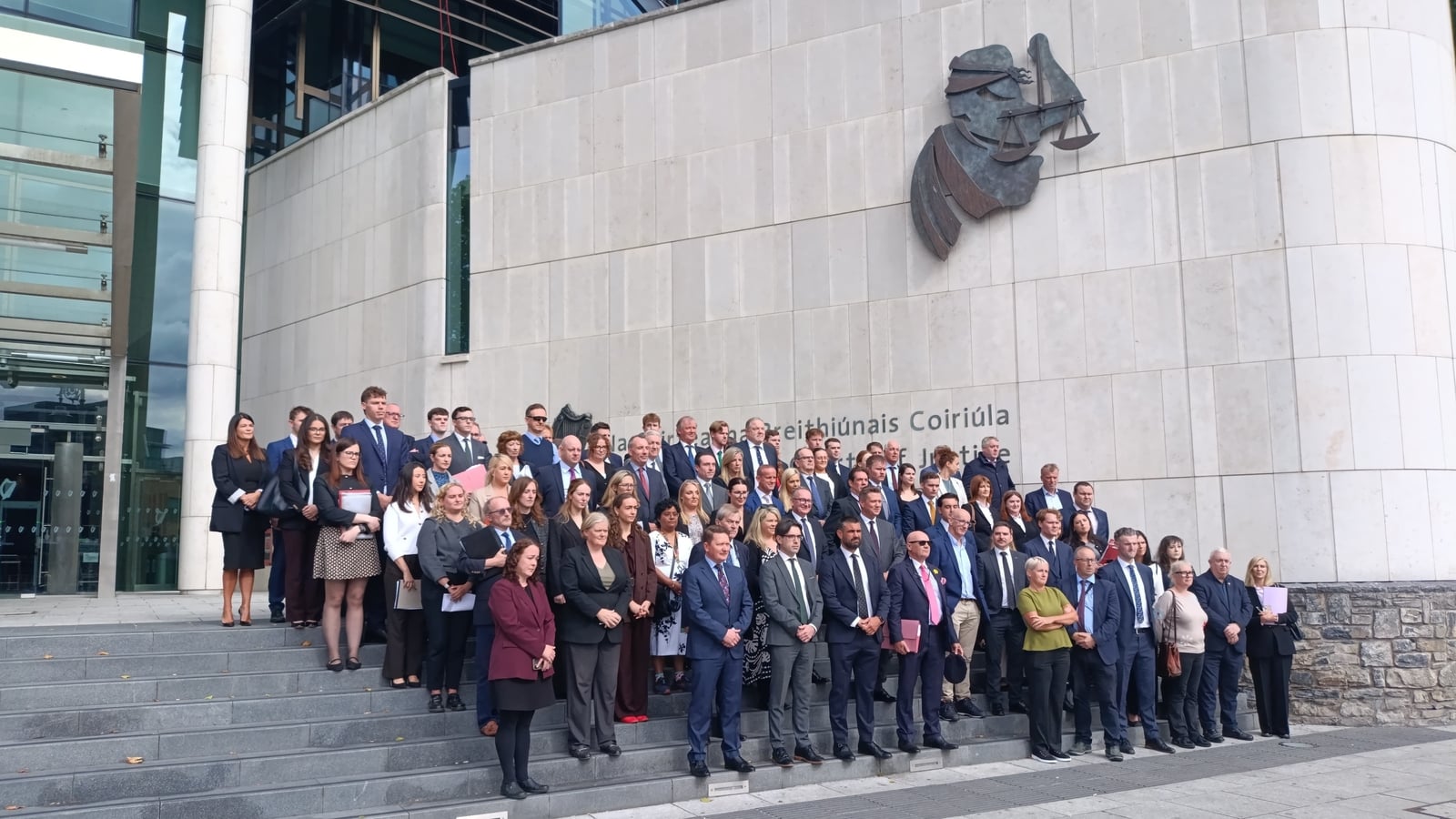
More than 100 criminal defence solicitors walked out of the district courts in Dublin this morning as part of their continued protest against a new legal aid scheme introduced earlier this year.
The solicitors say a new flat fee payment of €520 per client in the district court is unworkable.
Last week they voted unanimously to continue their withdrawal of services which began in June.
Under the old system, a solicitor was paid for each court appearance by a client starting at just over €239 for the first appearance and almost €60 for each subsequent hearing.
Minister for Justice Jim O’Callaghan said the old scheme incentivised multiple adjournments and said cases paid for by legal aid took longer to complete than other cases.
Solicitors said that many adjournments were sought by the prosecution.
They have also argued that many legal aid cases are complex and take longer because they involve children or vulnerable clients.
After talks with the Law Society, a change to the new scheme to allow staged payments failed to resolve the dispute.
Solicitors say they want the Minister for Justice to come back to the table and engage meaningfully with them.
In a statement this afternoon, Minister O’Callaghan said he regrets the decision of some solicitors not to engage with the Criminal Legal Aid panel.
He said over 600 solicitors remain on the Criminal Legal Aid panel as criminal cases continue to be dealt with in the courts, while over 700 new criminal legal aid certificates, equivalent to approximately €400,000 in criminal legal aid fees, have been issued since 1 July.
The minister said he is committed to improving efficiencies for court users, legal practitioners and the Irish taxpayer.
The new District Court Criminal Legal Aid Scheme will allow for those efficiencies, he said.
“The further changes sought by the Law Society are not compatible with the objectives of the reforms introduced as they would reintroduce the possibility of multiple certificates being awarded when the intention is to move to a single fee per case.
“It should be noted that the flat fee has been set at a level intended to compensate for cases where multiple certificates would have been granted under the previous system,” Minister O’Callaghan said.
Solicitor says continued delays a ‘ticking timebomb’
Solicitor Michael Finucane said the continued delays and adjournments in the criminal justice system caused by the dispute was a “ticking timebomb” that would have implications for criminal proceedings further down the line.
Solicitor Tony Collier said the criminal justice system was effectively griding to a halt.
He said victims of crime were being left in limbo and those who are accused were going without legal representation.
Criminal defence solicitors based in Munster have also voted to continue their withdrawal of services.
The dispute led to some accused being denied bail in the district court while not legally represented.
Some were subsequently granted bail by the High Court, which ruled their detention had been unlawful.
The court heard further similar actions during August and the State is now facing huge legal bills for costs in those cases.
The High Court is due to give its ruling next month in a judicial review taken by one solicitor challenging the new payment scheme.
Solicitor John Quinn wants the statutory instrument underpinning the scheme to be quashed.
His lawyers argued the new regulations did not allow district court judges to exercise discretion about issuing legal aid certificates.
And they also submitted that a flat fee of €520 could not be appropriate for someone facing one charge as well as for someone facing multiple charges.
Minister says he engaged with Law Society last week
There has been ongoing engagement since October 2025 between officials in the Department of Justice, Home Affairs and Migration, Minister O’Callaghan and the Law Society and Bar Council in relation to the changes to the criminal legal aid fee structure.
The minister also wrote to the Law Society on these matters as recently as last Thursday.
He met with the Law Society in July and listened to the issues raised by criminal practitioners regarding changes to the Criminal Legal Aid Scheme which commenced on 1 July 2026.
On foot of that engagement and at the request of the Law Society, the minister said he agreed to pay two-thirds of the new €520 fee at the commencement of a case, with the remaining third to be paid at the conclusion of the case or after 12 months, whichever is earlier.
“The fee of €520, up from €455, is equivalent to the payment for five appearances in a case under the old system, adjusted to reverse the outstanding 8% cut under FEMPI.
“In addition, the minister agreed to increase the proposed fee for District Court cases going to the circuit or higher courts from €100 to €520 and also introduced a separate fee of €80 for certificates issued following the execution of bench warrants,” Minister O’Callaghan said in his statement.
The Department of Justice said it “continues to keep the operation of the new criminal legal aid arrangements in the District Court under review following their introduction”.
“As part of this review process, the minister has already indicated the possibility of considering modifications to reflect the distinct nature of cases that may require a large number of hearings, such as cases before the Children’s Court and remand hearings,” it added.
Read more: Legal aid reform dispute ‘at standstill’ – Law Society