
For over ten years, scientists have put forward two different explanations for one of the ocean’s more unusual trends: the increase in squid numbers between 1970 and 2010. A recent modeling study now claims that only one of these explanations is valid and that it is not the one which attributes the rise to climate change.
A team of researchers from the Center for Ocean Life at the National Institute of Aquatic Resources (DTU Aqua), Technical University of Denmark, based in Lyngby, Denmark, developed a size and trait based ecosystem model in order to find out whether increasing ocean temperatures or the decline of large predatory fish is the better explanation for the historical increase in squid numbers. The conclusion they reached, which was published as a preprint on bioRxiv on September 1, 2026, is that overfishing of top predators has a small but genuine effect on squid populations, whereas warming waters have the opposite effect and actually reduce squid biomass.
Two old hypotheses, one new model
The notion that squid numbers are increasing all over the world originates in a 2016 study published in Current Biology, which identified two factors responsible for this trend: the decline of large predatory fish due to industrial fishing and the rise in sea temperatures associated with climate change. These explanations make sense: with fewer predators there should be less pressure on squid populations, and warmer water should accelerate the fast metabolism that is already a characteristic of squid biology, allowing them to grow and reproduce more quickly. However, no one had previously tested the two factors against one another within a complete ecosystem framework, since squid do not live in isolation; they compete with young fish for food, are eaten by larger fish, and at times eat one another, meaning that in order to separate out the individual effects of fishing and temperature a model had to be able to track all of those interactions simultaneously.
The team employed FEISTY-squid, a model which simulates five functional groups consisting of small pelagic fish, large pelagic fish, demersal fish, mesopelagic fish, and squid, the groups being determined according to body size, feeding depth, and metabolic characteristics; this model originated from the same group’s 2024 framework published in Ecological Modelling, which was the first version of FEISTY to assign squid their own functional group rather than including them among the fish.
That final point is important if the results are to be examined carefully. Instead of considering each squid species separately, the model treats all squid as a single, general group characterized by rapid growth, a high metabolism, and a short lifespan. It is likely that real squid species do not react in the same way. The two studies cited by the authors on squid temperature sensitivity, expressed as Q10 values, showed different figures for different species: 1.60 to 2.01 for small juvenile oval squid and 2.1 for adult jumbo squid. Squid that live in coastal, shallow waters also experience more stable conditions in terms of food and temperature than do deep-diving oceanic species, and this could cause them to respond differently both to warming and to the loss of predators than the single general squid group in this model. The researchers re-ran their simulations over a range of plausible Q10 values to see whether that uncertainty affected their conclusions, and the direction of the result remained unchanged even though the exact magnitude of the effect varied.
Two further simplifications are worth noting. The model reaches an equilibrium, so it depicts the state of an ecosystem when it has completely settled down into a steady condition under a particular temperature or fishing level, as opposed to the transition phase which real ecosystems are normally in. Also, the model assumes that temperature does not change with depth, whereas in reality the ocean water gets cooler the deeper you go. This assumption is most relevant to open ocean squid, which frequently inhabit the mesopelagic zone at depths of several hundred meters. The authors make the point that squid living at that depth are likely less sensitive to surface warming than the model suggests, because they only spend part of their time in the warmer surface layer.
Fishing does a little good for squid, whereas warming harms them a lot.
Taking those qualifications into account, the team tested the model using two different ecosystem types: one resembling a shallow shelf system 50 metres deep, in which squid are mainly preyed upon by large demersal fish such as cod and halibut relatives, and the other resembling a deep open ocean system 2,000 metres deep, in which the main predators of squid are large pelagic fish such as tuna and swordfish.
The increase in fishing pressure on those predator groups did result in a slight rise in squid biomass in both systems. In the case of the shelf system, squid biomass increased from around 8.5 to 15 grams per square meter, while demersal fish biomass collapsed from about 64 to 7.5 grams per square meter. In the open ocean system, the squid biomass went up from about 11 to 22 grams per square meter while the biomass of large pelagic fish decreased from about 82 grams per square meter to nearly zero. In each instance, the decline in predators was much greater than the increase in squid biomass, so the total biomass of the ecosystem still decreased overall.
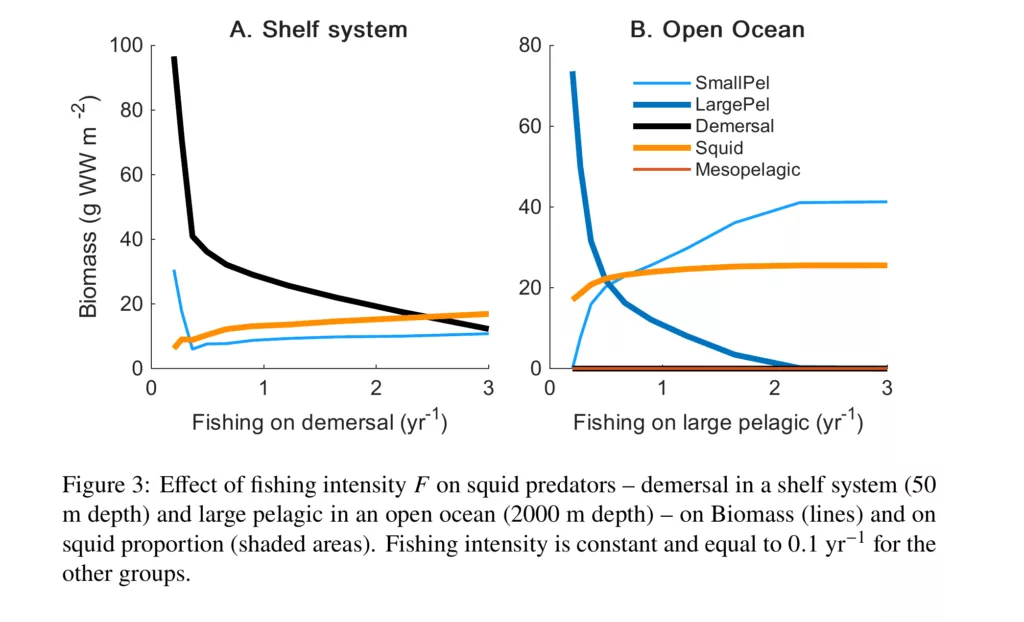 Figure adapted from Denéchère et al. (2026), bioRxiv, licensed under CC-BY 4.0.
Temperature presented a completely different picture. When the researchers increased the model’s baseline temperature by 2 degrees Celsius, squid biomass decreased in both the shelf and open-ocean areas, whereas fish biomass increased. The reason lies in the energy budgets. Although warmer water speeds up a squid’s metabolism and its capacity to search for food, it also raises the basic metabolic cost of just staying alive. Fish are better able to cope with this trade-off. Since squid have unusually high growth rates and high food requirements, they cannot eat enough to keep up with the rising cost of their own metabolism, and thus the net amount of energy available for growth and reproduction for them decreases as temperature goes up.
Temperature isn’t the only ocean chemistry shift squid have to contend with. Separate research has found that rising carbon dioxide levels also interfere with squid hunting, so a warming, more acidic ocean may be stacking multiple stressors on squid at once rather than just one.
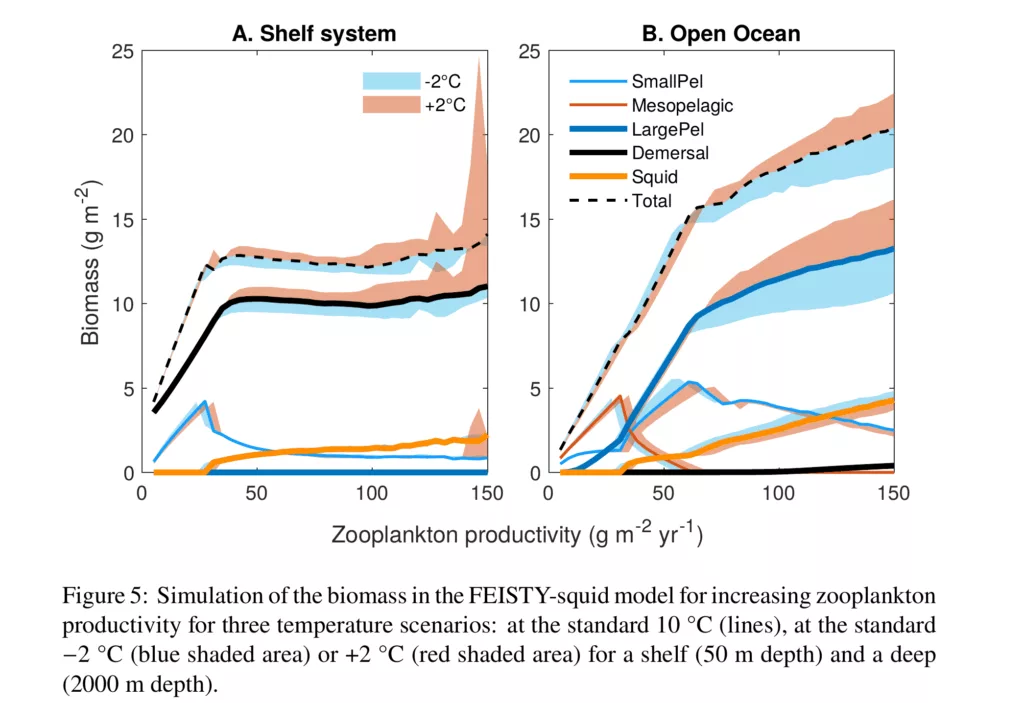 Figure adapted from Denéchère et al. (2026), bioRxiv, licensed under CC-BY 4.0.
Squid are ruled by food, not predators
Another result helps to explain why the fishing effect was so limited. In the simulations, the proportion of food found in the squid’s stomachs remained roughly the same even though the squid biomass increased, indicating that squid populations are mainly controlled by the amount of food available, i.e., a bottom-up limit, rather than by the number of predators hunting them, a top-down limit.
The model also came across a more disturbing observation. Even though fishing pressure on large predators increased, the predation pressure that squid faced did not decrease; instead, it increased. The researchers attributed this to a rise in cannibalism, since squid were taking a larger proportion of what other squid ate as their predators disappeared and as competition for prey changed. This is in agreement with earlier field observations of squid cannibalism which were made through analysis of stomach contents and surveys using deep-sea cameras.
A third possible explanation: squid as opportunists
Since neither of the two hypotheses by itself accounts for the historical boom in squid numbers, the authors suggest that another factor should be taken into consideration—that is, squid biology makes them particularly well-suited to take advantage of unstable environments. They grow about five times faster than fish of a similar size and have a lifespan of one to two years, characteristics which ecologists refer to as an r-selected life history, the same strategy that enables rapidly reproducing, weed-like species to quickly colonize disturbed habitats.
Over the last 100 years, the number of marine heatwaves has increased, and bottom trawling has altered the structure of shelf ecosystems. The authors propose that it is this increasing instability—rather than warming or the loss of predators alone—that has provided fast-growing squid with repeated opportunities to spread into disturbed niches before slower-growing fish could do so.
What it means going forward
The practical conclusion goes against a reassuring assumption: if the practice of overfishing large predatory fish is indeed brought under control, as fisheries management aims to do, the model indicates that the global squid biomass could in fact decrease rather than keep on rising, warming oceans reinforcing that decline rather than counteracting it.
The decrease would have effects beyond that. Since squid are in the middle of the marine food web, they act as a major food source for toothed whales and, in an indirect way, support commercial fish stocks that feed on squid; a reduction in the number of squid would therefore result in less food being available to both of them. Moreover, squid make up about 4 percent of the total catch from global marine fisheries on their own, so a shrinking population could directly lead to a lower catch. There is also a carbon aspect involved. As squid grow quickly, die young, and sink to the deep ocean after reproducing, it is believed that they are more efficient than many fish at moving carbon out of the surface ocean, so a smaller squid population could also weaken that process, even though the present study does not directly include that effect.
It will take more than just modeling to fill in the remaining gaps, since the authors specifically note that the development of squid embryos is still an open question; although it is known that warmer incubation accelerates hatching but results in smaller hatchlings, no one has so far linked that effect during early life to survival and growth in adulthood. Experiments involving the controlled rearing of squid eggs at constant temperatures and monitoring both the size of the hatchlings and their survival would help to address this issue. Likewise, more Q10 measurements taken across a broader range of squid species, sizes, and life stages, together with feeding trials to see whether squid are able to eat enough to meet the demands of a faster metabolism, and tagging studies that show how deep squid actually swim, would also be helpful so that future models can use the temperatures that squid actually experience rather than the surface temperature.
The study has not yet undergone peer review, and the authors are honest about these open questions. Nevertheless, the main finding — that increasing ocean temperatures are bad news for squid populations rather than good news—contradicts the assumption that has guided cephalopod research over the past ten years.
Journal Reference
Denéchère, R., van Denderen, P.D., and Andersen, K.H. (2026). “Historical squid biomass increase is not explained by rising temperature but rather by loss of top predators.” bioRxiv preprint, DOI: 10.64898/2026.08.30.748117.