
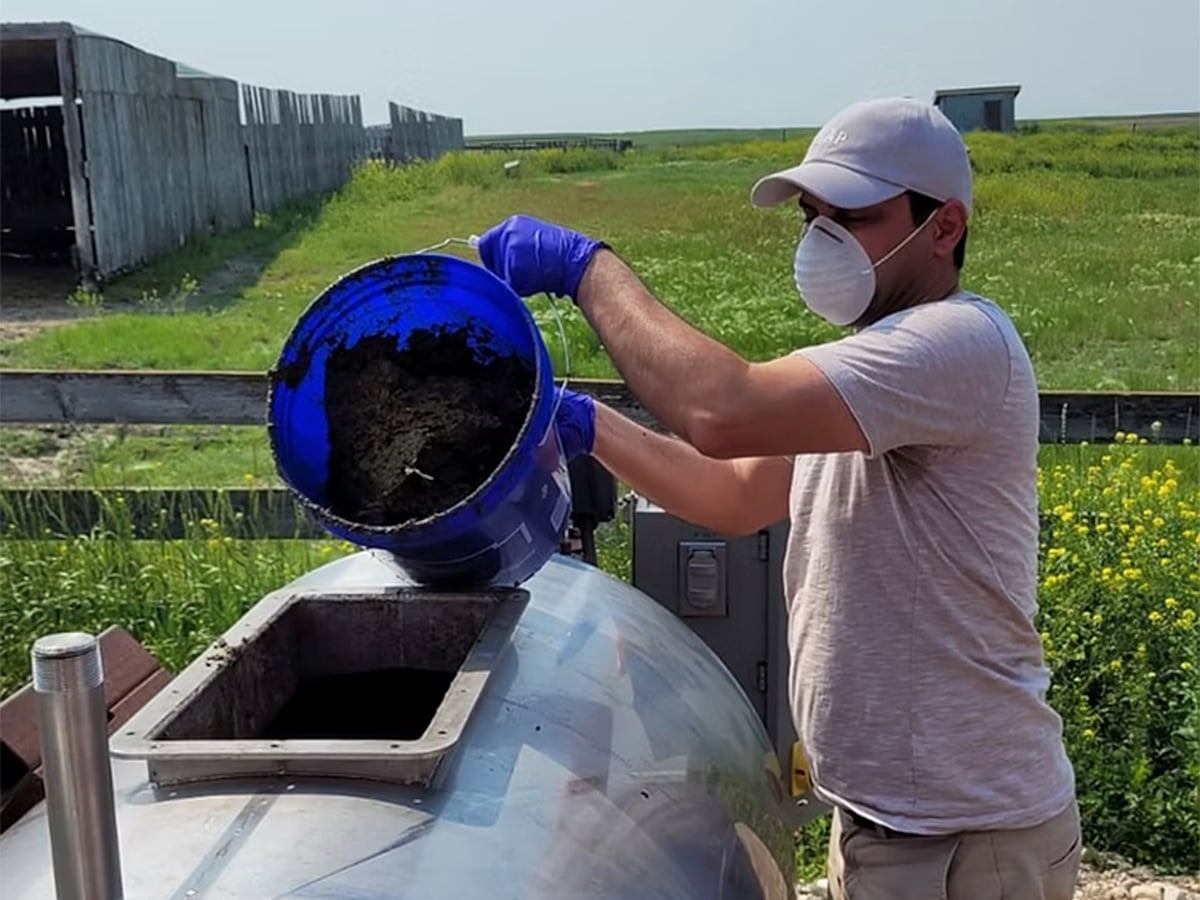
With Canada importing roughly 99 per cent of its phosphate needs, a Saskatchewan project is exploring whether agricultural waste and Canadian rock phosphate can be turned into a lower-carbon source of fertilizer.
B.Nature Biotech recently announced it has received $450,000 through the national Harvest wasteCANcreate program to scale technology that uses microbes to turn agricultural waste into a phosphate-enhanced biofertilizer.
B.Nature is a biotechnology company based in Saskatoon that specializes in rapid, industrial-scale composting technology.
The two-year project has a total value of $784,341 and is being developed with Cowessess First Nation and Cowessess Ventures LP in southern Saskatchewan.
The technology uses a mix of bacteria and fungi to break down organic material and release nutrients.
“This award validates the biology at the heart of our platform,” Babak Roshani, B.Nature’s chief executive officer and co-founder, said in a news release.
“We are not making compost faster — we are engineering a microbial consortium that unlocks phosphate and builds a living biofertilizer from material that would otherwise be wasted,” he said.
Read Also

The company is working with Canadian Phosphate Ltd. to combine its microbial technology with Canadian sedimentary rock phosphate.
The goal is to make the phosphate more available to plants and develop a domestic source of fertilizer.
Phosphate is on Canada’s critical minerals list, but the country has no active phosphate mines and imports most of its phosphate needs.
Daniel Gleeson, CEO of Canadian Phosphate, said combining Canadian rock phosphate with B.Nature’s microbial technology could provide a new source of domestic fertilizer.
“Pairing our high grade, Canadian sedimentary rock phosphate with B.Nature’s microbial biology is a compelling path to domestic, lower-carbon phosphate fertility,” said Gleeson in the release.
The microbial process works in two stages. Bacteria begin breaking down the material and helping release phosphate, while fungi continue the process as the material cures.
The system operates inside an enclosed vessel designed for cold climates and could be used in remote and on-reserve locations.
However, the company is aiming for more than simply producing compost. The goal is a consistent biofertilizer with nutrients that are more available to crops.
The project will include field testing and analysis to determine how well the product performs.
It will also examine the environmental benefits of the process.
B.Nature said lifecycle modelling suggests its system could produce up to 84 per cent lower greenhouse-gas emissions than sending the material to landfill and about 70 per cent lower emissions than conventional composting.
Those figures will be independently assessed through a life-cycle study by 5redo Sustainability Consulting.
The project is being co-developed with Cowessess First Nation and Cowessess Ventures, with field validation taking place on Cowessess lands through the asiskiy tech Indigenous clean-technology platform.
The partnership gives B.Nature a place to test the technology outside the laboratory while creating potential economic and environmental opportunities for Cowessess.
Raj Behari, B.Nature co-founder, said the partnership has been part of the project from the beginning.
“What makes this project different is who we are building it with,” said Behari in the release.
“From day one this has been a co-development with Cowessess — on their lands, with their team, through asiskiy tech,” he said.
The Harvest funding builds on $125,000 that B.Nature received through Innovation Saskatchewan’s Agtech Growth Fund earlier this year to advance its rapid-composting technology.
The new funding will support microbial strains, field trials, testing, pelletizing and other work needed to move the technology toward commercial use.
The project is expected to move the technology from its current development stage toward an operational demonstration by March 2028.
The company said the project could eventually provide Canadian agriculture with a way to get more value from agricultural waste while developing a domestic source of phosphate fertilizer.
“Harvest lets us prove that at the scale Canadian agriculture needs,” said Roshani.