
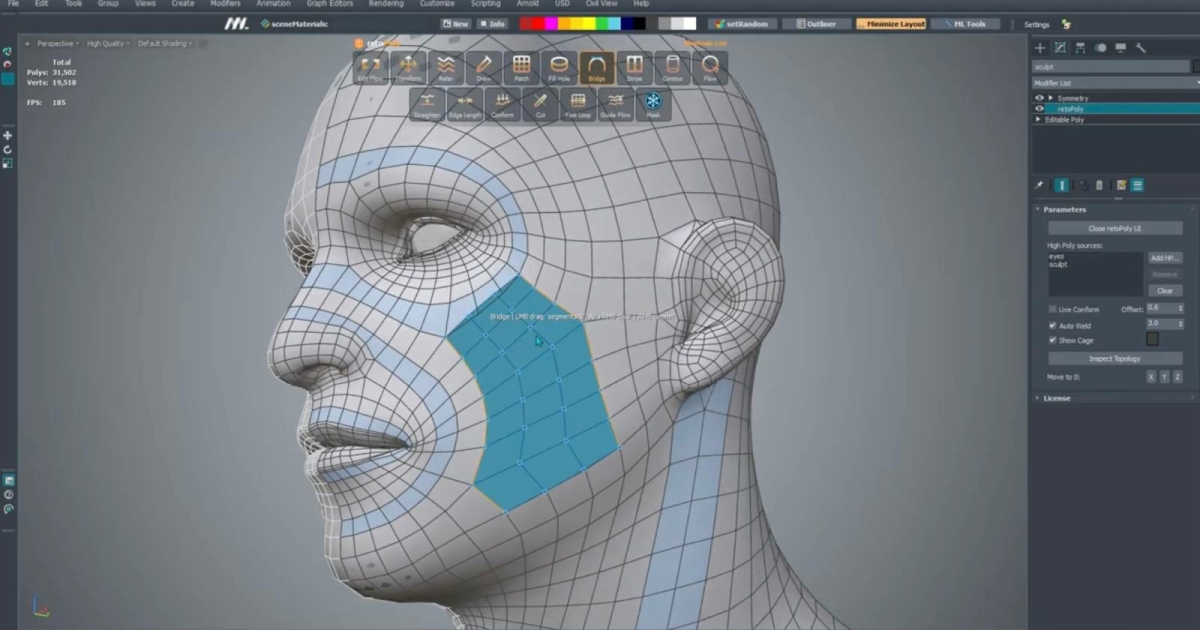
How retoPoly Started
I developed retoPoly myself for Autodesk 3ds Max. The project originally started as a personal tool and an experiment around my own retopology workflow. I wanted to explore a different way of doing manual retopology directly inside 3ds Max, while keeping the topology editable as part of the modifier stack.
As I continued working on it, the experiment gradually grew into a much more complete tool. More operations were added, the interaction became more visual, and eventually I realized that the same workflow could also be useful to other 3ds Max artists who prefer having direct control over their topology.
One of the main technical challenges during development was keeping the workflow interactive while the topology remained projected onto one or more high-resolution reference meshes and editable inside the modifier. I wanted the modifier to stay responsive and predictable even as the topology became more complex and more editing operations were added.
Another important part of the development was making the different tools feel like parts of the same workflow rather than isolated commands. I spent a lot of time refining the viewport interaction, previews, and UI so that most operations could be understood visually without constantly referring to documentation.
retoPoly eventually became a native manual retopology modifier built around that idea: the topology remains editable, the artist keeps control over the edge flow, and the whole process stays inside the regular 3ds Max workflow. The plug-in is mainly intended for 3D Artists, Environment Artists, Archviz Artists, Game Artists, Animators, etc.