
The Clare coast holds the attention of the golfing world this month.
Doonbeg hosts the Irish Open for the first time, with the likes of Jon Rahm and Brooks Koepka part of the field. The owner of the resort is also planning to descend on the venue.
Before that, Lahinch – where the aforementioned Rahm won the Irish Open in 2019 – becomes the third Irish links to host the Walker Cup.
Offaly’s Stuart Grehan, winner of the Amateur Championship in Royal Liverpool this summer and a one-time professional, is the only Irish player on the team this time.
The two previous matches played in Ireland have failed to yield a British and Irish victory.
This hardly amounts to evidence that Ireland is unlucky terrain for the home team given that America have won the vast majority of Walker Cups full stop.
The overall head-to-head is 40-9 and that’s even after an uptick in British and Irish competitiveness in the last 35 years. After the 1987 match, the head-to-head was 28-2 to the Americans.
A similar-ish head-to-head record in the Ryder Cup prompted Jack Nicklaus to write to the Earl of Derby – President of the British PGA – in 1979 proposing that the GB&I team be expanded to include continental players or else he and the other top American professionals would lose interest. It’s protected place in the pro calendar had become increasingly hard to justify.
That the Walker Cup never went the same way is presumably down to its amateur status and the fact that there wasn’t the same professional imperative to attract eyeballs and buzz to the product.
Also, Great Britain and Ireland had won the Walker Cup for only the second time ever in 1971 when a team containing Roddy Carr beat an American side which included Lanny Wadkins 13-11 at St Andrew’s.
The first Walker Cup to be held in Ireland also happened to be one of the most famous and compelling editions of the event.
Partly, this was down to the context. Great Britain & Ireland sensationally won the 1989 match, only their third win ever and their first away from home.
Cork’s Eoghan O’Connell, who had qualified for the 1987 Open Championship at Muirfield, halved a crucial match with US hot-shot Phil Mickelson as the visitors clung on to win 12.5 to 11.5. O’Connell’s professional career was subsequently marred by persistent wrist problems.
This came on top of Europe’s sudden dominance in the Ryder Cup in the second half of the 1980s. Players from the UK had begun to hoard green jackets. These were dark times for American golf when their previously easy supremacy was being threatened.
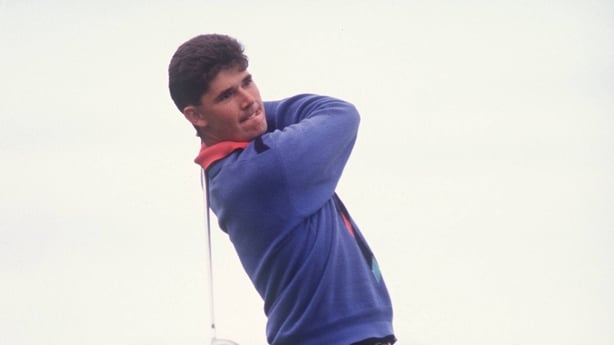
Padraig Harrington in action in the 1991 Walker Cup
The ’91 Walker Cup in Portmarnock was held just a few weeks before ‘The War on the Shore’ on Kiawah Island, probably the most heated and tension-laden Ryder Cup of them all, alongside Brookline ’99.
Mickelson was still in Arizona State University and had won the 1990 US Amateur title, the first left-hander to do so. He was anxious to be part of a winning Walker Cup team before turning professional, especially after the ignominious defeat on home soil two years earlier.
He wasn’t the only future world No 1 on Team USA in Portmarnock that week. David Duval, who wore no shades and boasted a floppy head of blonde hair, played his first and only Walker Cup in north county Dublin.
The only other name on the US team that might be recognisable to regular golf fans is Bob May, best known for facing off against Tiger Woods in a play-off for the 2000 PGA Championship.
The home side contained three Irish players in Padraig Harrington, Paul McGinley and Garth McGimpsey. Harrington, who’d just turned 20, went on to play three Walker Cups, and made it clear later on that he didn’t regard himself as destined for greatness at this point.
That certainly seemed the case that week – he played two matches and lost both. Curiously, he didn’t fare much better for his only home Ryder Cup 15 years later, collecting just one half point in five matches on a weekend where Europe won easily.
McGinley did earn a point, teaming up with England’s Liam White in the foursomes to beat Mickelson and May.
But it was Mickelson who provided all the stardust and the wow factor and, yes, the controversy. Before the first tee shot on Thursday morning, he enraged Mná na hÉireann and provoked a minor international incident.
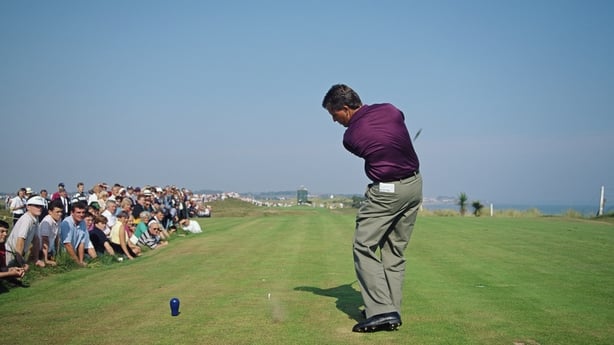
Phil Mickelson teeing off at a sunny Portmarnock in 1991
In an interview with ESPN, he was asked about one hooked tee shot which he lashed into the galleries.
“That’s not a place I want to be,” he said. “The Irish women are not that attractive.”
“It was like a scene in the movies, with everyone in the press tent rushing to their phones to call back to their paper,” Sports Illustrated’s John Garrity later told Alan Shipnuck.
‘BAD BOY PHIL’ and ‘MASTERFUL MICKELSON DRAWS IRISH IRE’ headlines were emblazoned across the tabloids.
The comments were even afforded a small column on the front page of the Irish Times alongside reports from the Kremlin about the Soviet Union’s slow-moving implosion and articles about the Greencore saga.
Dermot Gilleece wrote that Mickelson had “become embroiled in a diplomatic rumpus yesterday which overshadowed the superb quality of his golf.”
This being 1991, no person in Ireland actually saw the comments but the Irish consulate in New York was inundated with angry calls and they contacted the USGA demanding an apology.
The US bus had to be halted as it was leaving the course on Thursday and Mickelson had to dismount to film his apology, saying “I’m sorry, it was meant in jest.”
It was only later claimed that Mickelson had been a victim of misinterpretation.
That when Phil had declared that “Irish women were not that attractive”, he had put the emphasis on the word “that”. Read in that light, his comments were more about the denseness of the rough than anything else.
He was involved in another controversy on Day 1, when he had a testy exchange with Andrew Coltart over the latter failing to award a gimme. Mickelson held his putter parallel to the ground to demonstrate the shortness of the putt.
Coltart stood there, unmoved and unimpressed, and walked off the green muttering about Mickelson’s arrogance when the putt was holed. The American won the match 4&3.
“He’s an arrogant so-and-so,” the Scot said afterwards. “There’s no place for behaviour like that in an event like this – he was trying to take the mickey out of me.”
In his play that week, Mickelson wowed both the commentators and fans, and was described as a kind of American Seve Ballesteros, the obvious point of reference at the time. He sealed a 1Up win over Jim Milligan in his final singles match with an exotic flop shot to a couple of feet, which would later become his trademark.
The second Walker Cup on Irish soil, 17 years later, wasn’t quite as memorable or as controversial, but it did contain another very high-powered US team and another future Irish major winner on the other side.
It was held at another celebrated Irish links, this time in Royal County Down. On the American side, there were two future US Open champions in Dustin Johnson and Webb Simpson. Rickie Fowler, Billy Horschel and Chris Kirk were also part of a side that boasted uncommon depth.
On the home team was an 18-year old Rory McIlroy, who’d won leading amateur at that year’s Open Championship (won by Harrington) and another future Masters champion in Danny Willett. Jonathan Caldwell from Newtownards was also in the GB&I team.
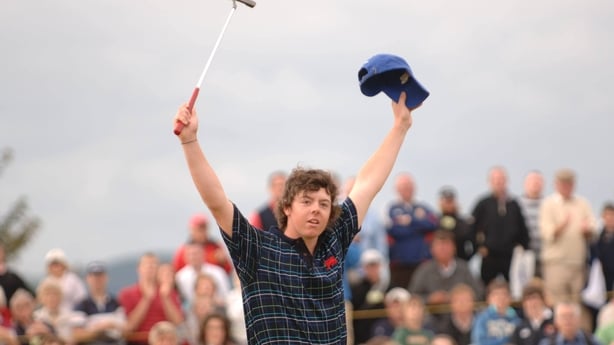
Rory McIlroy after beating Billy Horschel in singles
McIlroy was already a touch famous and was branded the “poster boy for amateur golf on this side of the Atlantic”. He played Horschel three times that week, losing their Saturday singles match and then again in the Sunday foursomes, when he and Caldwell were beaten by Horschel/ Fowler.
However, he did beat Horschel 4&2 in the Sunday singles as the home team almost pulled off a famous comeback, winning the final session 5.5 to 2.5 to lose by just a single point.