
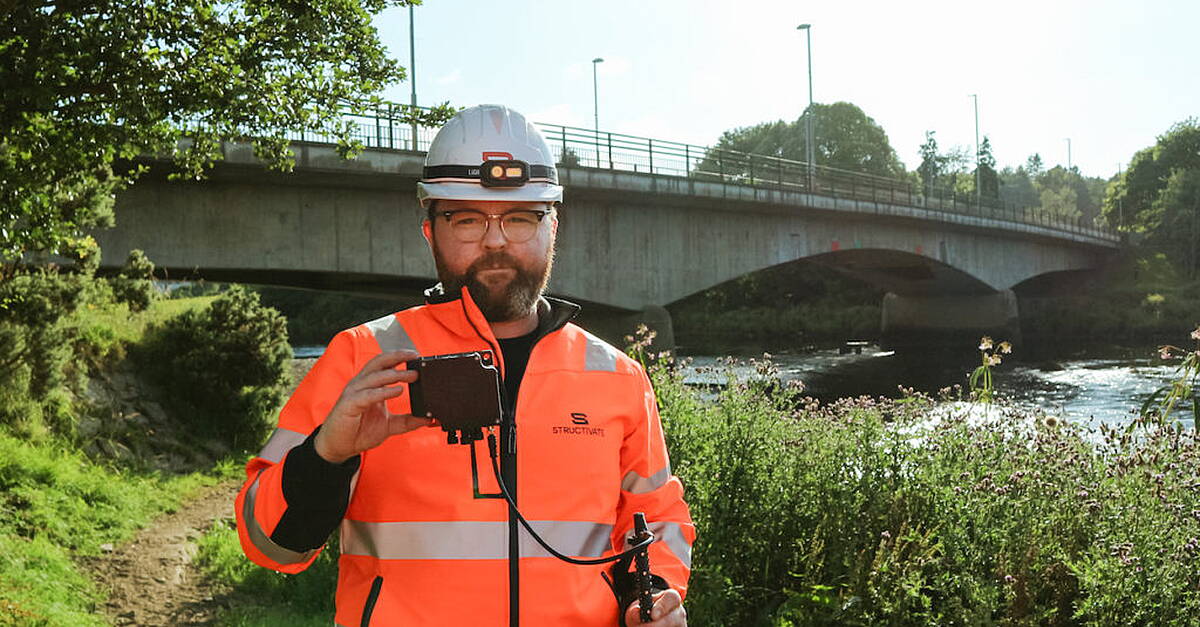
Lifford Bridge could well be the safest bridge in Ireland thanks to new sensors fitted in recent weeks.
Sensors that can detect corrosion hidden inside reinforced concrete have been installed on the bridge as part of brand new technology.
The four SM:ART (Structural Monitoring and Real-Time analytics) sensors were fitted to the bridge over the River Finn on July 17th last.
The sensors were placed at the bridge’s half-joints, the points where separate sections of the deck meet and support each other.
These areas are among the most difficult to inspect because damage from water and road salts builds up inside the concrete over decades without any visible sign on the surface.
The project was carried out in partnership with the Department for Infrastructure Northern Ireland (DfI).
Dr Sean Bond, who developed the SM:ART system from his PhD research at Technological University Dublin, led the installation. All four sensors were transmitting live data before the team left the site.
 The sensors are fitted at Lifford Bridge
The sensors monitor early signs of corrosion, the condition of the concrete, temperature, humidity and small changes in movement. The information is sent wirelessly to an online platform where engineers can review it when planning inspections and maintenance work.
You may also be interested in


Dr Bond said the system was designed to help engineers make better-informed decisions about the bridge.
“A bridge like Lifford is part of daily life for people in both towns, but some of its most critical areas are impossible to assess from a visual inspection alone. This gives engineers continuous evidence so they can act at the right time, not when it’s too late.”
He said many reinforced concrete bridges across the country were now reaching the same stage of life.
“We are facing a tsunami of bridges that were all built around the same era, and the budgets to replace them don’t exist. Monitoring like this allows asset owners to understand what is actually happening inside a bridge and prioritise before a problem becomes an emergency.”
The SM:ART project was developed at TU Dublin and is supported by Enterprise Ireland’s Commercialisation Fund.
The next planned deployment is at the Woodside Viaducts in Glasgow, in partnership with Transport Scotland.