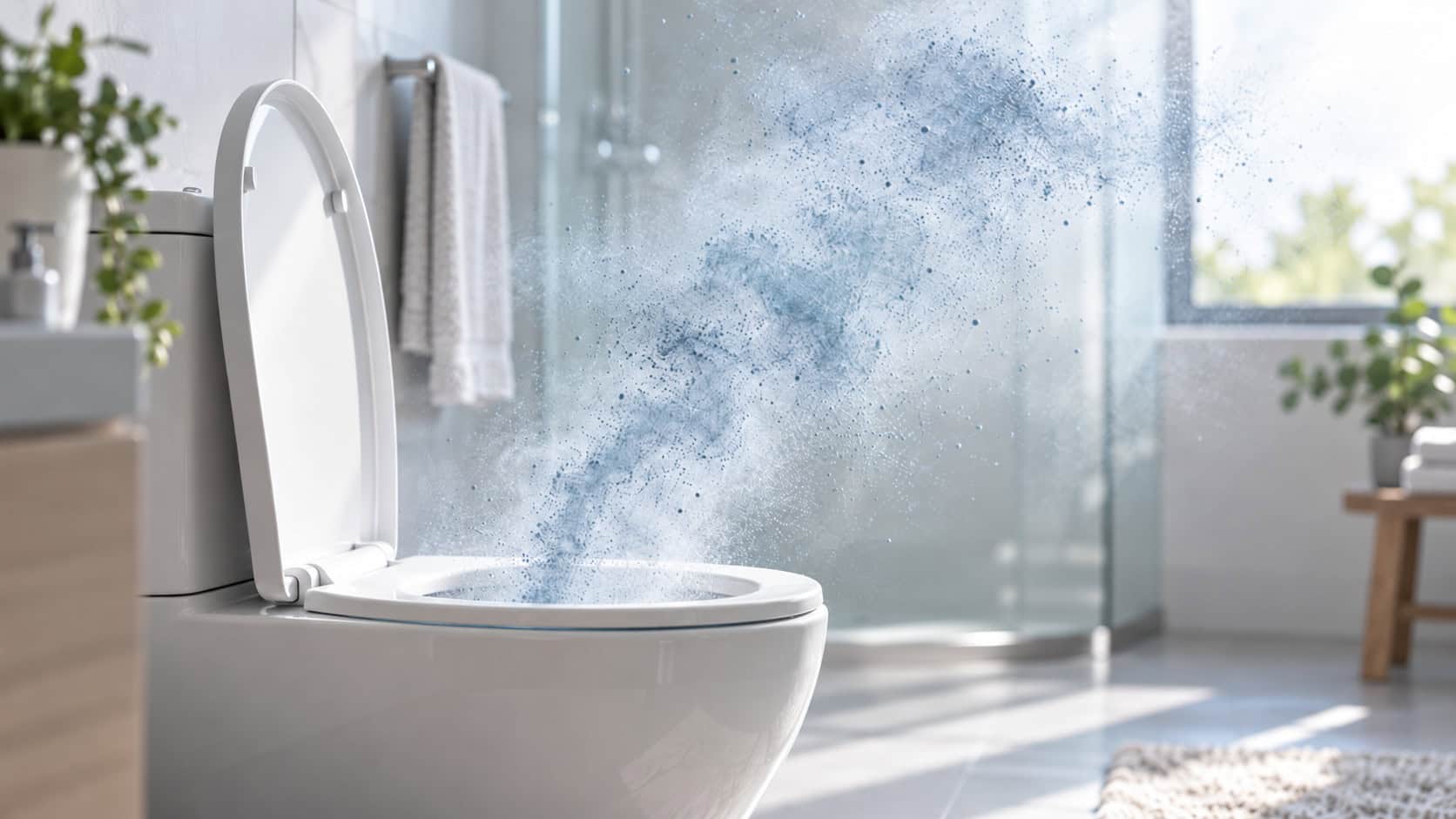
 Credit: ZME Science.
Most bathroom hygiene advice focuses on the things your hands touch. You’re supposed to wash your hands and avoid germs on flush handles, taps, toilet seats, and door handles. But flushing a toilet can create another, less obvious route for contamination: the air around you.
As water rushes through the bowl, it creates turbulence that throws microscopic droplets upward. Some of these particles can carry bacteria, viruses or other biological material from the bowl water. Researchers have detected them more than five feet above the floor, within the breathing zone of many adults, and found that some remain airborne for at least 20 seconds after a flush.
The findings are the result of a systematic review carried by researchers at Flinders University, who analyzed 22 previously published studies of aerosols released during flushing.
“Toilet flushing creates turbulence that can release aerosols into the surrounding air. Some studies detected these aerosols at adult breathing height, indicating a potential pathway for inhalation exposure,” said lead author Lira Adiyani, a Ph.D. student at Flinders University.
That does not mean a routine flush is likely to make someone sick, but it could.
What makes a bigger toilet plume?

The clearest pattern involved what was already in the water and how much water moved through the toilet.
Some experiments deliberately added known amounts of bacteria, viruses or harmless stand-ins to the bowl. Across all studies, simply comparing these “seeded” toilets with unseeded ones did not produce a significant difference. The experimental setups varied too much from study to study. But when the researchers looked only at controlled seeding experiments, they found that the more microbes were in the bowl water, the more they detected in the air.
In the review’s final analysis, every tenfold increase in microbial concentration in the source water was associated with about a 2.6-fold increase in airborne aerosol or bioaerosol concentration. Each additional liter of flush water corresponded to roughly a 1.3-fold increase.
×
Thank you! One more thing…
Please check your inbox and confirm your subscription.
Previously, a 2013 study of modern flush toilets found that more energetic flushing systems produced more airborne droplets, even when flush volumes were similar. And a striking 2022 laser-visualization experiment by the University of Colorado made the invisible plume visible: a commercial toilet launched aerosols to about 1.5 meters in eight seconds, propelled by a jet moving faster than 2 meters per second. That experiment used only tap water, but it vividly demonstrated the physics that can carry particles upward. In a real-world setting, those particles include fecal matter that may contain all sorts of bacteria and viruses.
 Laser visualization of flush plume from a 2022 study. Credit: John Crimaldi et al. / University of Colorado Boulder.
Most particle sizes reported in the new review ranged from 0.3 to 10 micrometers, with the majority below 3 micrometers — small enough to remain airborne and potentially be inhaled.
Does closing the lid actually help?

Probably somewhat, but the evidence is thinner than common bathroom advice might suggest.
The review could not establish a statistically reliable effect of lid position or ventilation because too few studies reported comparable measurements. Closing the lid also does not seal a toilet: particles can escape through gaps between the lid, seat and bowl.
A 2024 American Journal of Infection Control experiment found that putting the lid down did not reduce viral contamination of bathroom surfaces. More recently, a 2026 pilot study of the gap beneath a closed lid found that microbes could still escape, with larger gaps allowing more bioaerosols through.
“Based on the available evidence, I would recommend closing the toilet lid before flushing, where a lid is available, as a precautionary measure to minimise potential inhalation exposure — while recognising that it does not completely prevent aerosols from escaping,” Adiyani said.
The researchers also recommend regular toilet cleaning, handwashing and, on dual-flush toilets, using the lower-volume option when appropriate. Ventilation may help clear lingering particles even though the review could not reliably isolate its effect.
When at home, all of this should not really concern you. The flush plume is especially concerning in busy public bathrooms and places where vulnerable people may face repeated exposure. “Further research is needed to develop design and engineering interventions that reduce toilet-generated bioaerosols, particularly in high-risk settings such as hospitals,” co-author Harriet Whiley said.
The toilet plume, in other words, is real. The harder question is how often it matters to health — and how engineers can make each flush stir up less of it.
The findings were published in the journal Science of the Total Environment.