
As years of divisive rhetoric roll into decades, two Dublin drag queens reconsider the political power of disgust. Kate Demolder writes.
In November 2025, the Oxford English Dictionary’s publisher announced “rage bait” as its word of the year.
Defined as “online content deliberately designed to elicit anger or outrage by being frustrating, provocative or offensive, typically posted in order to increase traffic to or engagement with a particular webpage or social media content”, the use of the phrase, as per Oxford University Press’ analysis, had tripled in the past 12 months.
In the same year, rage – an emotion formerly socialised away – emerged as an emotion to be embraced. Good Anger: How Rethinking Rage Can Change Our Lives by Sam Parker was awarded five stars by Martin Chilton of The Independent, while psychotherapist Dr Aaron Balick described it as “enlightening and compulsory”.
Similarly, Good Housekeeping applauded the efforts of one columnist, who wrote the exceedingly well-read article ‘How reclaiming rage transformed my life’.
Rage is an emotion that is easy to recognise but difficult to define. Psychologists might classify it as a secondary emotion, one that can beget the full gamut of actions, from screaming to silence. Biologists might explain it as a feeling of pain or discomfort, accompanied by the release of hormones, like adrenaline, that increase blood pressure.
Disgust is more difficult to define again.
“The phrase we kept using was ‘fear means you protect yourself, disgust means you’re better than someone else,” actor and writer Niall Keane says.
“Yeah, disgust is having pride of place to police others,” agrees fellow actor and writer Constance Henry. “It means you’re fed up with pretending that you’re not better than others. It imposes a sense of hierarchy, which is, more often than not, cruel in its intentions.”
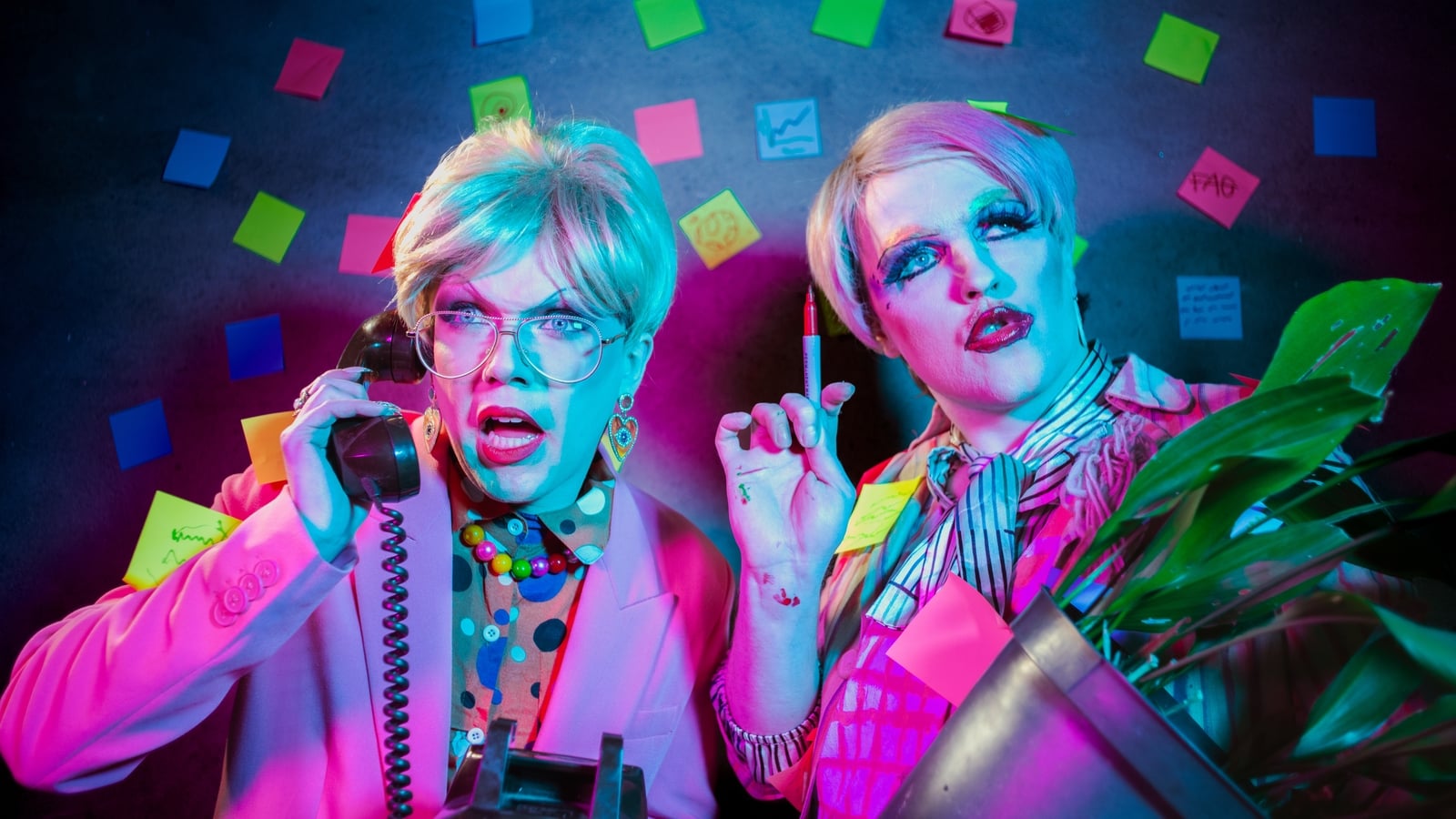
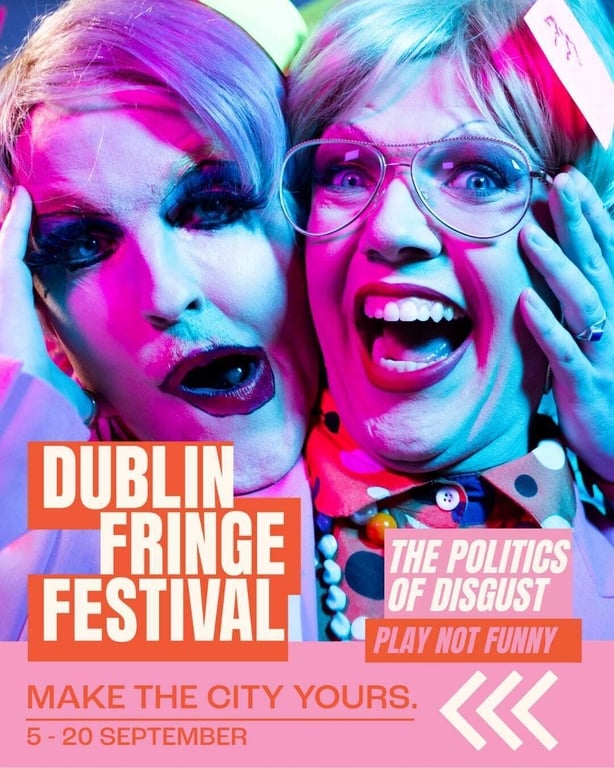
This definitional vagueness is being debated at this year’s Dublin Fringe festival, through The Politics of Disgust, Keane and Henry’s show performed in their drag personas, GoblinsGoblinsGoblins and Sasha Shame.
Promising to take “a filthy, feral look at politics, propaganda, and the things we hate”, the 60-minute piece centres around an emergency performance meeting, wherein HR associates, Susyan Pork (Shame) and Susan Beanz (Goblins), have been called in to teach audiences how to spot propaganda, interrogate the politics of disgust and survive their increasingly absurd reality.
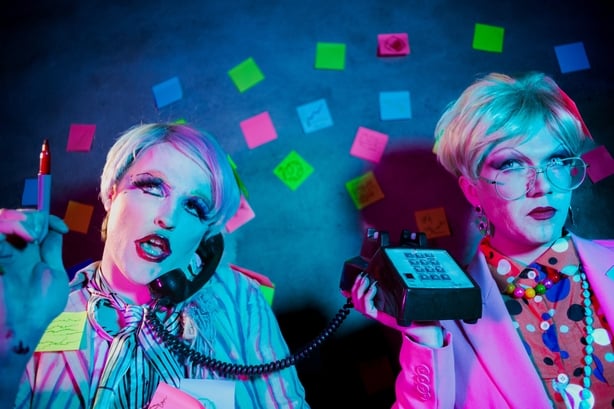
Split into four parts, the piece uses the two roles as conduits for modern vitriolic messaging. “They are the perfect mouthpiece for exploring politics of this kind,” Henry says. “Especially the idea of PC culture and looking into the question of why do people feel they can get away with saying certain things, but not others?”
The show’s impetus arrived by way of a suite of recent incidents, such as the Dublin riots, and Henry’s own experience with gender identity.
“As a trans woman, I definitely think about the slow but also very escalating creep of very hardline conservatism in the last several years,” she says. “But also specific incidents, like the riots a couple of years ago – I think they really showed us how bad it is here, and now I think most people are under no illusion how bad it is in Ireland, as it is in the rest of the world.”
Much of the show has also been inspired by Ireland’s reaction to immigration.
“There have been a few incidents of people being attacked on Dublin streets recently, and there’s a strategy behind it that we kind of explore in the show,” Keane adds.
“Even though it may seem simple and outrageous, there’s a social power to the confidence displayed when attacking someone like that, and that can only come from an internal confidence of knowing that you can get away with it in the first place.”
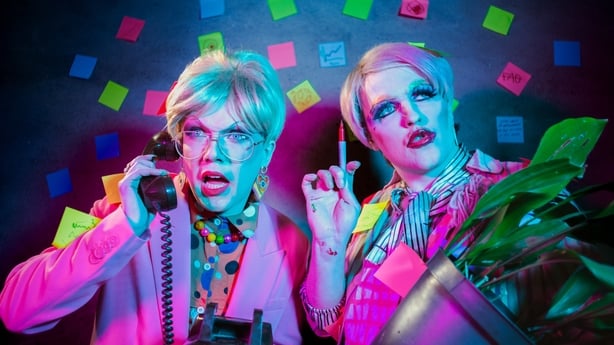
The Politics of Disgust can be viewed in a number of ways. Part-political education, part-theatrical breakdown and part-emergency workplace intervention, it aims to ask the question: what happens when disgust stops being a feeling and becomes a political tool?
“Doing it through two drag characters is just pure satire,” Henry says. “Like if we’d made this show in the 1980s, we’d probably be dressing up as Margaret Thatcher. We want audiences to feel weird about them, or even hate them, but also follow along with them, because at the end of the day, they’re two camp divas.”
“We’re not going to get rid of discussing politics by telling everyone to love each other, but we want people to be able to leave feeling informed about how disgust is politicised. Like how asylum seekers living in tents have become this scary thing, or how a trans person who could use a certain bathroom a few months ago, now can’t.”
As is customary in circumstances of Fringe theatre, both Keane and Henry are bringing a little bit of themselves to the performance. For Keane, a queer person, his most recent example of disgust was just two days before our conversation.
“I was at Electric Picnic in drag as the Salmon of Knowledge,” he smiles. “And at least once a night, I had these young lads come over and ask me, ‘are you a boy or girl?’ It was happening to loads of gender non-conforming people, and they were doing it because they wanted a fight, and they wanted to beat us up.
“They’re not scared of you, to be honest; I think fear and disgust are really separate things, but I did find it fascinating that we were fascinating to them.”
For Henry, a similar situation occurred when a group of adolescents called her a ‘ladyboy’ when they attempted to take over the room they’d booked to rehearse The Politics of Disgust.
“I know it’s because they’re bored and abandoned by government programmes,” she says. “But it’s alarming that when they hit any sort of conflict, they resort to what they feel is the most basic and easy form of abjection of the other person.” Thankfully, the comment didn’t hit home. “Calling me a ladyboy? Honestly, kind of fab.”
In 2015, Pixar’s animated film Inside Out, one of the most successful animated films ever made, told the story of 11-year-old Riley and the five personified core emotions living inside her mind: Joy, Sadness, Fear, Anger, and Disgust. Voiced by Mindy Kaling, Disgust is savvy, high-standard-wielding, snob-adjacent, and is billed repeatedly as Riley’s protector.
“It was always the thing [in the film] that Disgust keeps you safe,” Keane says. “But I just don’t think that’s true. Disgust is not a core human emotion, and the fact that its presence has been legitimised in one of the most popular children’s films on Earth is a little alarming.”
“I think there was good intention, and some really interesting attempts at storytelling,” Henry adds. “But I think they are walking themselves into a point where they’ll have to tactfully handle the idea of Disgust becoming a tiny green racist.”
Thankfully, The Politics of Disgust is more concerned about the brighter side of life. “We think about people like Andrew Tate and JK Rowling, and get very scared,” Henry says. “And I’m a very angry person, but I’m also a very scared person. So as someone who is very afraid and feeling a lot of dread, especially watching things get worse, I like being able to laugh.
“I like finding a chance to laugh, and I like giving other people a chance to laugh. This play is meant to be informative, but it’s also highly entertaining. Because while it’s important to say these things, it’s also nice to be able to walk out of something and still have that laughter, while also thinking in a different way, or more hopefully.”
The Politics of Disgust will run at Bewley’s Café Theatre as part of Dublin Fringe Festival 2026 from September 8 – 13. Tickets from €13 are available from fringefest.com.
The views expressed here are those of the author and do not represent or reflect the views of RTÉ