

Northern Ireland’s economy picked up pace during August with private sector output rising at the fastest pace in two years, a new report from Ulster Bank suggests.
The latest monthly growth tracker from the NatWest-owned lender found business activity in Northern Ireland outperformed all other regions last month, including London.
Based on the feedback of around 200 firms across the manufacturing, services, construction, and retail sectors, the survey is often an early bellwether for how the economy is performing.
The latest business activity index reached 55.5 in August, up from 51.4 in July, marking the sharpest increase since October 2024. Anything above 50.0 signals growth.

The survey showed all four subsectors in growth mode during August, led by manufacturing and services, with new orders rising for the first time in five months.
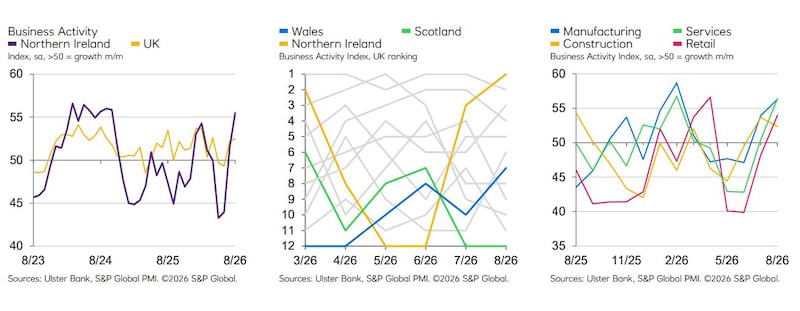 Highlights from Ulster Bank’s September growth tracker report. (Ryan)
The stronger third quarter performance follows a weaker second quarter.
Ulster Bank said some of the panellists in the latest survey pointed to new projects getting started and higher tourism numbers.
The period covers Belfast hosting Fleadh Cheoil na hÉireann for the first time in early August, attracting around 1.6 million into the city centre over the festival period.
“Northern Ireland companies are putting the disruption of the late-Spring behind them, with August seeing a sharp rise in business activity amid renewed growth of new orders,” said Ulster Bank’s chief economist Sebastian Burnside.
“In fact, Northern Ireland was the fastest growing part of the UK in terms of output.
“Expansions were particularly pronounced in manufacturing – where new projects are starting to ramp up, and services – boosted by increased tourism numbers and events such as the Fleadh Cheoil.”
However it wasn’t all plain sailing, with employment dipping for the second time in three months, with some tentative signs of capacity pressures building.
The survey also pointed to a sharp rise in input costs, while selling price inflation hit a three-month high.
“Difficulties hiring staff to resource the new business coming in were highlighted again, meaning that employment decreased. This, alongside rising new orders meant that operating capacity was only just able to keep outstanding business from expanding,” added Mr Burnside.
“Companies will be hoping to see further growth in the months ahead, but inflationary pressures remain a headwind.
“Costs for fuel and staff increased again in August, with other firms highlighting rising prices for steel. In turn, charges increased at the fastest pace for three months, potentially limiting demand growth.”