
One of the largest public art exhibitions in the country gets underway this week with a slew of performances and other events.
Counterpublic 2026 features work from 50 artists at sites around St. Louis and the Metro East.
The three-month exhibition officially kicked off Wednesday with the opening of related exhibitions with work by Juanita McNeely at the St. Louis Art Museum and Carolina Caycedo at the Kemper Art Museum.
It gathers momentum with a grand opening celebration at Powell Hall on Thursday night featuring members of the St. Louis Symphony Orchestra, and events on Friday, Saturday and Sunday related to artwork at Tower Grove Park; the Spring Church in Grand Center; the Ville; the International Institute; the Luminary gallery on Cherokee Street; the Contemporary Art Museum; the National Building Arts Center in Sauget and other locations.
The title of this version of the triennial art event is “Coyote Time” — a reference from the world of video games that describes the moment when a character steps into open space. The term is inspired by a scenario familiar from cartoons featuring Wile E. Coyote, when he runs off a cliff but doesn’t realize it yet.
“It’s this moment of being suspended in midair, where you have this choice of whether you continue with a sense of purposeful faith in the risk you’re taking. Are you going to jump backwards? Are you going to fall and plummet? It’s this moment of risk, this moment of possibility, this moment of vulnerability,” said Jordan Carter, one of five guest curators who helped organize Counterpublic 2026.
Carter and fellow curators Raphael Fonseca, Stefanie Hessler, Nora N. Khan and Wanda Nanibush hope the work on view will prompt some visitors to contemplate new possibilities and ways of life at a historical moment filled with uncertainty for many people.
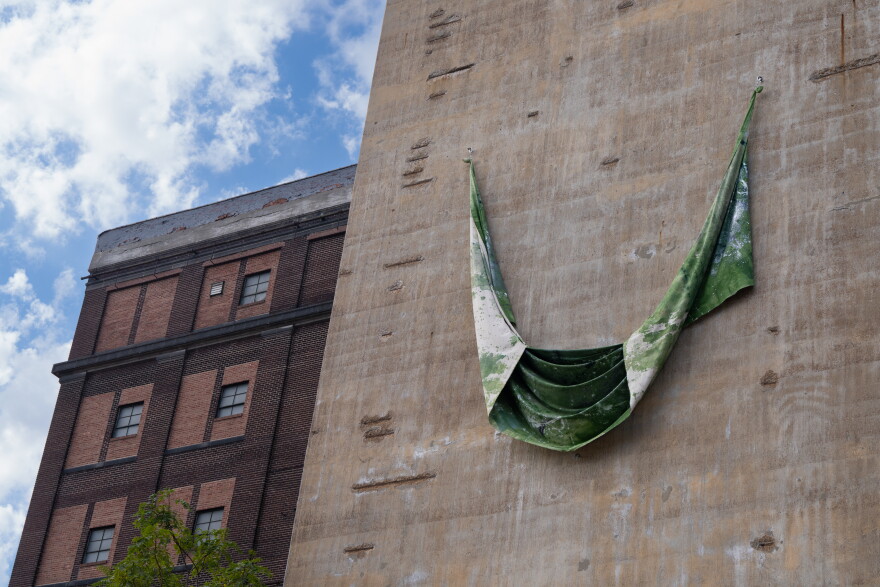
St. Louis-based artist Vaughn Davis Jr.’s piece “Fields Green” is hung on the outside of a building that faces the Gateway Arch.
Opening-weekend events include:
• A performance at Spring Church in Grand Center at 6:15 p.m. Thursday. St. Louis-based bassist Damon Smith will play work by the late Benjamin Patterson, followed by the local debut of one of Patterson’s sound installations at the Pulitzer Art Center’s nearby outdoor space, Park-Like.
• A community meal at the International Institute at 5 p.m. Friday.
• Kite’s performance of the score that accompanies her large installation at Tower Grove Park at 6:30 p.m. Friday.
• A 5K run beginning at 8 a.m. Saturday in the Ville, organized by artist Malcolm Peacock and 4theVille.
• A musical performance at 101 Chouteau Ave. at 3 p.m. Saturday by Natural Information Society amid a multimedia installation by Lisa Alvarado.
• A canoe tour with artists Yatika Fields and Anika Todd along the Mississippi River on Sunday morning.
• An afterparty at Kenny’s Upstairs at 9 p.m. Saturday.
A full list of opening weekend events can be found online.
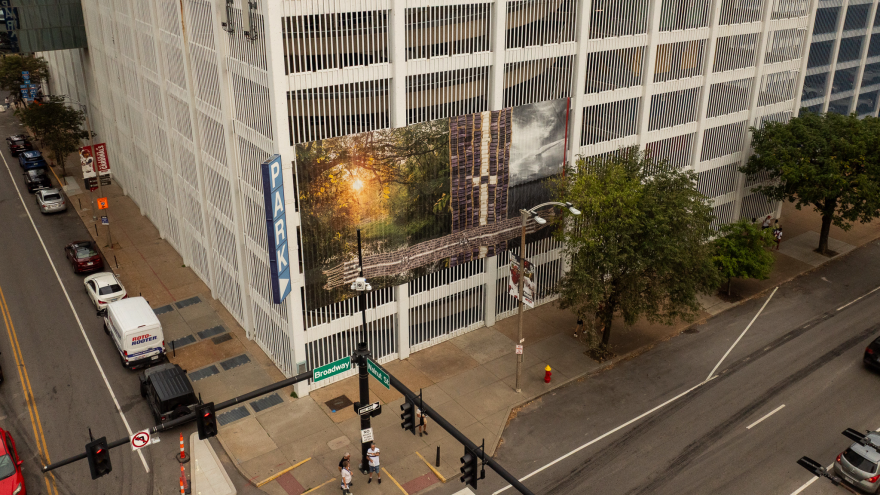
Yatika Starr Fields’ piece “Site Memory” is installed near the burial site of Chief Pontiac, or Ogimaa Obwandiyag, in present-day downtown St. Louis.
The Counterpublic exhibition originated in 2019 as an event produced by the Luminary, then led by co-founders James McAnally and Brea Youngblood. The founders later left the gallery, and McAnally created Counterpublic as a standalone organization in 2021.
Counterpublic 2019 was focused on locations on and around Cherokee Street. Organizers of the 2023 edition reached for a larger canvas, commissioning artwork that was placed near Sugarloaf Mound, at the Griot Museum of Black History and other locations around St. Louis.
This year’s exhibition includes work by artists from around the world, some of whom addressed issues specific to St. Louis. Much of the artwork in “Coyote Time” is meant to be in conversation with its location in public space.
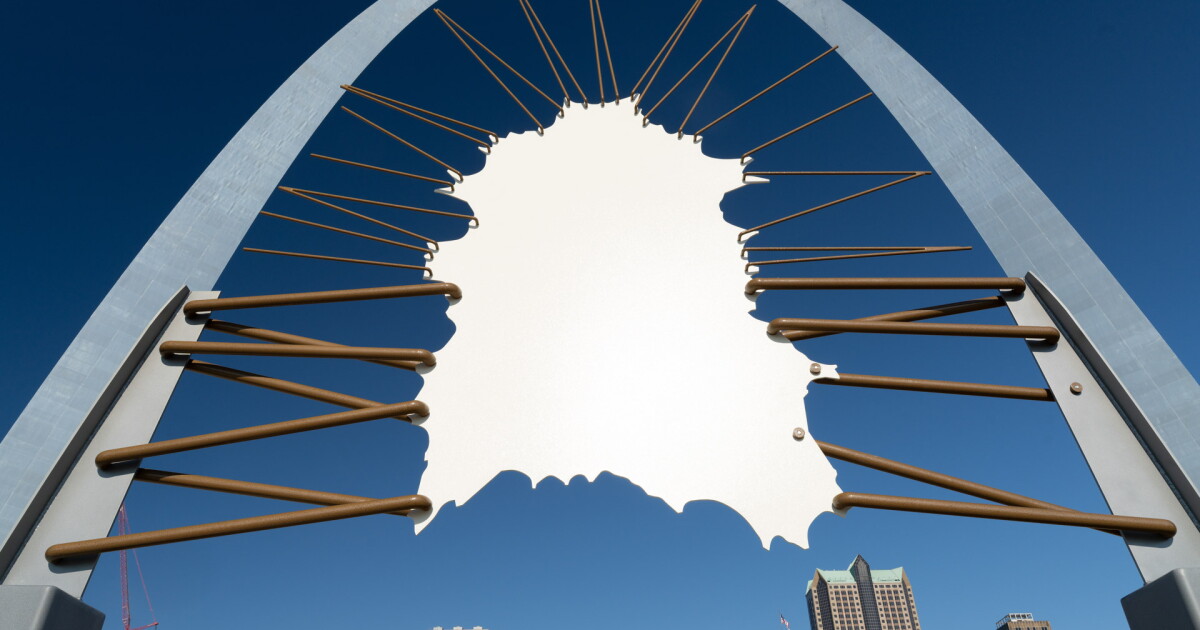
Nicholas Galanin’s sculpture “Land is never a gateway (Sightline/Lifeline)” is installed near the base of the Gateway Arch, creating an optical illusion that changes form as the viewer moves around. From one viewpoint, the piece appears to transfer the Arch into a frame used by Native Americans to process animal hides.
“There was the decision about dialoguing with some neighborhoods and venues,” said Fonseca, one of the curators. “[The theme came together] little by little, from place to place, from space to space, and from learning and learning about the history of here — and also being attentive to what’s happening in the U.S. and in the globe right now.”