
PC Guide is reader-supported. When you buy through links on our site, we may earn an affiliate commission. Read More
Xiaomi has decided to launch its new 18 Fold smartphone during the same week as the iPhone Duo, though the latter won’t be available for purchase until October 16 – when pre-orders go live. It’s also worth noting that the Xiaomi 18 Fold is currently a China-exclusive device, with no current plans for a global rollout in the likes of the US, UK, or Europe.
The iPhone Duo will be getting a much wider release (just like the new iPhone 18 Pro & Pro Max). The Xiaomi 18 Fold is already available to purchase in China, so the local brand has an early bird advantage. In any case, if you’re curious to know how these two flagship foldables compare, we’ve put together a cheat sheet of what you should know regarding specs, features, and price.
Xiaomi 18 Fold vs iPhone Duo specs and price
We’ll get the pricing details out of the way before we move on to the lengthy specs table. As mentioned, the Xiaomi 18 Fold is not available outside of China, where it carries a ¥10,999 starting price tag (around $1,640 USD). The iPhone Duo launches for $1,999 in the United States and ¥15,999 in China, climbing all the way up to $3,199 / ¥26,499 for the 2TB model.
Latest PC & Tech deals
Prices correct as of August 20th, 2026.
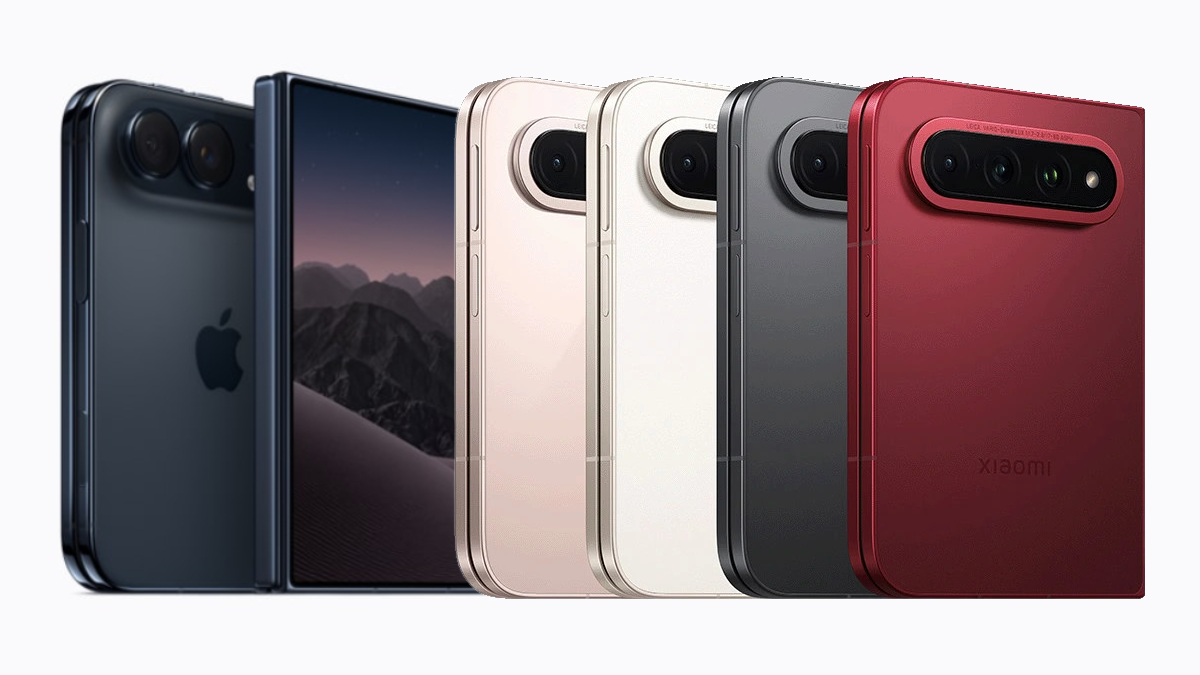
iPhone Duo doesn’t offer the same colorway variety as Xiaomi, only shipping in Star White and Night Sky, while the Xiaomi 18 Fold offers a more colorful selection of Warm Gold, White, Black, Nishino Red, and Ceramic. Of course, custom skins and cases will allow for much wider customization, and we’ve already seen Apple announce two first-party iPhone Duo cases.
Apple’s foldable will be widely available on October 23 following its pre-order period (starting on October 16), while the Xiaomi device was released in China the same day it was officially announced/launched, on September 7.
SpecificationiPhone DuoXiaomi 18 FoldInner display7.6-inch OLED Super Retina XDR
2670 x 1878
Up to 120Hz ProMotion7.58-inch LTPO AMOLED
2364 x 1672
1-120HzOuter display5.4-inch OLED Super Retina XDR
2034 x 1398
Up to 120Hz ProMotion5.38-inch LTPO AMOLED
1712 x 1168
1-120HzPeak brightness3,000 nits4,000 nitsChipsetApple A20 ProXiaomi XRing O3RAM12GBUp to 16GBStorage256GB, 512GB, 1TB, 2TB256GB, 512GB, 1TBRear cameras48MP Fusion Main + 48MP Fusion Ultra Wide200MP main + 50MP 3.5x telephoto + 50MP ultrawideFront cameraCenter Stage + under-display FaceTime cameraFront cameras on both displaysBattery5,400 mAh Dual-battery system6,000mAhWired chargingFast charging67WWireless chargingMagSafe / Qi250WOSiOS 27HyperOS 4 / Android 17Dimensions164.6 x 117.8 x 5.2mm (unfolded)
117.8 x 84.1 x 11.3mm (folded)163.8 x 117.8 x 5.02mm (unfolded)
117.8 x 83.6 x 10.68mm (folded)Weight254g219gFrameGrade 5 titanium7-series aluminiumHingePrecision hinge with titanium componentsDragon Bone three-link hingeBiometricsTouch IDFingerprint sensor
Xiaomi 18 Fold is lighter, thinner, and has a larger (6,000mAh) battery than iPhone Duo, though Apple does claim impressive battery longevity benchmarks nonetheless, with “up to 24 hours” of typical use and up to 44 hours of video playback on the outer display; this value drops to 31 hours for the larger inner display. We await any more battery endurance tests via reviews.
Exact differences in performance remain difficult to judge, though Xiaomi says its new premium Xring O3 chip is more powerful than the Snapdragon 8 Elite Gen 5 and Apple’s last-gen A19 Pro, based on Geekbench scores shared so far. Apple claims the A20 Pro – which powers the new iPhone 18 Pro series, as well as the Duo – offers around 20% and 40% improvements to its CPU and GPU, respectively.
In terms of cameras, the Xiaomi 18 Fold’s 200MP + telephoto camera system is far more ambitious than the iPhone Duo’s 48MP Fusion design. Apple is always pushing build quality, however, boasting a titanium build, an under-display inner camera and a nano-textured inner display, which is designed to reduce crease visibility.
China has a pretty crowded foldable phone market, with major domestic brands already having multiple generations of foldables under their belt. Not to mention Samsung’s Fold and Flip series, which aren’t particularly popular in China either due to the plethora of local brand alternatives. As such, iPhone Duo faces strong competition in the region, and it’s difficult to imagine it prospering as it may in other regions, especially when you consider the price disparity.