
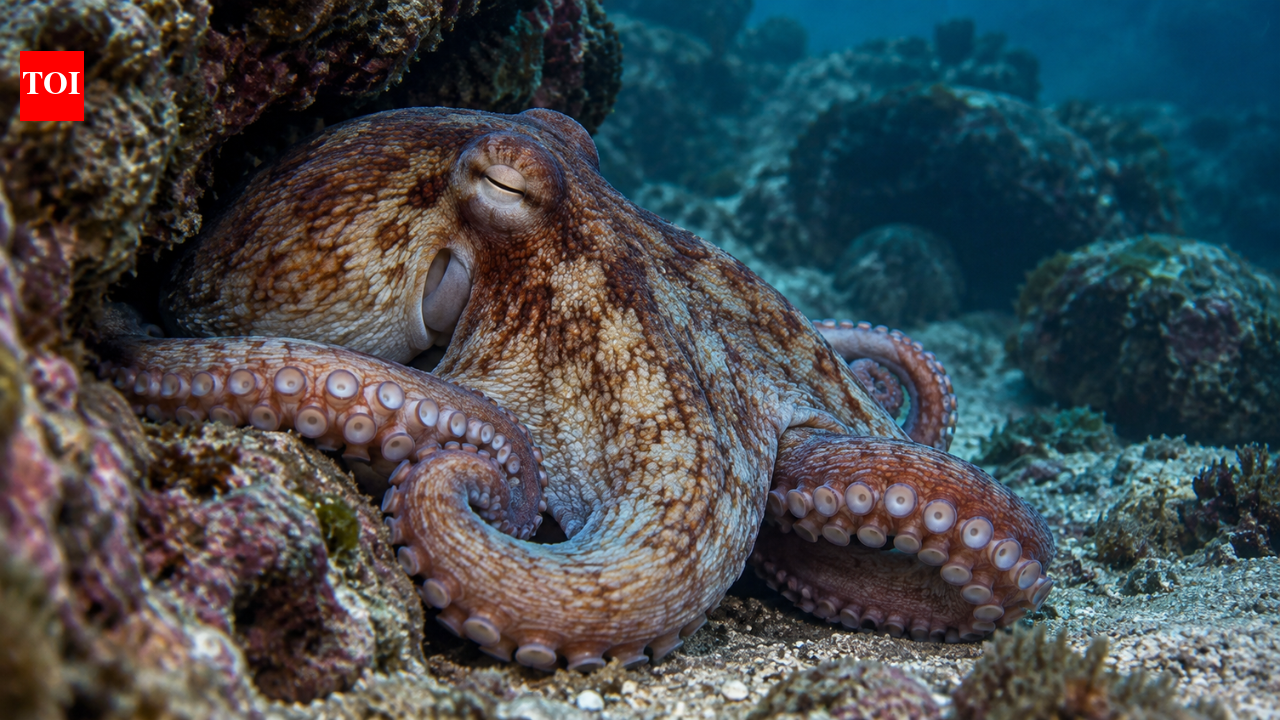
 An octopus can look completely lifeless in sleep, lying flat with its eyes closed and its skin turned white. But beneath that still exterior, something far more active can be happening. Every so often, the animal enters a brief phase in which its body twitches, its breathing changes and its skin races through patterns that resemble those seen while it is awake. Scientists have found that this strange display is not simply restless sleep. The octopus’s brain also becomes highly active, producing electrical signals that closely resemble those recorded during wakefulness. The discovery offers a remarkable glimpse into the hidden complexity of sleep in these animals.
Active sleep makes octopuses twitch and change colour
According to the study published in Nature, titled ‘Wake-like skin patterning and neural activity during octopus sleep’, the transition into active sleep is striking because several parts of the animal change at once. According to the researchers, active bouts involve rapid transitions through a series of skin patterns, along with increased eye movements, body movements and breathing. Breathing also becomes more variable and irregular than during quiet sleep.The researchers found that these episodes behaved like genuine sleep rather than brief periods of ordinary waking. Weak mechanical stimulation caused movement when the animals were awake, but not during either quiet or active sleep. Preventing the octopuses from sleeping for two days also increased the rate of active bouts afterwards. According to the study, interrupting one active bout caused the next to arrive roughly 22 minutes earlier, further supporting the idea that active periods are regulated as part of sleep.
Octopuses show complex skin patterns during active sleep
The researchers filmed 98 active-sleep bouts in three octopuses using high-resolution cameras and analysed how the animals moved through different skin patterns. According to the study, the patterns did not follow one fixed sequence. Instead, each bout had a diverse and complex trajectory, although similar patterns could appear in different bouts and across different animals.The researchers then compared sleeping and waking patterns and found a striking overlap. Skin patterns produced during active sleep fell within the range of patterns seen when the animals were awake, including patterns used during camouflage, social behaviour and threat displays. According to the study, detailed image comparisons showed precise alignment between some waking and sleeping patterns, suggesting that active sleep involves rapid transitions through patterns normally displayed by awake octopuses.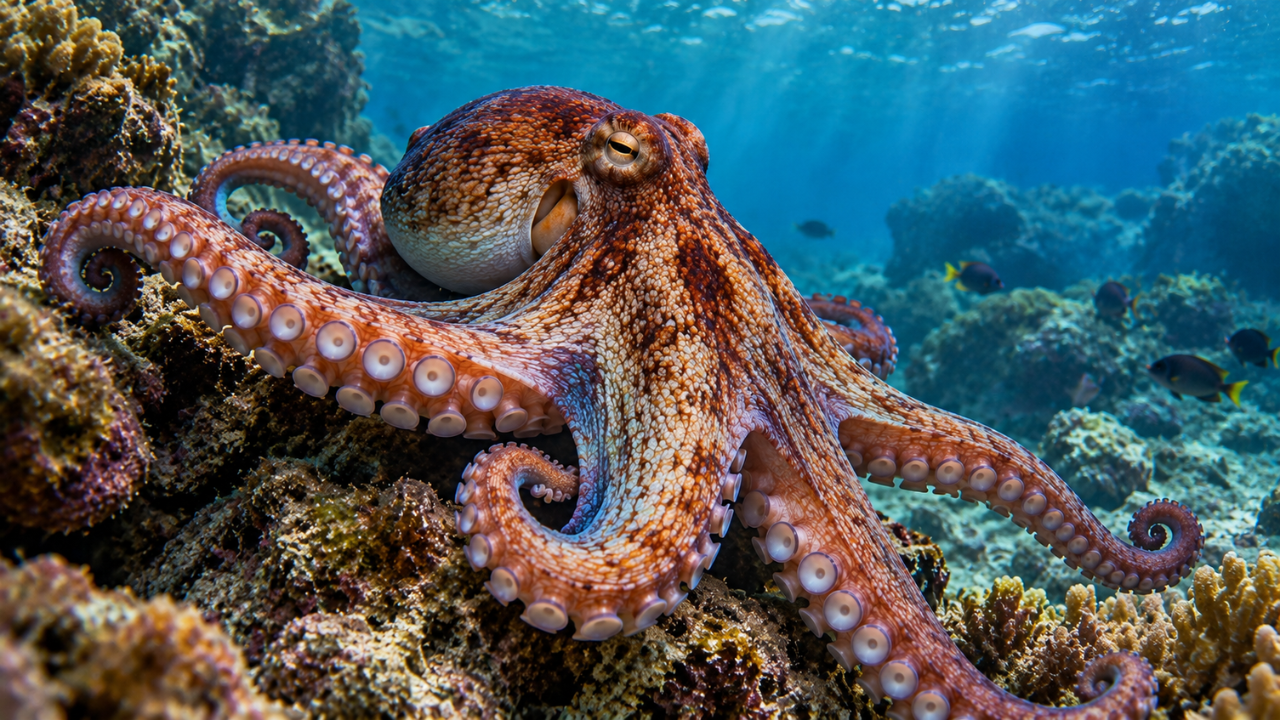
Image AI generated
Brain activity rises sharply during octopus active sleep
Researchers used multi-site Neuropixels probes to record electrical activity from the central brains of sleeping octopuses. According to the study, active sleep produced a large increase in local field potential activity compared with quiet sleep, while waking was generally intermediate. The strongest active-sleep activity was found in brain regions associated with learning and memory, including the superior frontal and vertical lobes.When researchers directly compared active sleep with waking, they found a strong correlation between brain activity in the two states. The study reports correlations of 0.74 for low-frequency activity and 0.95 for high-frequency activity. Some regions were actually more active during active sleep than while awake. According to the researchers, this wake-like neural activity, combined with eye and body twitches, makes octopus active sleep resemble aspects of vertebrate REM sleep.
Why octopuses change their skin patterns while sleeping
The researchers do not claim to know exactly why an octopus produces such elaborate skin displays while asleep. One possibility is that active sleep allows the animal to refine control of its skin patterns while offline. Because octopuses normally produce these patterns for camouflage, social interactions and threats, replaying aspects of that behaviour during sleep could potentially be connected with maintaining or refining the underlying motor control.The researchers compare this possibility with forms of memory-related neural reactivation observed during sleep in vertebrates. But they stress that the function of active sleep remains unresolved. According to the study, further work is needed to determine whether the skin patterns can be deliberately manipulated and to understand the circumstances in which those patterns are produced while the animals are awake.